



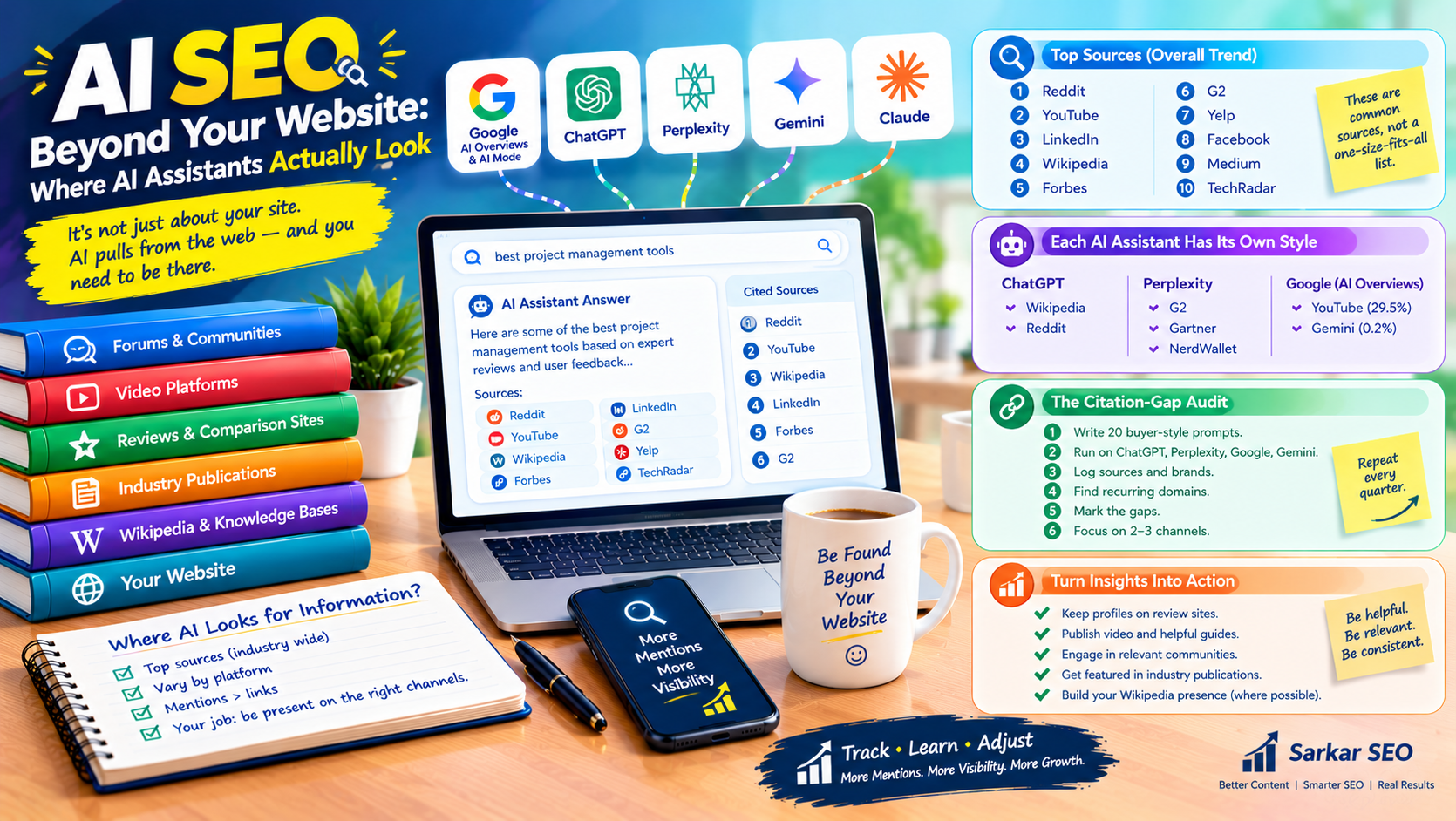
Most AI SEO advice focuses on your own pages. But when an assistant recommends a product or explains a category, it often leans on other people’s pages. If those pages never mention you, a perfect website may not be enough.
This article looks at where AI assistants pull their information from, why the answer differs by platform, and how to find your own gaps.
The sources AI keeps returning to
Several 2026 studies converge on the same handful of domains. Peec AI analyzed 30 million cited sources across ChatGPT, Google AI Mode, Gemini, Perplexity and AI Overviews. Its March 2026 ranking puts Reddit first, followed by YouTube, LinkedIn, Wikipedia, Forbes, G2, Yelp, Facebook, Medium and TechRadar.
The same pages also say something more useful: the generic list is a starting point, not a strategy, because industries have their own dominant sources. In hotels, for example, Booking.com and Airbnb often outrank Reddit.
Treat these as vendor-run studies. They use different prompts, time periods and counting methods, so exact percentages vary between reports. The pattern is more reliable than any single number.
There is no single AI
The platforms behave differently, so one off-site plan will not fit all of them.
- ChatGPT leans toward Wikipedia and Reddit. Similarweb’s January–February 2026 data, as summarized by 5W, shows Wikipedia at 13.15% and Reddit at 11.97% of ChatGPT’s U.S. citations.
- Perplexity skews toward review and comparison sources. Profound’s analysis, as reported by 5W, lists G2, Gartner, NerdWallet, PCMag, TripAdvisor and Yelp among its most-cited domains.
- Google’s AI Overviews lean on video. One roundup reports that YouTube is the most-cited domain in Google AI Overviews, at 29.5% of citations, but Gemini cites it at only 0.2%. thrivestack
The overlap is also small. One estimate says only about 11% of domains are cited by both ChatGPT and Perplexity. Being visible on one assistant does not mean you are visible on another.
Mentions matter more than links
A second finding changes how you should measure success. According to the same 5W report, ChatGPT mentions brands roughly 3.2 times more often than it cites them with links. Much of your AI exposure may never show up as a referral visit.
Surfer’s study of 26,573 prompt responses adds a clue about where to earn those mentions. It found that blog posts make up only 28.7% of cited sources, yet mentions in those blog posts correlate most strongly with recommendation strength. That is correlation, not proof that blog mentions cause recommendations. Still, it suggests that third-party articles discussing your category are worth more than another page on your own domain.
Ahrefs’ December 2025 study of 75,000 brands, as summarized by Contently, found that YouTube mentions were the strongest single correlation with AI visibility, at 0.737. I could not review the original dataset, so treat that figure as indicative.
The citation-gap audit
Here is a method Sarkar SEO recommends. It is our own working process, built on the research above, and it takes about a day.
- Write 20 buyer-style prompts. Include comparison questions (“best X for Y”), problem questions (“how do I fix Z”) and brand-neutral category questions. Avoid prompts that name you.
- Run each prompt in four places: ChatGPT, Perplexity, Google (AI Overviews or AI Mode) and Gemini. Use fresh sessions.
- Log every cited domain and every brand named. A spreadsheet with prompt, platform, sources and brands is enough.
- Count the recurring domains. Which five or six sources appear across many prompts in your niche?
- Mark the gaps. For each recurring source, note whether you appear there and whether your competitors do.
- Pick two or three channels, not ten. Choose where the gap is largest and where you can contribute something real.
Repeat the audit quarterly. Citation patterns shift quickly: one analysis claims ChatGPT’s reliance on Reddit and Wikipedia dropped sharply within six weeks after a change in September 2025. That is a secondary claim, but it shows why a one-off snapshot ages fast.
What to do with the results
Match the action to the gap, not to a trend.
If review sites dominate (common for software and services), keep your profiles on platforms like G2 or Trustpilot complete and current, and ask satisfied customers for honest reviews.
If video dominates, publish clear tutorials or explainers that answer the exact questions in your prompt list.
If community threads dominate, take part openly and helpfully. One roundup notes that 99% of Reddit citations in ChatGPT went to individual discussion threads, not brand profiles or subreddit front pages. Threads are valued for the discussion in them, so promotional posts are unlikely to help and may get removed.
If industry publications dominate, offer original data or expert commentary to those editors. Earned coverage is the goal. According to the Contently roundup, AI engines distinguish between sponsored content and editorial mentions through markup and context, and earned mentions work while paid sponsorships often don’t.
If Wikipedia matters, be careful. It has strict notability and conflict-of-interest rules, and attempts to write about your own company usually fail. Focus on being documented in independent, reliable sources first.
Keep your own site as the anchor
Off-site work does not replace on-site work. Assistants still need an accurate home base to verify who you are and what you offer. Make sure your About page, service pages and author details are clear and consistent with what others say about you.
