



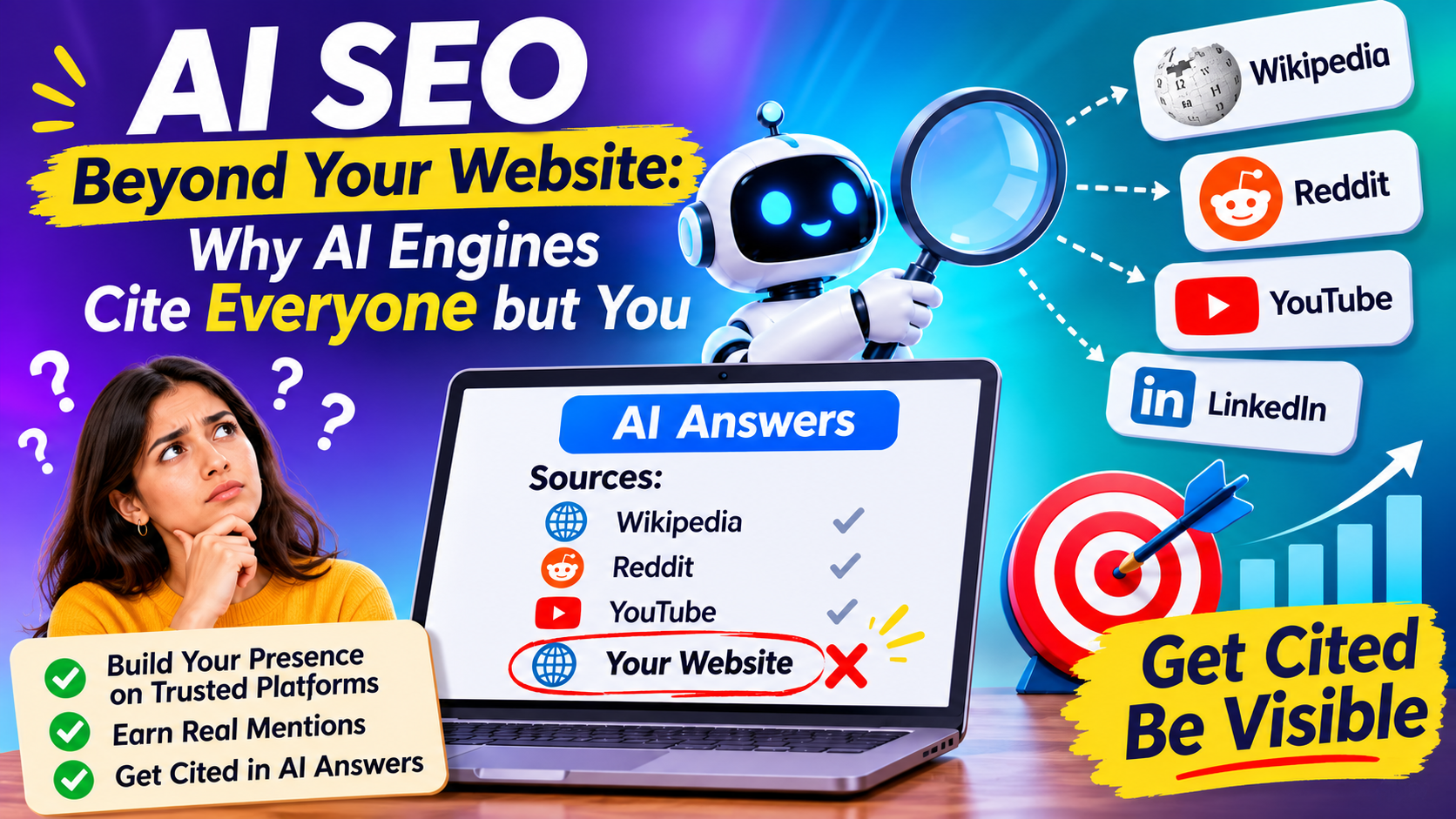
You can publish excellent pages and still be absent from AI answers. One reason is simple: AI engines often borrow from other people’s websites when describing your category. If the sources they trust don’t mention you, you are easy to overlook.
This guide covers the off-site side of AI SEO, which gets far less attention than on-page work.
The Pattern: A Small Group of Sites Does the Talking
Citation studies show heavy concentration. A Profound analysis of 30 million citations from August 2024 to June 2025 found that ChatGPT mostly sources from Wikipedia, while Google AI Overviews and Perplexity mostly source from Reddit.
The top-10 shares are striking. Wikipedia accounts for 47.9% of ChatGPT’s top-10 citation share, while Reddit accounts for 46.7% of Perplexity’s top-10 share. Read that carefully, because it is a share of the top ten sources and not of all citations. Across all citations, the same research puts Wikipedia at 7.8% for ChatGPT. parseparse
Other studies see different mixes. A May 2026 audit by 5W found Wikipedia at 13.15% and Reddit at 11.97% of ChatGPT citations, together driving more than a quarter. Treat all these figures as directional. Most come from vendors and agencies with their own prompt sets, and results shift with each model update.
Engines Do Not Agree With Each Other
A strategy built for one assistant may do little for another. Across 680 million citations analyzed in early 2026, only 11% of domains were cited by both ChatGPT and Perplexity.
Their habits also differ:
- ChatGPT mentions brands about 3.2 times more often than it cites them with links. You can be named without receiving a click.
- Perplexity averages 21.9 citations per response, more than double ChatGPT’s 10.4.
- Google AI Overviews lean on a third mix, with YouTube prominent in the Averi benchmark above.
One analysis even documented a 615x citation-volume variance between platforms for the same brand. Performance on one engine tells you very little about the others.
Why Mentions Matter
Ahrefs’ December 2025 research, as summarized by Contently, found that branded web mentions, the references a brand earns when others write about it on platforms it doesn’t control, correlated at 0.664 with AI Overview visibility. The same summary reports a 0.737 correlation for YouTube mentions.
Correlation is not proof of cause. Strong brands attract mentions and also get cited, so the relationship runs both ways. Still, it fits the pattern in the citation studies: AI engines lean on consensus across many sources, and a brand that appears in few of them has little to retrieve.
Where to Build Presence, Honestly
At Sarkar SEO, we frame off-site work as reputation building, not link or citation hunting. The sites below matter because real people use them to learn about your category.
Wikipedia and reference sources. Few businesses qualify for their own page, and forcing one rarely works. A more realistic goal is being accurately described in relevant articles through independent coverage. Guidance in the 5W index calls for treating Wikipedia as infrastructure. That means earning notable, citable coverage first, then letting editors decide.
Community platforms. Reddit and Quora feature heavily. One SE Ranking figure reported by Contently says domains with millions of brand mentions on Reddit averaged 7 ChatGPT citations versus 1.8 for minimal presence. The ethical route is to answer questions as a named, transparent expert, over months. Planting fake recommendations is a bad idea, because Google’s spam rules already cover inauthentic mentions.
Video. Because YouTube features in Google’s results, tutorials and product explainers that answer real questions give another route into AI summaries.
Review and comparison sites. ChatGPT’s top sources in the Ahrefs dataset included G2 at 6.7%, TechRadar at 5.5%, and NerdWallet at 5.1%. If your category has trusted review platforms, accurate profiles and real customer reviews are worth the effort.
Professional networks. For B2B, one report found 59% of Perplexity’s LinkedIn citations come from Company Pages. A complete, active page is a low-cost step. everything-pr
A Five-Step Audit You Can Run This Week
- List 20 questions your buyers ask, written the way they would type them.
- Run each question in ChatGPT, Perplexity, Gemini, and Google, and record who is mentioned and which sites are cited.
- Build a source map. Count which third-party domains keep appearing. These are your gatekeepers.
- Check your presence on each gatekeeper: accurate description, recent coverage, real reviews.
- Pick two gaps and fix them over the next quarter. Do not try everything at once.
Repeat monthly, since one source cautions that a change in how ChatGPT weights Reddit, or how Perplexity handles primary sources, can reroute millions of citation events overnight.
What Not to Do
- Don’t buy mentions or fake reviews. The risk outweighs any gain, and the policy risk is real.
- Don’t neglect your own site. Perplexity data suggests it rewards primary sources and named B2B authority, so original research on your site still earns citations.
- Don’t treat vendor studies as law. Check any claim against your own prompt tests.
- Don’t expect instant results. Reputation builds slowly, and AI answers vary from run to run.
