



For two decades, off-site SEO meant one thing: links. AI search is pushing that definition wider. When an AI system decides which companies to name in an answer, the strongest signals appear to live outside your own website. This article looks at what the data says, what it does not prove, and how to build a credible web presence that AI systems can recognise. Sarkar SEO treats this as the part of AI SEO that most businesses neglect.
What the largest study found
Ahrefs analysed 75,000 brands and measured which signals tracked with appearing in Google’s AI Overviews. Branded web mentions showed the strongest correlation at 0.664, ahead of backlinks at 0.218. The same analysis found the top three correlations were all off-site factors: brand web mentions, brand anchors and brand search volume. Mentions counted whether or not they included a link.
A later expansion of the research reportedly found even stronger results for video. One summary states that YouTube mentions showed the strongest single correlation with AI brand visibility across ChatGPT, AI Mode and AI Overviews. Secondary write-ups put the figure near 0.737. I could not confirm that number against Ahrefs’ primary page, so treat it as indicative.
Other research points the same way on authority scores. A report covering 177 brands found domain authority had a correlation of just 0.017 with AI citation rate. That is effectively no relationship. victorious
The caution most articles skip
These figures are correlations. They do not show that mentions cause AI visibility. One analyst notes that the relationship is real and replicated, but consistently misread as proof that mentions cause visibility. The reverse may also be true: well-known brands attract more mentions, and they also get named more often by AI.
One of the studies I reviewed is open about its limits. It says it does not model sentiment or source authority numerically, so those remain context layers, not proven inputs. Vendor studies also use different samples and methods. Read the numbers as a direction of travel, not a formula.
The sensible conclusion is modest. The strategic response is not to stop building links, but to stop measuring off-site authority only through links.
Recognition is not the same as recommendation
Being known is only the start. A study reported by Search Engine Journal found that AI systems already know most brands, yet getting mentioned requires more than recognition alone. The headline there, that models recognise around 96% of brands but mention almost none, shows that familiarity alone does not win a place in an answer. AI needs a reason to include you for a particular question. searchenginejournal
That reason usually comes from context: what you are known for, who says so, and how consistently the story is told.
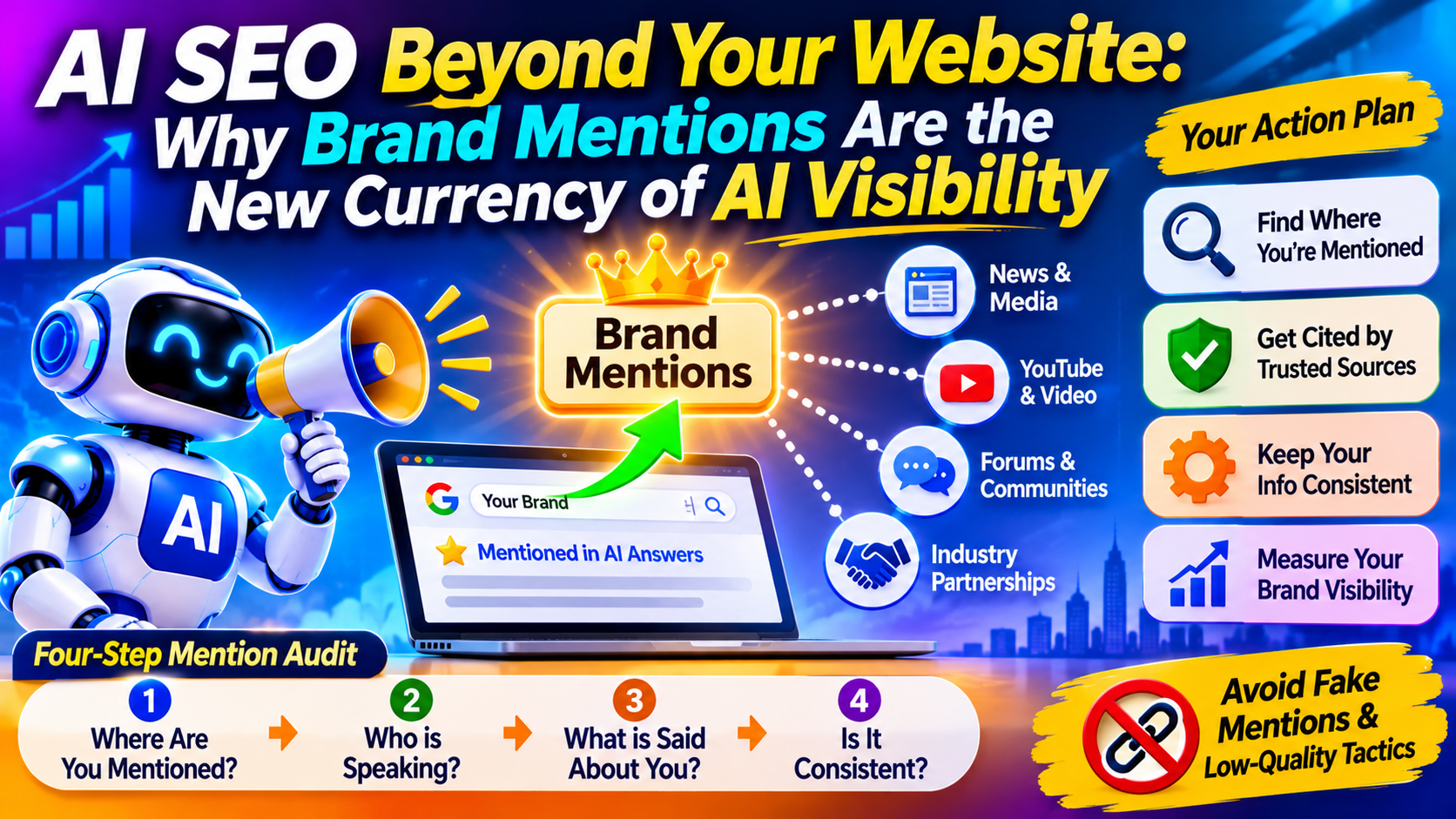
A practical framework: the four-point mention audit
The following is my own organising method, not a published standard. It turns the research into something you can act on.
- Where are you mentioned? List the places that discuss your category: industry publications, review platforms, forums, video channels, podcasts and professional directories. Note which ones you appear on and which your competitors do.
- Who is speaking? A mention from a respected independent source carries more weight than your own press release. One study of AI search found that third-party sources account for 85% of brand mentions, and the strongest results come from aligning on-site and off-site signals. Treat that figure as one vendor’s finding, not a law.
- What is said about you? Are you described accurately, and for the right problems? A brand mentioned only for a former service or the wrong location sends confusing signals. Capture the exact phrases others use to describe you.
- Is it consistent? Your name, services, locations and positioning should match across your site, social profiles, directories and listings. Inconsistency makes it harder for any system to treat you as one clear entity.
How to earn mentions honestly
Publish something worth referencing. One content team suggests that original data or research others want to reference can generate several off-site mentions from a single asset. A genuine survey, benchmark, free tool or well-documented case study gives journalists, bloggers and creators a reason to cite you.
Other routes that tend to work:
- Expert commentary. Offer informed quotes to writers covering your field.
- Video and podcasts. Appear as a guest, or publish useful explainers. The video correlation suggests this channel deserves attention.
- Community participation. Answer questions helpfully in the forums where your customers ask them, without spamming links.
- Customer reviews. Ask real customers to share honest experiences on relevant platforms.
- Partnerships. Co-create content with complementary businesses.
What to avoid
Do not buy mentions, run fake review campaigns or flood forums with scripted posts. Google’s guidance warns against inauthentic brand mentions, and low-quality tactics can damage trust with both people and machines. Quick wins here tend to be short-lived, and the reputational risk is real.
Measuring progress without fooling yourself
Track a small set of indicators monthly:
- Branded search volume and branded clicks in Search Console.
- The number of new, relevant third-party mentions, in a simple spreadsheet or a monitoring tool.
- Whether you appear when you run a fixed set of customer questions across several AI engines.
- Enquiries that mention where the customer first heard of you.
Expect slow movement. Reputation builds over months, not days.
Your own site still matters
None of this means your website is irrelevant. Your pages give AI systems something accurate to retrieve, and some analysts note that your own content still plays a supporting role, especially where AI retrieves and cites live web pages. Think of off-site mentions as the reputation and your site as the source of record.
