



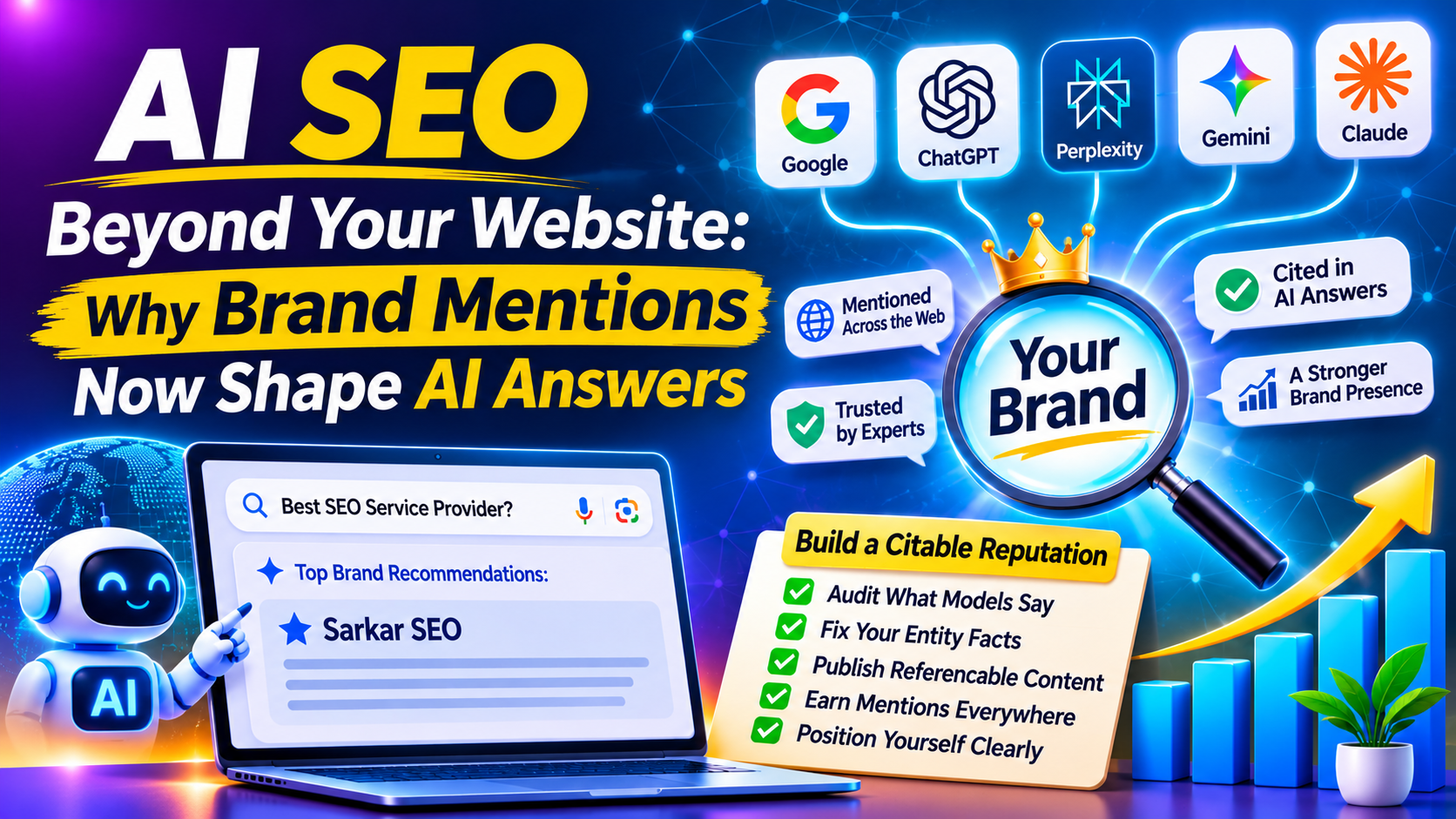
Most AI SEO advice focuses on your own pages: structure, schema, answer-first paragraphs. That work matters, but it covers only half the picture. When someone asks ChatGPT, Perplexity or Gemini for the best provider in a category, the answer often reflects what the rest of the web says about you. This article looks at that off-site half, which gets far less attention. At Sarkar SEO, we think it is the most overlooked part of AI SEO.
The contradiction in the data
A BrightEdge analysis compared citations and brand mentions across ChatGPT, Perplexity, Gemini, Google AI Mode and Google AI Overviews. Its most striking result was that pairwise overlap in the top 100 cited sources across engines ranged from only 16% to 59%, yet the engines converged on similar brand recommendations. In plain terms, they reach the same brands by different routes.
That matters because it changes the goal. You are not trying to win one engine’s source list. You are trying to be a brand that many different sources already vouch for.
Each engine has its own habits
The same study describes distinct “editorial personalities.” Some examples:
- ChatGPT spreads its citations the most widely, with its top 10 domains making up only 18.5% of citations, and it names brands earlier than other engines.
- Gemini leans toward institutional sources, with about 26% of citations from authority sites and almost none from user-generated content.
- Google AI Overviews show the opposite pattern, with 18% of citations from user-generated content.
A separate analysis of 40,000 responses found Perplexity averaged 6.61 citations per response, Gemini 6.1 and ChatGPT 2.62. Citation habits differ, and so do the platforms people use, so a single-engine strategy leaves gaps. Treat all of these figures as snapshots from vendor studies. Methods and prompts differ, and engines change often. searchenginejournal
Why mentions matter more than links
Older SEO taught us to count backlinks. AI answers appear to reward something broader. Ahrefs, in a study of 75,000 brands, found that branded web mentions correlated at roughly 0.66 to 0.71 with brand visibility across ChatGPT, Google AI Mode and Google AI Overviews. Correlation is not proof of cause, but the direction is clear. Brands that people discuss tend to be brands that models recall.
Another report describes how one brand appeared in ChatGPT answers about its category even when no web search fired, because of years of mentions across review sites and industry press. That is a vendor anecdote, so treat it as illustration, not evidence. It does show a mechanism worth understanding: models carry memory of your reputation, and live retrieval adds fresh sources on top.
Where mentions come from
A practical way to think about it is three layers.
Owned content. Your site, documentation and profiles. This is where you control accuracy. Gemini, according to Yext’s analysis, prioritizes brand-owned content, so keep your facts consistent and current.
Earned coverage. Industry publications, podcasts, expert quotes, conference talks and partner pages. These give an independent voice saying what you do.
Community and review spaces. Forums, review platforms and discussion sites. One study found ChatGPT often references LinkedIn, G2 and Gartner Peer Reviews, while Gemini frequently cites Medium, Reddit and YouTube. The right platforms depend on your industry, so check where your category is actually discussed before investing.
A five-step plan to build citable reputation
- Audit what models say about you today. Ask ten category questions in several engines. Note whether you appear, how you are described, and which sources are named. Look for errors, because outdated descriptions often trace back to one stale page.
- Fix your entity facts. Use the same business name, description, services, leadership names and location details everywhere. Inconsistency makes you harder to identify, and a brand that cannot be identified cannot be recommended.
- Publish something worth referencing. A small original study, a benchmark, a free template or a clear framework gives others a reason to mention you. Reworded common knowledge gives them none. A research summary of the Princeton GEO work reports that adding cited sources lifted visibility by about 115% for a lower-ranked baseline site and adding statistics improved it by about 22%. That is a secondary report of an academic study, so read the original before relying on exact numbers, but the principle that evidence-backed content gets used more is sensible. wellows
- Earn mentions deliberately. Offer expert commentary to journalists, contribute to relevant communities honestly and without spam, and ask satisfied customers to leave reviews on the platforms your buyers use. Never buy fake reviews or manufacture discussion. It violates platform rules and damages the trust you are trying to build.
- Position yourself clearly. One experiment reported that a single Perplexity citation was a weaker endorsement signal than a ChatGPT one, and that explicit “best in category” positioning in the cited content helped. This came from a small developer test, so treat it as a hypothesis. The takeaway still holds: say plainly who you serve and what you do best.
What not to conclude
Do not abandon your website. Google states that no special optimization is required for AI Overviews and AI Mode, and standard SEO fundamentals still apply. Your pages are the base that makes mentions useful, because people and models arrive there to verify you.
Also avoid chasing a single magic metric. Another dataset found brand search volume had the strongest correlation, at 0.334, with citation frequency among the factors examined. That is a modest correlation, which tells us brand strength helps but is not a formula.
How to track it
Keep a simple monthly log of the same prompts across engines. Record whether your brand is mentioned, whether it is cited, the sentiment, and which competitors appear beside you. Pair this with branded search trends in Search Console and with enquiries. Because AI answers vary from run to run, judge direction over three to six months, not one result.
