



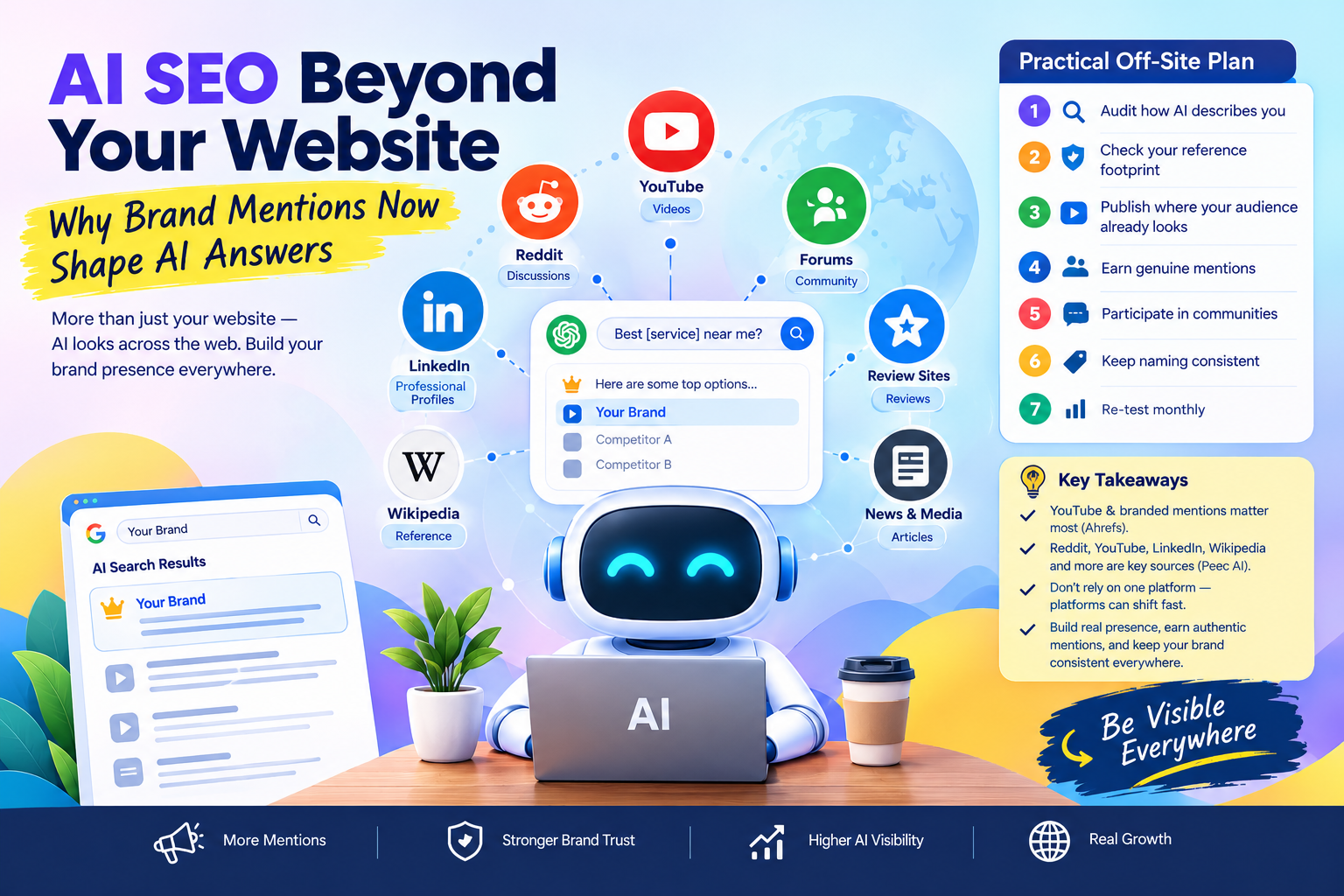
Your website is only one place where AI search learns about you. When someone asks an assistant to recommend a provider or explain a topic, the answer often leans on what the wider web says: videos, forums, review sites, encyclopedias and professional networks. That makes off-site presence a core part of AI SEO, and one most content teams neglect. Sarkar SEO treats it as its own workstream. This guide explains what the data shows, where it falls short, and how to act on it.
What the Data Says About Brand Signals
Ahrefs studied about 75,000 brands in a December 2025 report, covering brands with a Domain Rating above 40 and analyzing millions of AI responses. It compared how often each brand appeared in answers against several signals, using Spearman correlation.
The strongest signal was YouTube mentions, at roughly 0.74. Branded web mentions followed at about 0.66 for ChatGPT, 0.71 for Google’s AI Mode and 0.66 for AI Overviews. Domain Rating scored far lower, between 0.27 and 0.33. Backlink metrics showed very weak relationships, and sheer page count barely mattered, at about 0.19.
In plain terms, brands that are talked about widely tend to be named more often by AI systems. Having many pages did not.
Treat this carefully. Ahrefs itself stresses that correlation is not causation, and its brand selection used proxy thresholds it calls imperfect. Branded web mentions also included YouTube titles, so the two measures overlap. Famous brands may simply get mentioned everywhere, which would explain both patterns. The finding is a strong hint about where to look, not proof that a tactic works.
Which Outside Sources AI Engines Lean On
Peec AI analyzed roughly 30 million cited sources across ChatGPT, AI Mode, Gemini, Perplexity and AI Overviews, in a US-only study labeled March 2026. The most-cited domains, in order, were Reddit, YouTube, LinkedIn, Wikipedia, Forbes, G2, Yelp, Facebook, Medium and TechRadar.
Three cautions apply. The page gives a ranking without percentage shares. The data is US-only and comes from a vendor. And leading sources vary by industry: in hotels, for example, booking platforms often outrank Reddit.
The useful lesson is that AI answers draw from community, video, review and reference platforms alongside publisher sites. Your own domain competes with all of them.
Why You Should Not Build a Strategy on One Platform
Reddit shows how unstable these patterns are. Semrush, citing Promptwatch data, reported that Reddit’s share of ChatGPT citations held near 3.8% in late July and early August, then averaged 0.5% for a few days in mid-August, an 86% fall. Promptwatch called the drop provisional and could not rule out a data collection problem. OpenAI said it does not set a fixed visibility level for individual sites. The drop was much smaller in AI Overviews and AI Mode.
An earlier Semrush analysis of more than 230,000 prompts saw Reddit citations fall from about 60% of responses to roughly 10% in late 2025, which one analyst linked to a change in Google’s search parameters rather than any editorial decision.
The takeaway is not “avoid Reddit” or “invest in Reddit.” Platform weighting can shift within days, so spread your presence across several credible places.
A Practical Off-Site Plan
Sarkar SEO suggests thinking of off-site AI SEO as a reputation map, not a link-building list. Work through it in this order.
- Audit how AI describes you today. Ask several assistants about your brand, category and competitors. Record what each says and which sources it names.
- Check your reference footprint. Look at whether your brand appears accurately on its own listings, professional profiles and any relevant encyclopedia or industry directory pages. Fix inaccuracies where you control the profile.
- Publish where your audience already looks. For many topics that means video. Explain a process on camera, answer a common question, or show a real workflow. Transcripts and titles then carry your brand name next to the subject you want to be known for.
- Earn genuine mentions. Contribute data, expert commentary or a useful tool that others reference. Mentions that come from real usefulness last longer than mentions you request.
- Participate honestly in communities. Answer questions with substance, disclose affiliation, and follow each forum’s rules. Undisclosed promotion risks bans and reputation damage.
- Keep naming consistent. Use the same brand name, descriptions and category language across profiles so systems can connect the mentions to one entity.
- Re-test monthly. Run the same prompts again and compare. Expect variation, because AI outputs change from one run to the next.
Mistakes That Waste Effort
- Buying mentions. Paid or fake placements are easy to spot and can damage trust. The research measures organic talk, not purchased posts.
- Ignoring niche platforms. Industry directories and specialist communities may carry more weight in your sector than the general leaders.
- Spamming forums. Low-value posts rarely earn citations and often get removed.
- Neglecting your own site. Off-site signals support strong pages. They do not replace them.
- Reading correlation as a guarantee. No study here shows that a specific number of mentions produces a citation.
Do backlinks still matter for AI SEO? They still support classic search performance. In the Ahrefs data, however, link metrics correlated weakly with AI mentions compared with brand signals.
Is ChatGPT easier for small brands? Ahrefs noted that ChatGPT showed the weakest correlations with traditional authority metrics, so the authors suggested it may offer smaller brands an easier entry. That is an interpretation, not a tested result.
