



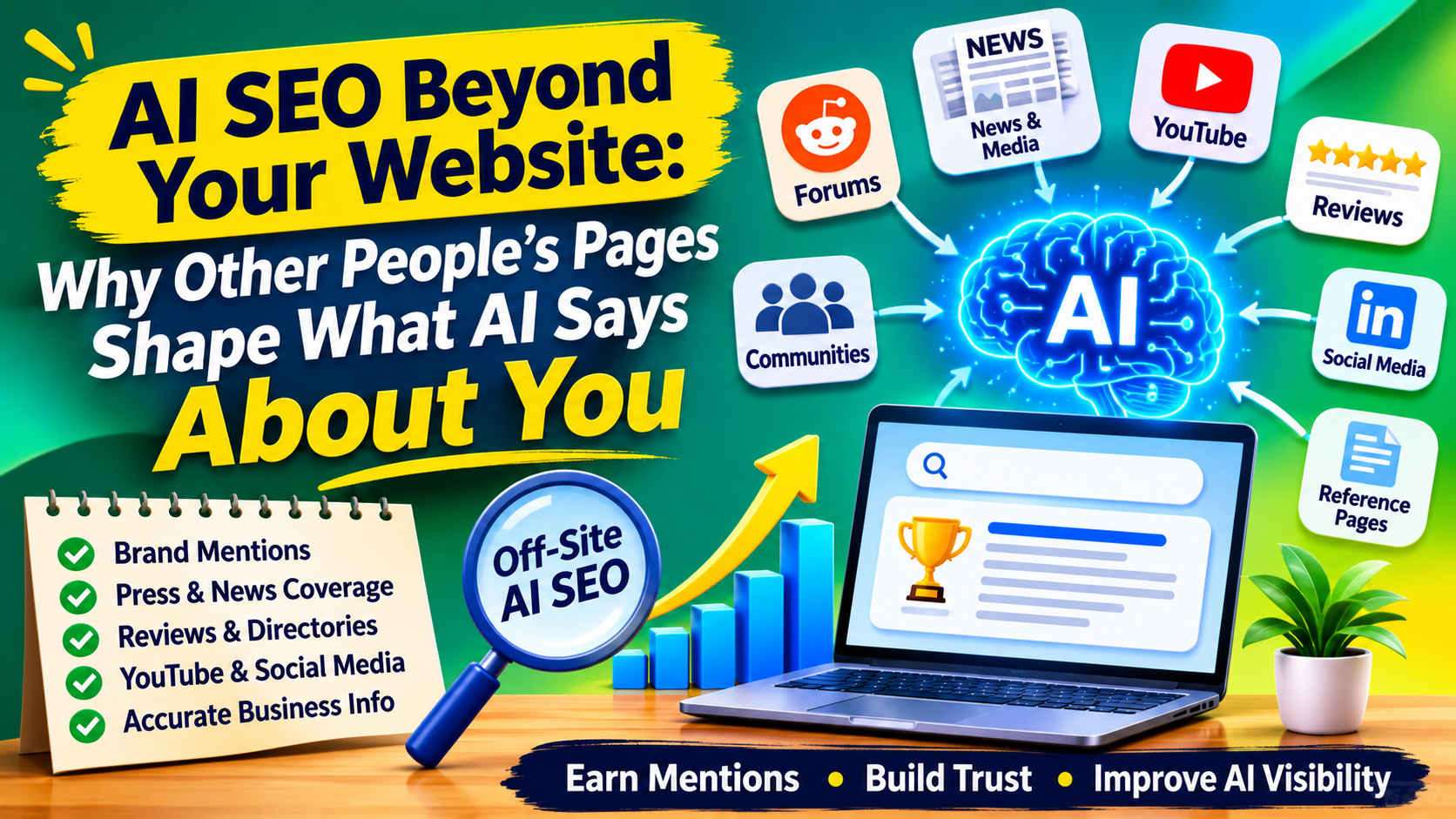
An AI answer about your industry is rarely built from your website alone. It draws on forums, review sites, video platforms, reference pages and news. So AI SEO has an off-site half: being accurately and repeatedly described by sources the AI already trusts.
Sarkar SEO treats this as a category-mapping exercise, not a link-building campaign. The goal is to find where answers about your market come from, then earn a genuine presence there.
Which sources AI answers lean on
Source studies disagree, and the disagreements are informative.
Peec AI analyzed 30 million cited sources across ChatGPT, Google AI Mode, Gemini, Perplexity and AI Overviews in the US in March 2026. Its most-cited domains were Reddit, YouTube, LinkedIn, Wikipedia and Forbes, followed by G2, Yelp, Facebook, Medium and TechRadar. Peec sells tools in this space, and the data is one month and one country.
An older Profound study, covering about 30 million citations from August 2024 to June 2025, split by platform. ChatGPT leaned heavily on Wikipedia (47.9%), while Google AI Overviews favored Reddit (21%) and gave Wikipedia just 5.7%. Search Engine Roundtable noted that an Ahrefs study published hours later produced somewhat different results.
The two studies are not directly comparable, since one pools engines and the other separates them. The lesson is that no universal list exists. Peec itself notes that industries have their own leaders; in travel, for example, booking platforms can outrank Reddit.
Brand mentions: a strong signal, but not a proven cause
Ahrefs studied 75,000 brands and published its findings in May 2025. Brand web mentions showed a correlation of 0.664 with AI Overview visibility, brand anchors 0.527, and backlinks only 0.218. About 26% of the brands had no AI Overview mentions and were excluded from the correlations.
Treat this carefully. Ahrefs itself states that correlation does not imply causation. Popular brands attract both mentions and AI visibility, so mentions may be a symptom of fame rather than its engine. What the data does support is a shift in emphasis: being discussed matters at least as much as being linked.
Build a source map for your category
Here is a method you can run in an afternoon, and the first step Sarkar SEO suggests for off-site AI SEO.
- Write 20 questions your customers genuinely ask, including comparison and “best for” questions.
- Run each in several AI tools and record every domain cited.
- Classify each source: your own site, review platform, community forum, reference page, video, or news outlet.
- Mark where your brand is present, absent or described wrongly.
- Pick the three source types where the gap is largest and most realistic to close.
Patterns emerge quickly. A software company may find review platforms dominate. A local service may find directories and community threads. A B2B consultancy may find professional networks and trade media. The map tells you where effort pays.
Earn mentions without gaming them
Off-site AI SEO fails when it becomes astroturfing. Fake reviews and undisclosed promotion are policy violations on most platforms, and they put your reputation at risk when discovered. Sustainable routes are slower but safer:
- Answer real questions in communities, disclose your affiliation, and help without selling.
- Complete and correct your profiles on the review and directory sites your category uses, so the facts AI retrieves are accurate.
- Publish something quotable: original data, a clear framework or a specific opinion that journalists and creators can cite.
- Create useful video where the source map shows video is cited, with accurate descriptions and transcripts.
- Correct inaccuracies at the source. If an old listing misstates your pricing or services, fix that page, because AI tools can reuse it.
Audit what AI already says about you
Alongside the source map, Sarkar SEO recommends a simple accuracy check. Ask each AI tool what your company does, who it serves, what it costs and how it compares with two competitors. Save the answers with the date.
Then trace errors to their origin. A wrong claim often reflects an outdated directory listing, a stale review or a competitor comparison page, not a flaw in the AI. Fixing the source is more effective than arguing with the answer. Avoid creating self-promotional reference pages, such as a Wikipedia entry, unless your organization genuinely meets that site’s notability standards.
Measure carefully, because AI answers are noisy
If you track citations, beware of reading too much into one check. A preprint by Ronald Sielinski of IQRush tested Perplexity, OpenAI’s SearchGPT and Gemini on repeated consumer queries. Identical citation sets were rare: about 0.01% to 0.10% of Gemini responses and roughly 3% to 8% for SearchGPT and Perplexity. In one example, two publishers at 9.5% and 6.0% citation share had overlapping confidence intervals, so the gap was not statistically clear.
The author’s guidance is practical. Use repeated samples, report ranges rather than single numbers, and treat small differences as ties. For a share estimate within about five points, the paper suggests roughly 40 to 50 queries for Gemini, 100 for Perplexity and 150 or more for SearchGPT. The paper is a preprint from a vendor-affiliated author, and the full text I reviewed was truncated, so use it as direction, not doctrine.
What this means for your priorities
Keep your own pages strong, since they remain the source other sites and AI tools describe. But allocate some effort outward. A brand that is consistent, accurate and genuinely discussed across several trusted sources gives AI systems more to work with than a brand that only talks about itself.
If you want a source map built for your market and a realistic plan for the gaps it reveals, Sarkar SEO can help you turn off-site presence into a measurable part of your AI SEO.
