



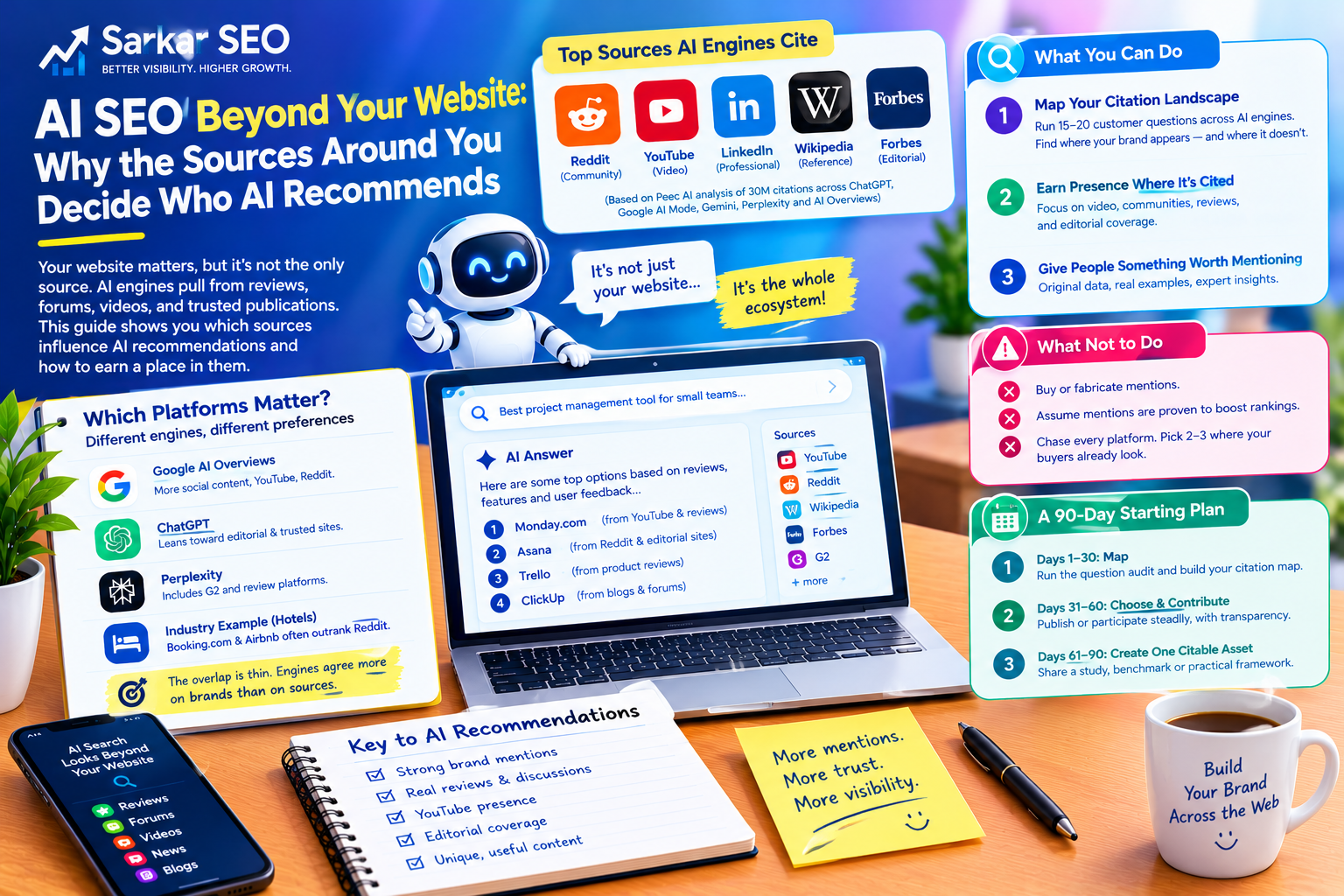
Most AI SEO advice starts and ends on your own domain: fix the technical basics, sharpen the copy, add structure. All of that helps, but it skips the place where recommendations are often formed. When someone asks an AI engine to suggest a project tool for a ten-person agency, the answer draws on reviews, forum threads, videos and articles, and many of them are not yours. Sarkar SEO treats that wider ecosystem as part of AI SEO, not a side project.
The sources AI engines actually lean on
Peec AI analyzed 30 million cited sources across ChatGPT, Google AI Mode, Gemini, Perplexity and AI Overviews. It ranked Reddit, YouTube, LinkedIn, Wikipedia and Forbes as the five most-cited domains.
That headline hides real differences between engines. Reddit and YouTube appear in the top five of all five platforms studied, but Google’s AI surfaces lean toward social content, ChatGPT leans editorial, and G2 appears only for Perplexity. Your industry matters as well: in hotels, Booking.com and Airbnb often outrank Reddit.
The overlap between engines is thinner than most people assume. One comparison reports that Google rankings strongly predict Google AI Overview citations but barely predict citations in ChatGPT, Perplexity or Gemini, and that engines agree more on which brands to recommend than on which sources to cite.
A caution on the numbers: these are vendor-run datasets with different methods and time windows. Another study ranked Wikipedia first by share of citation slots, which does not match Peec’s ordering. Treat the rankings as directional, not as a fixed leaderboard. thrivestack
Mentions beat links, with a catch
Ahrefs studied 75,000 brands. Branded web mentions correlated with AI Overview visibility at 0.664, against 0.218 for backlinks. A later study across ChatGPT, AI Mode and AI Overviews found that YouTube mentions, meaning a brand name in a video title, transcript or description, showed a correlation of about 0.737. That was the strongest signal tested.
Now the catch. The study’s authors note that correlation does not equal causation. One critique points out that well-known brands have more mentions, more branded search, more backlinks and more YouTube coverage than small ones, so everything rises together. Ahrefs itself cautioned that improving these metrics would not automatically improve AI visibility. ahrefs youtube mentions ai visibility brand search +2
So read the data as a pattern, not a lever. Brands that AI recommends tend to be brands people already discuss. That is a reason to build real reputation, not to chase a number.
Map your own citation landscape
Generic rankings are only a starting point. Your category has its own sources, and you can find them in an afternoon:
- List 15 to 20 questions a customer asks before buying.
- Run each one in Google AI Mode, ChatGPT, Perplexity, Gemini and Claude with search switched on.
- Record which brands appear and which domains are cited.
- Sort those domains into owned, community, video, review, editorial and reference.
- Repeat monthly, because answers shift between runs.
The result is usually revealing. You may find that every engine quotes the same two review sites and one YouTube channel, and that you appear on none of them. That gap is your priority list, and it is more specific than any industry study.
Earn presence where your category is cited
Video. Because YouTube mentions correlate so strongly, tutorials, comparisons and honest walkthroughs are worth considering. Say the brand name clearly, put it in titles and descriptions where it fits, and publish accurate transcripts.
Communities. Reddit’s prominence makes it tempting to promote there. Resist that. Answer questions in your area of expertise, disclose your affiliation, and let usefulness carry the reputation. Communities remove self-promotion quickly.
Reviews. Peec’s data indicates that Yelp and G2 appear frequently in recommendation queries across major AI engines. If your category uses them, ask real customers for honest, specific reviews and respond to criticism in public.
Editorial coverage. One analysis argues that AI engines treat established publications as confidence-weighted sources. Expert commentary, contributed articles and original research give journalists and bloggers a reason to name you.
Give people something worth mentioning
Mentions are an output, not a task. An Ahrefs conversation on the study put it this way: mentions result from brand-building but are not the goal itself.
What earns them is something worth referring to: original data, a named method, a free tool, a clear and defensible position. Your own site still matters because it is where those assets live. At Sarkar SEO, the working principle is that your website should be the best place to cite and the rest of the web should be the proof that others did.
What not to do
Do not buy or fabricate mentions. Google’s guide says that seeking inauthentic mentions is not as helpful as it might seem. Fake reviews also breach platform rules and, in many jurisdictions, consumer-protection law.
Do not assume the mechanism is proven. As one analysis notes, mentions and AI visibility move together in every study, but no published experiment shows that adding mentions moves anything.
Do not chase every platform. Pick two channels where your buyers already look and your team can contribute consistently.
A 90-day starting plan
Days 1 to 30: Map. Run the question audit and build your citation map. Note where competitors appear and you do not.
Days 31 to 60: Choose and contribute. Select two channels from the map. Publish or participate steadily, with transparency about who you are.
Days 61 to 90: Create one citable asset. Produce something others can reference, such as a small original study, a benchmark or a practical framework. Share it with people who cover your topic.
Throughout, track two simple signals: how often your brand appears in the question audit, and how many people search for your brand by name.
