



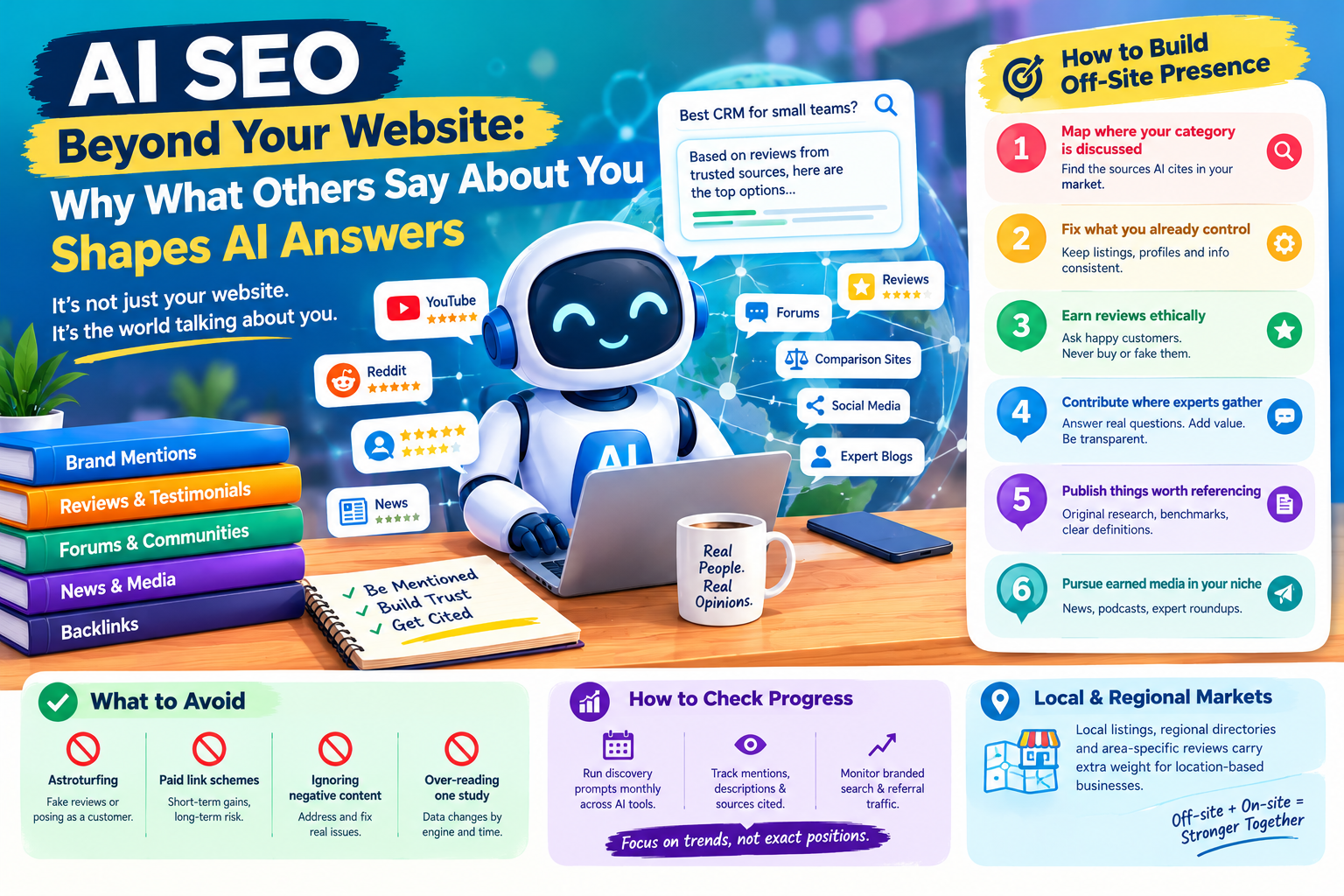
Most AI SEO advice focuses on your own pages. That is only half the picture. When an AI system answers “which provider should I choose?”, it often builds its response from reviews, forums, comparison sites, and news coverage, not just from the brand’s own domain.
This article looks at how much off-site presence matters, where the research disagrees, and how to build it without turning to spam.
The Evidence for Off-Site Influence
Several studies point the same way, though each has limits.
An Ahrefs analysis of 75,000 brands, reported by multiple secondary sources, found that brand mentions across independent websites correlated with AI visibility at 0.664, versus 0.218 for backlinks. In the same dataset, YouTube mentions scored higher still, at 0.737. These are correlations, not proof of cause, and I could only reach the figures through secondary write-ups rather than Ahrefs’ original report.
Search Engine Journal covered an xfunnel.ai analysis concluding that AI search engines cite third-party content most often. And a Trustmary study of more than 35,000 measurements found review platforms supplied nearly half of third-party citations for brand-specific queries.
The pattern makes sense. A model that wants to recommend something needs corroboration, and an independent source is more credible than a company describing itself.
The Counterevidence Worth Knowing
The picture is not one-sided. Yext analyzed 6.8 million citations across ChatGPT, Gemini, and Perplexity and reported that 86% came from sources brands own or manage. Brand websites alone supplied 44%, and reviews and social supplied just 8%.
How can both be true? Three differences likely explain it:
- Query type. Trustmary’s own data suggests official domains supply roughly 62% of citations when someone asks about a company by name, while third-party sources dominate generic discovery queries such as “best CRM for small teams.”
- Definition of “controlled.” Yext counts listings and managed profiles as brand-controlled, which is a broader category than a company’s website.
- Vendor perspective. Yext sells listings management and Trustmary sells review tools. Each study fits its publisher’s business. That doesn’t invalidate the data, but it is a reason to read it critically.
The practical reading, which is my interpretation and not a study finding, is this: your own site wins when people already know your name, and outside sources win when people are still choosing. Sarkar SEO advises clients to plan for both stages instead of betting on one study.
Why Reddit and Review Sites Keep Appearing
A Semrush study, as cited by Passionfruit, found Reddit to be the leading citation source in AI answers, and other reports say it leads on Perplexity and Google AI Overviews. A separate study that tracked answers from four AI engines found Google’s AI Overviews led by YouTube and Reddit, followed by Gartner and G2.
One explanation offered by practitioners is that AI systems treat community threads as independent opinion rather than marketing. That is an interpretation, not something the platforms have confirmed. Note too that engines differ: ChatGPT is reported to lean on LinkedIn, G2, and Gartner Peer Reviews, while Gemini’s citations in one study concentrated on Google’s own results. Optimizing for one engine’s habits will not carry over automatically.
A Practical Off-Site Plan
This framework is mine, built around what the research suggests, not an industry standard.
- Map where your category is discussed.
Run 15–20 discovery prompts a customer would ask, such as “best [product] for [situation].” Record which domains the AI cites. You now have a list of the sources actually shaping answers in your market, which is more useful than any generic list. - Fix what you already control.
Complete and consistent profiles on directories, review platforms, and professional networks are the cheapest wins. Make sure business names, descriptions, and services match everywhere. If reviews matter in your sector, confirm they exist as crawlable text, not only inside widgets. - Earn reviews ethically.
Ask real customers at the moment they are happiest, make it easy, and never buy or fabricate them. Fake reviews risk platform bans and legal trouble, and models trained to weigh consensus gain nothing from them. - Contribute where experts gather.
In forums and communities, answer real questions with substance and disclose your affiliation. Reporting suggests that AI engines weigh overall thread consensus rather than individual brand comments, so one promotional post achieves little. Genuinely useful answers build reputation slowly. - Publish things worth referencing.
Original research, benchmarks, and clear definitions get cited by journalists, bloggers, and educators. Third-party coverage then points back to you without any outreach script. - Pursue earned media in your niche.
Trade publications, podcasts, and expert roundups create mentions in places both humans and models treat as credible. One study summary says distributing identical articles across third-party news sites outperformed hosting them on a brand’s domain alone, though the sample was small.
What to Avoid
Astroturfing. Posing as a customer in forums or planting reviews is deceptive, violates most platform rules, and is easy to unravel.
Paid link or mention schemes. Mass placements on low-quality sites trade short-term mentions for long-term risk.
Ignoring negative content. If the dominant third-party narrative about you is unflattering, AI answers may repeat it. Address legitimate complaints publicly and fix the underlying problem.
Over-reading a single study. Citation data shifts by engine, industry, query type, and month. Treat any percentage as a snapshot.
How to Check Progress
Repeat your discovery prompts monthly across several AI tools. Track three things: whether you are named, how you are described, and which outside sources are cited. Pair this with branded search trends and referral traffic in analytics. Avoid chasing exact positions, since AI answers vary between runs, and compare trends across a month instead of single results.
A Note on Local and Regional Markets
Yext’s report highlights that AI answers can depend on a person’s real-world location and context. For businesses serving specific regions, that means local listings, regional directories, and area-specific reviews carry extra weight. Sarkar SEO builds these off-site foundations alongside on-page work, because the two reinforce each other.
