



Almost every content team now uses AI somewhere in its workflow. The risk lies in how it is used, not in whether it is used. Misjudging that line can cost a site most of its search traffic, so it pays to understand exactly where Google draws it.
This article covers what Google’s rules say, what has happened to sites that ignored them, and a practical workflow for AI SEO content that stays on the right side.
What Google Actually Says About AI Content
Google’s guidance on generative AI content is short. AI can be useful for researching a topic and adding structure to original content. Using AI tools to generate many pages without adding value for users may violate the scaled content abuse spam policy.
Note the test: value to users, not production method. Google’s guidance also says to focus on accuracy, quality, and relevance, especially when content is generated automatically.
This position dates back to February 2023, when Google stated that appropriate AI use is not a violation, while automation used mainly to manipulate rankings is. In March 2024 the rule moved from “was it automated?” to “was it made mainly to manipulate rankings?” and now applies whether AI, people, or both produced the pages.
Why the Risk Is Real
Scaled content abuse is not a theoretical policy. Reporting from PPC Land, which I reviewed in full, records several developments worth knowing:
- Google has published no page count or publishing-rate threshold, so no volume is guaranteed safe.
- Enforcement works two ways: automated demotions that arrive without notice, and manual actions that come with a written notice and can be appealed.
- Google’s rater guidelines tell reviewers to look at several pages before judging a site, and sites built from valueless scaled content can receive the lowest rating.
- Google stated in May 2026 that its spam policies also apply to generative AI responses, including AI Overviews and AI Mode.
- A spam update began on September 24, 2026, and its scope includes scaled content abuse.
Case evidence is mixed, which matters. A marketer’s 2023 experiment publishing about 1,800 AI-written articles reportedly saw traffic rise and then fall sharply. A large brand blog lost most of its traffic across successive 2025–2026 updates, but neither Google nor the analyst who tracked it attributed the decline to a scaled content action. So treat dramatic examples as warnings about patterns, not proof of cause.
The Real Problem Is Replaceability
At Sarkar SEO, we think about this through a single question: if this page vanished, would anyone lose something they couldn’t get elsewhere? AI left to its own devices produces the average of what already exists. That is exactly what scaled abuse looks like from the outside, and it is also what answer engines have no reason to cite, because they can generate the average themselves.
So the SEO risk and the AI visibility risk are the same risk. Replaceable pages get demoted in classic search and ignored in AI answers.
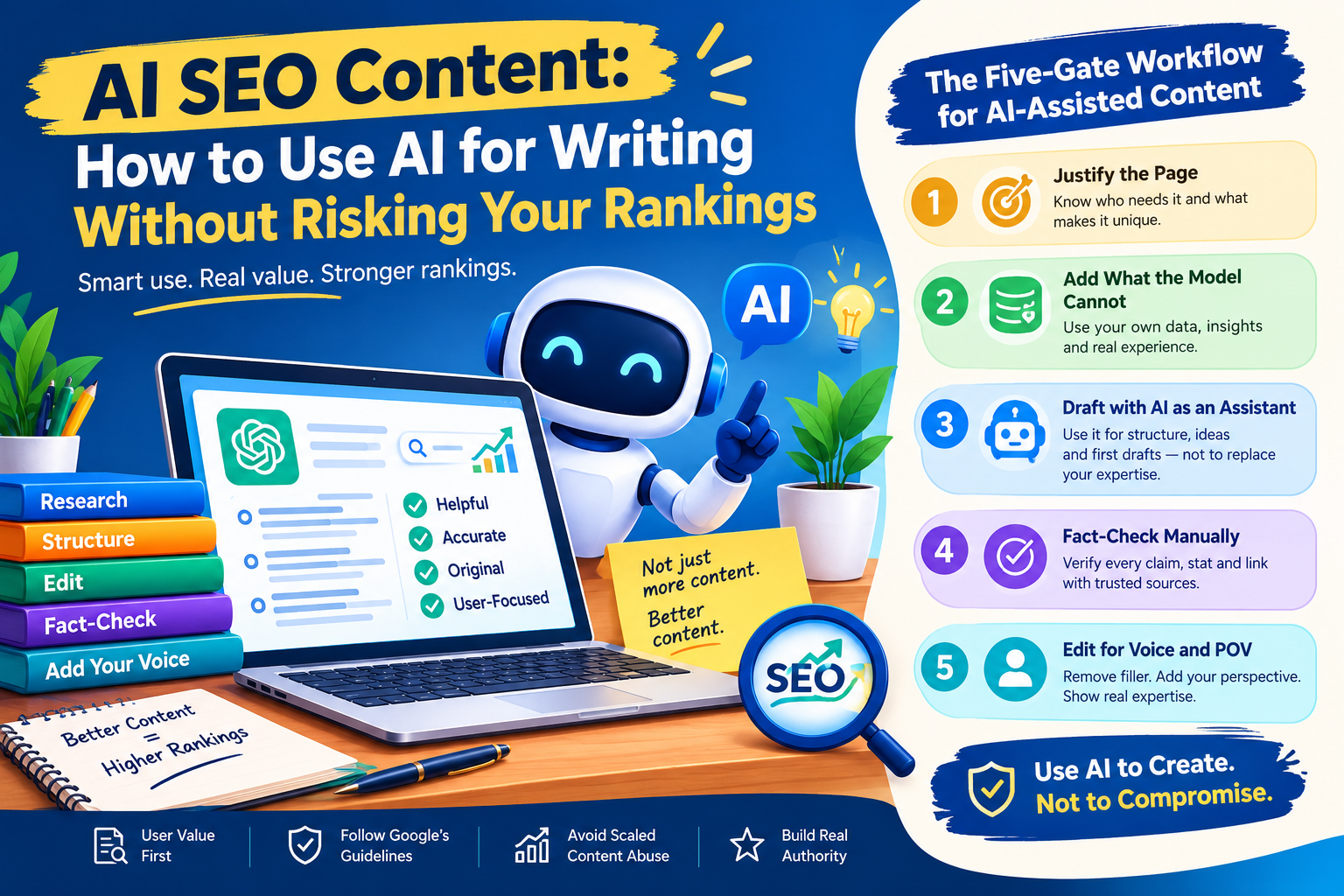
A Five-Gate Workflow for AI-Assisted Content
This is a working framework I’m proposing, not an official standard. Each draft passes five gates before publication.
Gate 1: Justify the page. Write one sentence stating who needs this page and what it provides that your other pages don’t. If a keyword list is the only reason it exists, stop. Google’s own descriptions of abuse include pages made because a keyword list said to make them, and the same logic applies to variations of one topic.
Gate 2: Add what the model cannot. Before drafting, collect inputs only you hold: customer questions, internal data, project outcomes, product testing, expert interviews, or screenshots. AI can organize these. It cannot invent them honestly.
Gate 3: Draft with AI as an assistant. Use it for outlines, structure, alternative phrasings, and first passes on sections where you supplied the substance. Avoid prompts that ask it to simply “write an article about X.”
Gate 4: Fact-check manually. PPC Land reports that on October 1, 2026, Google added language to its guidance saying AI-generated content should be manually fact-checked before publication, including titles, meta descriptions, structured data, and image alt text. I could not confirm that wording on Google’s own page, so verify it there before citing it. Regardless, it is sound practice: check every statistic, name, date, and claim against a primary source, and delete anything you cannot verify.
Gate 5: Edit for voice and point of view. Remove filler, generic openings, and sentences that could appear on any competitor’s site. Add a clear position where you have one. Name the author and their real qualifications.
What to Do With Volume
Publishing less is often the better strategy. Fewer, stronger pages organized around a topic usually serve both readers and retrieval systems better than hundreds of thin variations. If you already have a large body of AI-assisted pages, audit them:
- Group pages by topic and find duplicates in purpose.
- Merge overlapping pages into the strongest one, with redirects.
- Improve pages with some traffic by adding original material.
- Remove or noindex pages with no unique value, which matches Google’s own remediation advice for violating material.
Sarkar SEO uses this consolidation approach in content audits, because pruning weak pages frequently helps strong ones.
Should You Disclose AI Use?
Google says sharing how content was created can give readers helpful context. A reasonable rule is to disclose when readers would wonder, for example when AI produced most of the text, images, or audio. For ecommerce, Google Merchant Center has separate rules, including labeling AI-generated product text and image metadata.
Common Mistakes
Mass-producing comparison pages. Reporting on self-ranking “best alternatives” pages shows conflicting outcomes: one study found visibility losses, another found gains for vendor-written lists. The evidence is unsettled, so don’t build strategy on either result.
Trusting AI detectors. Google’s policy is not based on detecting AI. Quality and purpose decide the outcome, so spend effort on value, not on disguising text.
Skipping updates. Algorithmic demotions arrive without notice, so monitor Search Console and traffic after each announced spam update.
