



Most teams chasing AI visibility make the same assumption: to get cited by AI answers, publish more. The 2026 data suggests the opposite. The faster win is usually sitting in your archive, waiting to be updated properly. This article explains why freshness matters in AI SEO, where it stops mattering, and how to run a refresh programme that doesn’t just move dates around. Sarkar SEO uses this maintenance-first thinking as a starting point for AI search work.
What the evidence says about freshness
Ahrefs analysed roughly 17 million citations across major AI platforms. It found AI-cited content is 25.7% fresher on average than the results that rank organically on Google.
A later study from Seer Interactive adds detail. Based on 7,683 cited pages, 75% of pages cited in LLM answers had been updated within the last year. The same analysis notes that in every vertical, freshness comes from updates, not new publishing. Agencies reading the study reached a similar conclusion: what AI engines reward is evidence of recent attention, not recent authorship. Study: Content Recency’s Impact on AI Visibility in 2026 +2
Engines also differ. In Seer’s data, Gemini leaned freshest, with 78% of cited content updated in the last year, while Perplexity was more forgiving at 65%. Your refresh rhythm should therefore reflect where your audience searches.
The counterweight: freshness is not magic
Be careful with the headline numbers. Several vendor claims, such as large multiples for pages updated within 30 days, come from single-source benchmarks and I could not verify their methods. Treat them as directional.
Ahrefs itself offers a useful warning: freshness is one factor among many, and low-quality, irrelevant content updated daily won’t produce a boost in AI visibility. Another study of Claude and Grok answers found that a source’s position separated cited from uncited pages far more sharply than recency did. In other words, a recent date cannot rescue a page that fails to answer the question.
Fake freshness is also a trap. One content agency distinguishes real updates from the annual habit of swapping one year for the next each January. Changing a date without changing substance gives readers nothing and gives AI systems no new reason to trust you.
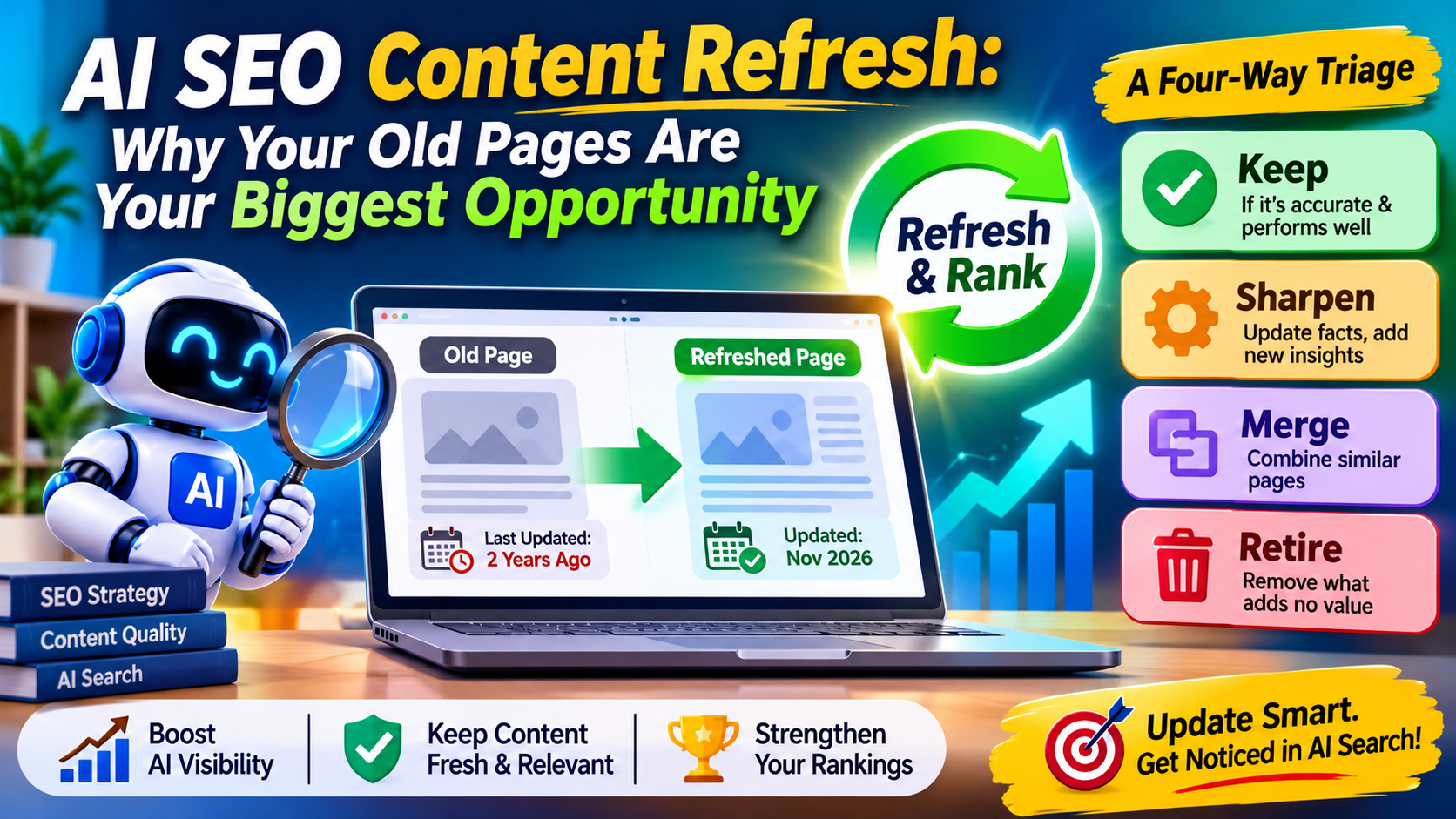
A four-way triage: Keep, Sharpen, Merge, Retire
Not every old page deserves the same effort. Sort your archive into four buckets before touching anything.
Keep. Pages that are accurate, rank well and drive conversions. Check the facts, fix broken links and leave them alone. Over-editing a performing page is a common mistake.
Sharpen. Pages with good rankings or impressions but outdated details. These are your best candidates. Examples include old statistics, retired product names, obsolete screenshots and steps that no longer match current interfaces.
Merge. Several thin articles on near-identical questions compete with each other. Combine them into one authoritative page and redirect the rest. A single comprehensive resource gives retrieval systems one clear source to select.
Retire. Pages that serve no reader and have no backlinks or traffic. Remove or redirect them. A smaller, cleaner site is easier to maintain and easier to trust.
What a genuine “Sharpen” looks like
A real refresh changes what a reader learns. Use this checklist:
- Replace stale evidence. Swap old statistics for current, named sources. State the date of each figure.
- Add something you actually know. A new test result, a client pattern you can legitimately describe, a screenshot from your own workflow or a corrected mistake. One agency’s advice captures the idea: updates should go beyond timestamp changes, adding proprietary data to deliver real value. siegemedia
- Answer the follow-up questions. Look at Search Console queries and your support inbox. Add sections for the questions people actually ask after reading.
- Show your changes. A short visible note, for example “Updated November 2026: replaced pricing data and added a new comparison,” helps readers and gives machines an honest date. Keep any structured date field aligned with the real revision date.
- Tighten the opening. Put the direct answer first. Readers want it, and answer engines can lift it cleanly.
Prioritising by content type
Spend effort where decay hurts most:
- Fast decay: pricing, tool comparisons, “best of” lists, platform how-tos, statistics roundups. Review these every one to three months.
- Medium decay: strategy guides and process explainers. Review every six months.
- Slow decay: definitions, foundational concepts and principles. Review annually, or when something material changes.
There is no universal schedule. Some vendors suggest bi-weekly updates for ChatGPT visibility, but that advice rests on a single source, and it conflicts with Ahrefs’ warning about low-value churn. Let the page type, and evidence that something has changed, set the cadence.
How to measure whether it worked
Refreshing without measuring is guesswork. Before editing, record the page’s impressions, clicks, average position and whether the key questions it targets produce citations in a fixed prompt list. Re-check after four to eight weeks. AI answers fluctuate from run to run, so look for a trend across several prompts, not one lucky result. Track business outcomes too: enquiries, sign-ups and branded searches.
Common mistakes to avoid
- Updating hundreds of pages at once with automated rewrites and no human review.
- Changing URLs during a refresh without proper redirects.
- Adding statistics you haven’t verified, which damages trust faster than a stale date.
- Ignoring internal links. When you merge or retire pages, update every link that pointed to them.
