



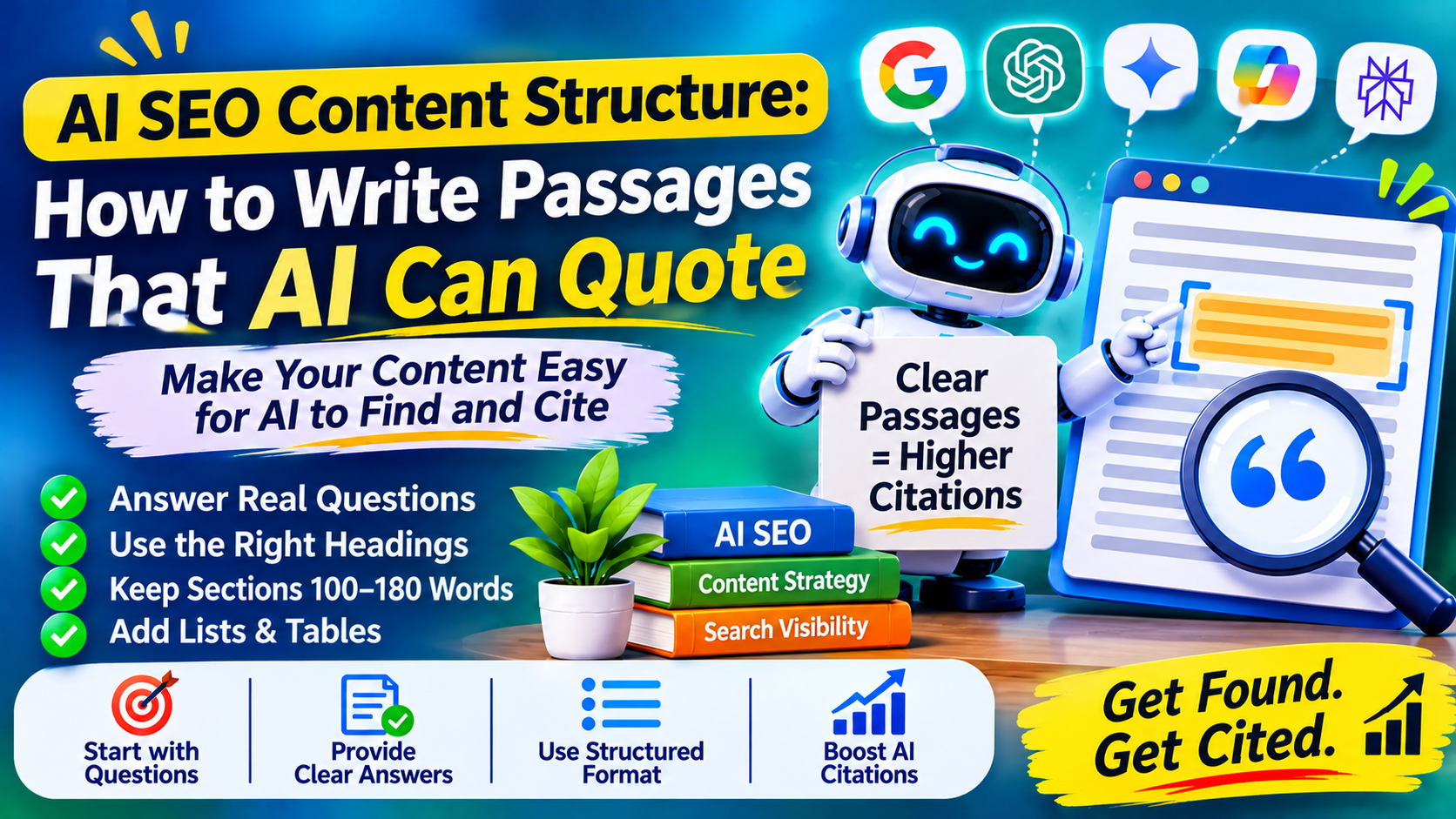
Most advice about AI SEO talks about pages. AI systems, however, tend to work with passages. A chatbot with web access retrieves a set of pages, finds the section that best supports its answer, and quotes or paraphrases that. Your page can be found and still ignored. This article looks at what the research says about writing quotable passages, where the evidence is weaker than it sounds, and how to audit your own content.
Being found is not the same as being cited
The retrieval step is a filter, not a finish line. AirOps analyzed 548,534 retrieved pages in March 2026 and found that ChatGPT left 85% of them uncited. A page only wins when the model judges one of its passages to be the best support for a claim. That makes passage quality the practical lever.
What the data suggests
Several studies converge on a few structural patterns. All are correlational, and most come from companies that sell AI visibility tools, so read them as signals, not rules.
- The top of the page matters most. One analysis attributes 44.2% of ChatGPT citations to the first 30% of page text. An independent CXL check of 100 AI Overview citations found 55% came from the top 30% of source pages. loganixradiantelephant
- Section length has a sweet spot. SE Ranking studied 216,524 pages and found 120 to 180 words between headings averaged 4.6 citations, versus 2.7 for sections under 50 words.
- Heading hygiene shows up. In AirOps’ analysis of more than 12,000 URLs, 68.7% of ChatGPT-cited pages used a proper sequential heading structure, compared with just under a quarter of page-one Google results. A single H1 appeared on 87% of cited pages versus 64% of Google leaders.
- Lists appear more often. Pages cited by ChatGPT were almost three times as likely to include at least one HTML list as Google’s top-ranking pages for the same queries.
What does not matter: length
One finding corrects a common instinct. Ahrefs’ study of 174,048 pages found the correlation between word count and AI citation was 0.04, and 53.4% of cited pages were under 1,000 words. A near-zero correlation means longer is not better by itself. A tight 900-word page with clear passages can outperform a bloated 3,000-word guide.
Reading the numbers carefully
Three cautions keep you honest.
Correlation is not cause. Well-structured pages often come from better-resourced teams, which also earn more mentions and links. Structure may help, but these studies do not isolate it.
The multipliers disagree. For tables alone, one guide claims they are cited roughly 4.2 times more than equivalent prose, while another reports only that comparison pages with three tables earned 25.7% more citations. Different datasets, different definitions. Expect direction, not precision. gogochimpparse
The sources have interests. Several are vendors, and some reports reach me through secondary summaries. Treat any single ratio as a hypothesis to test on your own pages.
The passage audit
Here is a method Sarkar SEO uses when reviewing a page. It is our own checklist, not an industry standard. Apply it to each H2 section.
- Does the heading name a real question? One analysis suggests a heading like “What is the optimal section length for AI citations?” matches a query, while “Content structure best practices” is too vague. A descriptive statement can work too, as long as it is specific.
- Does the first sentence answer it? Put the direct answer in the opening 40 to 60 words, then support it.
- Can the passage stand alone? If a reader needs three other paragraphs to understand it, the passage is unlikely to be lifted cleanly. Define terms where they appear.
- Is it one idea? Split sections that cover two topics.
- Does it carry something checkable? Add a named source, a figure with its date, or a concrete example.
- Is the length sensible? Treat 100 to 180 words as a starting range, not a law. Cut padding, but don’t chop useful nuance into fragments.
A quick before-and-after
Weak version: a section titled “Best Practices” that opens with two sentences about how important content is these days, then drifts toward the point.
Stronger version: a section titled “How long should each section be?” that opens, “Aim for roughly 100 to 180 words per section, enough to answer fully without padding. Shorter fragments tend to lack context, while longer ones bury the answer.” Then it adds a source for the figure and one example.
Same substance, but the second is easy to quote because the answer leads and the heading mirrors a question someone might ask.
Use lists and tables where they fit
Structure should reflect content, not the other way round. Use numbered lists for procedures, bullet lists for criteria or options, and tables for comparisons across the same attributes (prices, features, pros and cons). Don’t force a list when the idea needs reasoning. Explanation, trade-offs, and judgment read better as sentences, and readers can tell when formatting is decoration.
When not to restructure
Not every page should become a chunked reference. Opinion pieces, case studies, and narrative content succeed through voice and argument. A practical approach is to restructure pages that answer questions, compare options, or explain processes, and leave storytelling pages mostly alone, perhaps adding a clear summary at the top.
Common mistakes
- Opening with a long preamble about “the evolving landscape.”
- Turning every paragraph into a bullet, which strips reasoning.
- Skipping heading levels or using multiple H1s.
- Stuffing question headings that your text does not actually answer.
- Optimizing structure while leaving the content thin and unsourced.
