



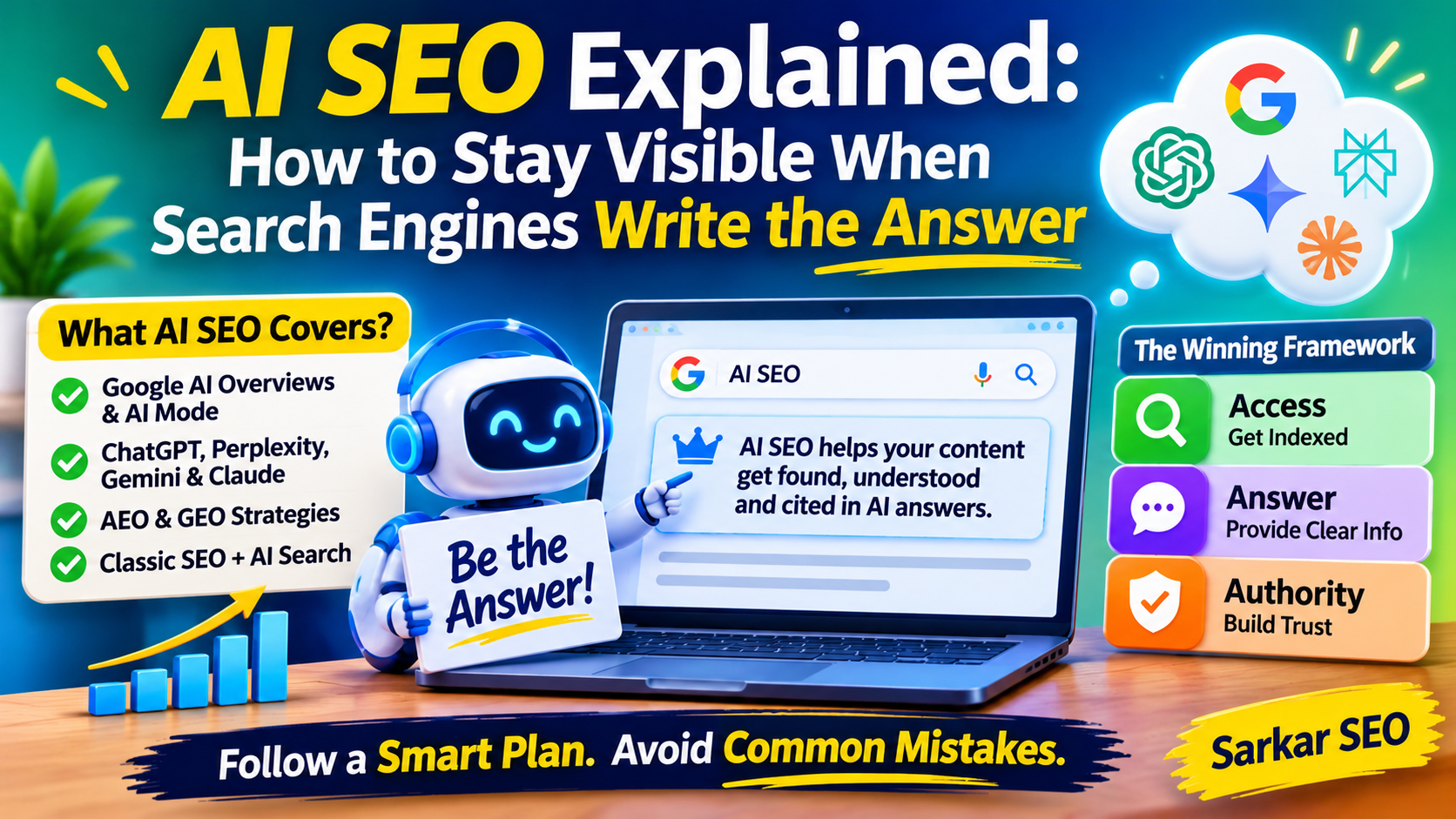
AI SEO is the work of making your content easy for search engines and AI assistants to find, understand and cite. It covers Google’s AI Overviews and AI Mode, plus answer engines such as ChatGPT, Perplexity, Gemini and Claude. It does not replace traditional AI SEO. It extends it, because the same page now has to satisfy a ranking system and a system that reads, summarizes and decides whether to mention you.
The useful question is no longer only “where do I rank?” It is “when someone asks this, does an AI system trust my page enough to use it?” Here is how those systems differ, what is known, and what to do first.
What AI SEO covers
You will see AEO (answer engine optimization) and GEO (generative engine optimization) used alongside AI SEO. The terms overlap heavily and none is standardized. They describe one job: being an accurate, retrievable, citable source wherever a question gets answered. Sarkar SEO uses AI SEO as the umbrella term because it keeps classic search and AI answers in a single plan instead of two competing projects.
What Google actually says
Google’s documentation states there are no additional requirements or special optimizations needed to appear in AI Overviews or AI Mode, and a page simply has to be indexed and eligible to show in Search with a snippet. Google also says AI Overviews appear only when its systems judge them additive to classic Search, so they often do not trigger. It adds that clicks from these pages tend to be higher quality. That is Google’s claim, so test it against your own analytics. googlegoogle
For Google, then, AI SEO is mostly disciplined fundamentals: crawlable pages, helpful content, clear structure. One point is often misunderstood. Blocking Google-Extended is a decision about AI model training and does not remove pages from AI Overviews or AI Mode, while blocking Googlebot removes you from Search itself.
Why other assistants behave differently
Google rankings carry over less than most people assume. Ahrefs found that 76% of AI Overview citations came from top 10 pages, yet across ChatGPT, Gemini, Copilot and Perplexity only about 12% of cited URLs ranked in Google’s top 10 for the original prompt, with Perplexity closest to Google.
An academic study of 158,099 answers explains part of this. Every page ChatGPT cites is one its own search retrieved, using sub-queries the model rewrites for each answer, and those rarely coincide with Google or Bing results. Your page can rank for the headline keyword and still never be retrieved for the sub-question that decides the answer.
Off-site presence matters too. A Yext study of 6.8 million citations reported that 48.7% of ChatGPT citations came from third-party listings such as review sites and directories. A small Perplexity test of 50 commercial queries found that brands mentioned across forums and trade publications were cited far more than brands publishing only on their own domain. Treat both as directional. They come from vendor research with limited methodology disclosure.
A working framework: access, answer, authority
At Sarkar SEO we sort AI SEO problems into three layers, in this order, because a failure at one layer cancels the next.
Access. Confirm important pages are indexed, load cleanly and keep their main content in the HTML where possible. Review robots rules and decide AI crawler access deliberately, bot by bot, instead of inheriting a blanket rule from a template.
Answer. Open each section with the direct answer in one or two sentences, then add evidence. Write passages that survive being quoted alone: name the subject instead of writing “it,” and keep each qualification next to its claim. Cover the follow-up questions a person would ask next, since ChatGPT, per the study above, retrieves by sub-question.
Authority. Publish something others cannot copy: your own data, a documented process, a named author with real experience, a tested comparison. Keep your business name, services and descriptions identical across your site, profiles and directories so systems find one consistent entity. Earn mentions where your audience already looks for advice.
Four mistakes that waste effort
- Treating schema as a trick. Structured data helps machines interpret a page. Nothing documented guarantees it earns a citation.
- Optimizing for one platform. The overlap figures above show each system retrieves differently.
- Publishing unedited AI drafts. Text that merely restates existing results gives a retrieval system no reason to prefer you.
- Measuring only clicks. Search Console now has a Generative AI performance report with impressions for AI Overviews and AI Mode. Impressions are not clicks, and other assistants offer no equivalent, so you must test them yourself. elementera
A 30-day starting plan
- Week one: List 20 questions your customers genuinely ask. Run each in Google, ChatGPT, Perplexity and Gemini. Record who is cited and whether you are mentioned or linked.
- Week two: Fix access problems on the pages that should be cited: indexing, blocked resources, thin or duplicated content.
- Week three: Rewrite your five most valuable pages answer-first, adding one original element to each, such as a data point, a worked example or a clear comparison.
- Week four: Close off-site gaps: consistent profiles, accurate directory listings, reviews and a few credible mentions. Repeat the question test and compare.
If you would rather have a specialist run that audit with you, Sarkar SEO can do it.
