



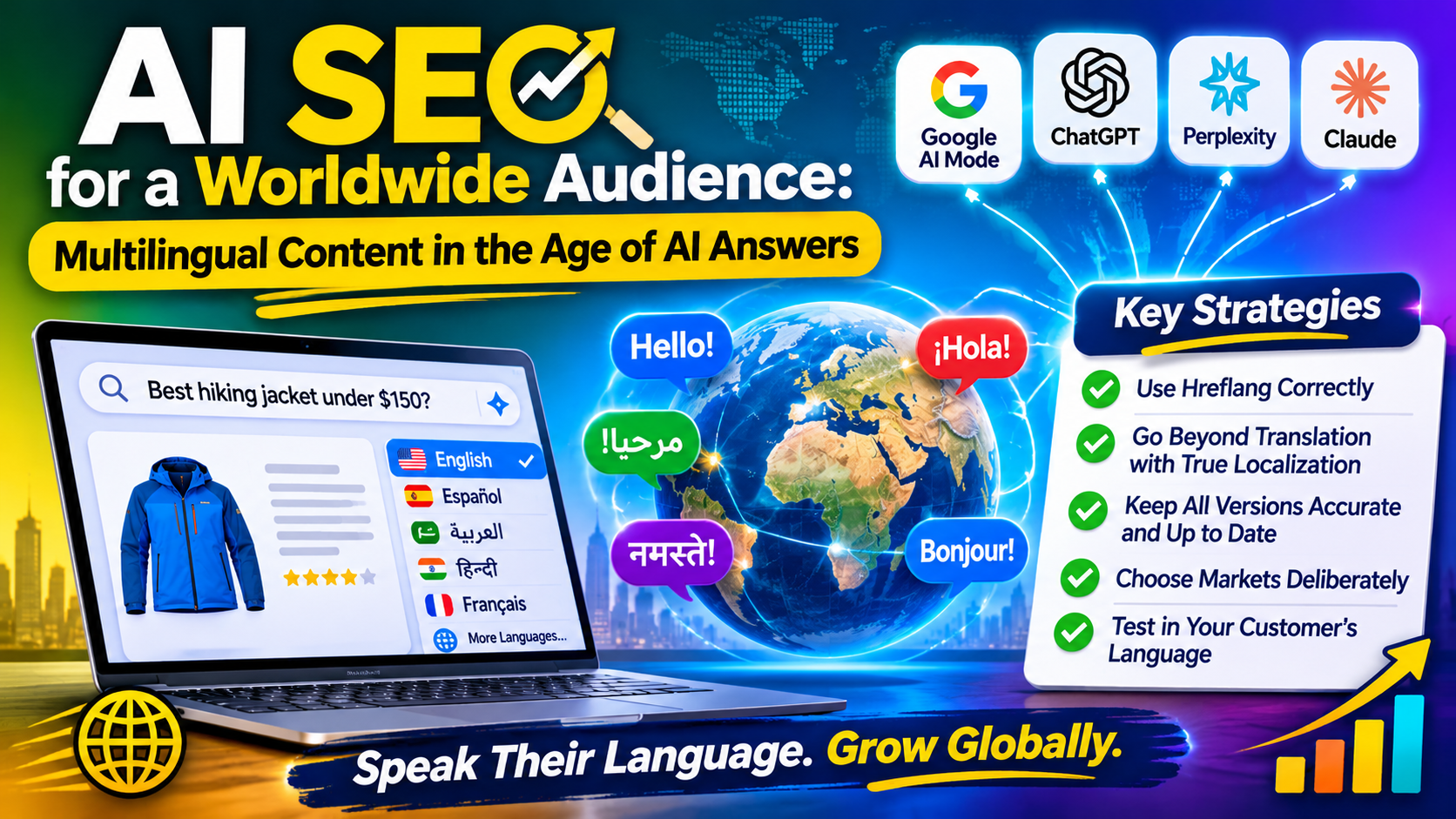
If your customers live in several countries, AI SEO search raises a question that classic international SEO only partly answers: when an assistant builds an answer for a Spanish, Arabic or Hindi speaker, which of your pages does it read, and which version does it show? This guide covers what is known, what is still uncertain, and how to prepare a multilingual site for AI-driven discovery without wasting budget.
The Language Barrier Is Shrinking Fast
Google’s AI features are spreading across languages quickly. In late 2025, Google said AI Mode was expanding to more than 35 new languages and over 40 new countries and territories, bringing it to more than 200 in total. In 2026, Google’s Liz Reid said that earlier Search features sometimes took months or even years to reach all countries and languages, while AI Mode shortened that process thanks to its multilingual models. Google has not published a country-by-country rollout schedule. seroundtablesearchenginejournal
One caution before you build a strategy on country counts: published figures for AI Overviews vary widely between third-party sources, from roughly 40 to over 200 countries. Treat none of them as authoritative. Check Google’s own availability pages for the markets you care about, and expect that coverage and answer quality differ by language.
Hreflang Still Matters, But It Is Not a Guarantee
Hreflang tells Google which language or regional version of a page to show. For traditional results it remains the standard tool. How well AI answers respect it is less settled.
Glenn Gabe ran a small test using multilingual documentation from Google and Cloudflare across several search products and assistants. For one query, AI Overviews did not appear, AI Mode and ChatGPT surfaced both the Spanish and English URLs, and Perplexity and Claude returned the English page. His broader summary was that Google and Bing generally show the correct language version when hreflang is in place, while AI Overviews and AI Mode often get it right but not always.
This was one tester’s limited experiment, so do not generalize from it. But it carries a useful lesson. Do not assume a user will land on the version you intended. One third-party review also reports finding no AI vendor documentation of any way for site owners to target a language or country in AI answers. The practical response is to make every version trustworthy on its own.
Translation Is Not Localization
Sarkar SEO treats this distinction as the center of multilingual AI SEO. Translation converts words. Localization changes what the page actually says so it is true and useful in that market. Google’s guidance for AI features points at the same underlying quality bar: content that offers a unique point of view and goes beyond what others have already said, or what a generative model could easily produce.
Here is a simple check, a practical suggestion rather than an established method. For each market page, ask whether it contains something a plain translation could not supply:
- Local facts: prices in local currency, units, delivery times, tax treatment and legal requirements
- Local proof: customers, case studies, certifications and reviews from that region
- Local language use: the terms people actually search and speak, not literal translations of your English terms
- Local examples: scenarios and references your readers recognize
If a page fails every item, it is a translation, and an AI system has little reason to prefer it over a better-localized competitor.
Make Every Version Safe to Be Shown
Because any version might surface, inconsistency becomes a risk. Imagine an assistant citing your English page to a customer in another country, with a price, return policy or service area that applies only to your home market.
Reduce that risk with a few habits:
- State scope on the page. Say which countries a price, shipping option or offer applies to.
- Keep core facts aligned. Business name, contact details, product specifications and policies should match across languages, unless a real local difference exists.
- Date and update every version together. A stale translation that contradicts a fresh original is worse than no translation.
- Link versions clearly with correct, self-referencing hreflang annotations and consistent canonical tags, following Google’s international site guidance.
Do Not Mass-Translate
Machine translation is a legitimate drafting aid, and the earlier point about AI in the workflow applies here too. The danger is scale without review. Google warns that using AI tools to generate many pages without adding value for users may violate its scaled content abuse policy. Publishing hundreds of auto-translated pages that nobody has checked for accuracy or relevance is a fast route to thin, low-trust content in every language at once. Have a native speaker review anything that carries claims, prices, legal terms or medical and financial information.
Choose Markets Deliberately
You do not need to be everywhere. Prioritize by evidence:
- Look at current demand. In Search Console, review impressions and clicks by country and query language.
- Match language to revenue. Favor languages where you already have customers, support capacity and the ability to deliver.
- Check platform reach. Assistants are not equally available everywhere, and availability changes. Confirm which tools your target audience can actually use.
- Start narrow. Localize your five most valuable pages properly in one new language before expanding.
Test in the Customer’s Language
Do not test AI visibility only in English. Have a native speaker write ten realistic questions in each priority language, run them through the assistants your audience uses, and record which pages and sources appear. Note whether the answer uses the right version, the right currency and the right facts. Repeat quarterly, since AI features in this area are changing quickly, and expect inconsistent results between runs.
