



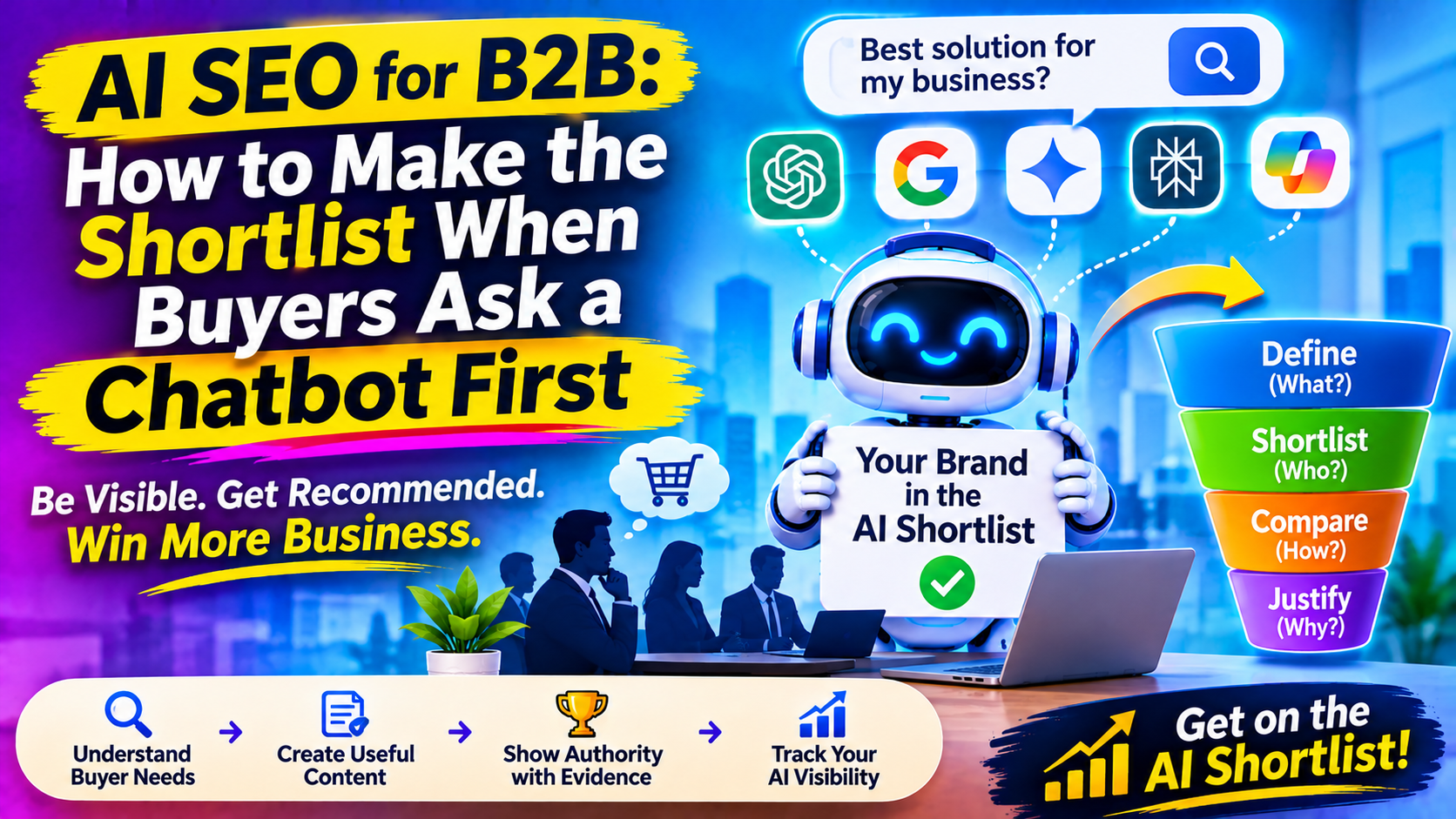
For B2B companies, AI SEO search is not mainly a traffic question. It is a shortlist question. If a buyer asks an assistant to name the best options in your category and you are absent, the evaluation may be over before your website ever gets a visit. This article looks at what buyer surveys show, why those numbers need careful reading, and how to prepare your content for each stage of an AI-assisted evaluation.
What the surveys say
The most detailed recent data comes from G2’s March 2026 survey of 1,076 B2B software buyers. It found 71% now rely on AI chatbots for software research, up from roughly 60% about seven months earlier, while 80% still use Google somewhere in their buying journey. Buyers did not abandon search. They added a new first stop.
Forrester’s 2026 survey of nearly 18,000 business buyers points the same way. It found 94% used generative AI in their most recent purchase, using it to research product information (54%), compare vendors (55%), and build internal business cases (47%).
Influence looks significant too. In G2’s data, 85% of buyers think more highly of a vendor when a chatbot mentions it in a recommendation, and comparing vendor strengths and weaknesses is the top use case at 41%. One summary adds that 69% of buyers switched vendors based on chatbot guidance. Half of B2B Software Buyers Now Start Their Research with AI Chatbots: G2 +2
Read these numbers with care
A few honest caveats. G2 runs a software review marketplace, so it has a stake in how buyer behavior is described. The figures are self-reported, and “switched vendors” does not reveal how large the change was. The samples concentrate on software buyers, so they may overstate behavior in industries such as manufacturing, logistics, or professional services. Treat the direction as strong and the exact percentages as approximate. A sensible next step is to ask your own recent customers how they researched you.
The journey has several stages, not one
Most commentary stops at “buyers discover vendors in chatbots.” The surveys suggest more. Buyers define the category, build a shortlist, compare options, test objections, and justify the decision internally. Each stage involves different prompts and needs different content. At Sarkar SEO, we map content to four stages. This is our own framework, not an industry standard.
Stage one: define. The buyer asks what a category is or which approach fits their situation. Your content needs a clear, neutral explanation in plain language, which positions you as a credible guide before any pitch.
Stage two: shortlist. The buyer asks who the credible vendors are for their size, industry, or budget. Appearing here depends heavily on whether the web consistently connects your brand to the category and its use cases.
Stage three: compare. This is the busiest stage in the data, which means comparison content decides outcomes. Buyers want honest differences, not brochure language.
Stage four: justify. Nearly half of buyers use AI to build internal business cases. They need figures, implementation timelines, risks, and language they can paste into a memo.
Four assets that matter most
You don’t need a hundred new pages. Most B2B sites benefit from four well-built assets.
- A category explainer. Define the problem, the main solution types, and how to choose among them. Be fair to alternatives.
- Honest comparison pages. Include who each option suits, where your product is not the best fit, and what to verify during a trial. Buyers can sense one-sided content, and so can the models that summarize it.
- An implementation and pricing explainer. Even if exact prices vary, describe how pricing works, typical timelines, team requirements, and common setup pitfalls. Specifics are quotable. Vague claims are not.
- An evidence page. Collect case studies with real numbers, named customers where permitted, and clear descriptions of the starting situation. Treat these as proof for the justify stage.
Why third-party presence still decides a lot
The assistant’s recommendation is rarely based on your site alone. One commentator argues that buyers trust the chatbot’s output only when it is anchored to third-party sources they already respect. That is an opinion from a vendor-side analyst, but it fits what we know about how engines assemble answers. Review platforms, analyst mentions, industry publications, and partner pages all contribute. Make sure your profiles are complete, current, and consistent with your own site, and encourage genuine customer reviews rather than inflating them.
Audit your shortlist share
Before changing anything, find out where you stand. One suggested move is to ask ChatGPT, Perplexity, Gemini, and Claude to recommend vendors in your category using the same prompts your buyers would. Build a set of 20 prompts across the four stages, with variations by company size, industry, and budget. Run them in several tools, and record three things: whether you are named, how you are described, and which sources are cited. authoritytech
Look for patterns. If you appear at the define stage but vanish at compare, your comparison content is thin. If you are named but described inaccurately, fix the source pages that feed the error. If a competitor dominates a specific use case, you may need a dedicated page on that use case.
Connect it to sales
Give your sales team the findings. Ask every new lead during discovery which tools they used to research you and what they asked. Capture it as a field in your CRM, not as an anecdote. This turns scattered stories into evidence, and it helps you separate AI-influenced pipeline from the traffic your analytics can see.
Common mistakes
- Publishing only top-of-funnel content and ignoring comparison and evidence pages.
- Writing comparisons that never admit a weakness.
- Letting profile pages and pricing details drift out of date.
- Treating AI visibility as a marketing project with no input from sales.
- Waiting for perfect data before acting.
