



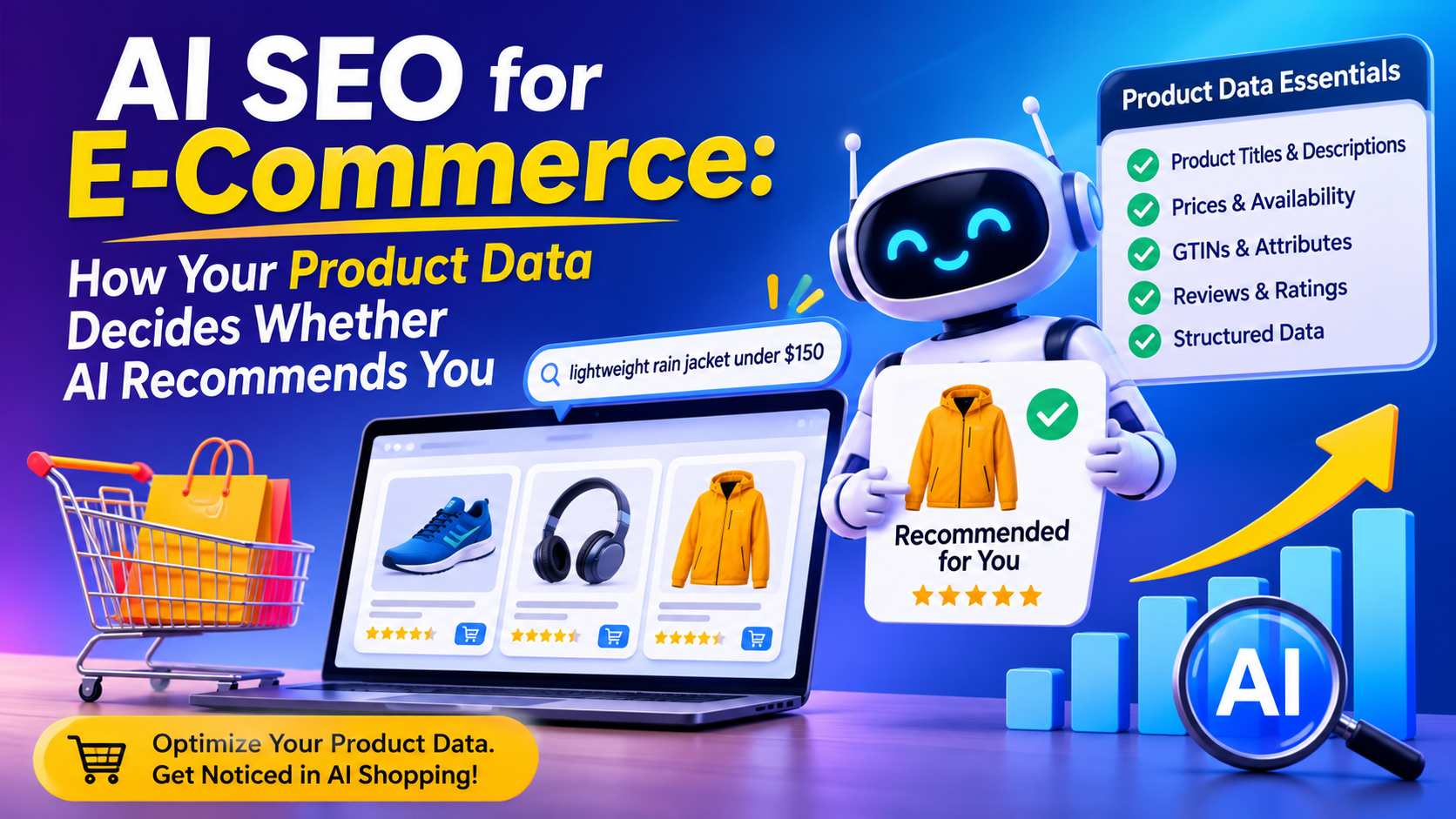
In most industries, AI search rewards good content. In e-commerce, it rewards good data first. When a shopper asks an assistant for “a lightweight rain jacket under $150,” the answer is assembled from product feeds, prices, stock status and reviews, not just from blog posts. For online stores, AI SEO is as much about your catalog as your copy.
This article explains how AI shopping surfaces get their product information, where the evidence is solid or thin, and a practical order of work for any store.
Three Surfaces, Not One
One practitioner guide frames e-commerce visibility as working three surfaces at once: classic search results, Merchant Center listings, and AI answers such as AI Overviews, AI Mode and ChatGPT. The same source says classic SEO is not dead: transactional queries still flow through organic search and product pages, but two new surfaces were added.
That reframing matters. A store that only publishes blog content misses the layer where product decisions are increasingly made.
Where AI Gets Product Information
For Google’s AI features, the product catalog is shared infrastructure. One explainer says Google’s Shopping Graph, built from Merchant Center feeds, helps ground product mentions in AI Mode, AI Overviews and Gemini shopping answers. Importantly, the same piece adds that Google has not confirmed Merchant Center as a direct AI Mode ranking signal. So the safe reading is “shared data source,” not “guaranteed ranking factor.” alhenaalhena
Other platforms differ. A comparison guide states that ChatGPT uses the Agentic Commerce Protocol, Perplexity has a Merchant Program, and Google AI Mode and Gemini read your Merchant Center feed. Another summary notes that Perplexity relies more on web crawling, editorial citations and review sites.
Availability varies by country and changes quickly. Programs, eligibility and checkout features that exist in one market may not exist in yours, so confirm current rules with each platform before planning around them.
The Evidence on ChatGPT and Google Shopping
One widely repeated figure is that a Peec AI study found 83 percent of ChatGPT product results matched Google Shopping organic listings. If accurate, it implies that fixing your Google product data helps beyond Google. But the number reaches us through trade blogs, and I could not review the study itself. Use it as a reason to check your feed, not as a precise rule.
A related pattern: one explainer claims that ChatGPT fires shopping sub-queries to Google Shopping and then assembles results. That is a practitioner’s description of observed behavior, not a published specification, so treat it as a hypothesis.
What Appears to Matter Most
Across sources, one theme repeats: complete, consistent data. Incomplete or poorly structured feeds risk missing visibility in AI-assisted shopping. One guide lists the essentials as product titles, descriptions, images, prices, availability, GTINs and all relevant attributes.
Consistency across channels is equally important. One source warns that when Merchant Center says “in stock” but the product page says “sold out,” Google penalizes both Shopping visibility and AI grounding confidence. That is a vendor’s claim, but the logic is sound: contradictory data erodes trust for shoppers and for machines. alhena
A Five-Step Plan for Online Stores
At Sarkar SEO, we recommend working from the data layer outward, because errors there undermine everything built on top.
- Audit your feed against your live pages
Compare price, availability, variant, shipping and return details between your feed and your product pages. Fix every mismatch. This is the highest-value check and costs nothing but time.
- Fill the attribute gaps
Add identifiers (such as GTINs where they exist), brand, material, size, color, compatibility and use case. Google reportedly added new fields for AI discovery. One source says Merchant Center recognizes six attributes designed for AI-driven discovery, which Google calls Conversational Attributes since a May 2026 global rollout. Verify the current list in Merchant Center Help before building around it.
- Write titles and descriptions for real questions
Shoppers ask AI tools in plain language: “waterproof backpack for a laptop under 2 kilograms.” Product copy that states who an item is for, what problem it solves and how it differs from alternatives gives an AI something to match. Avoid keyword stuffing. Specific facts beat adjectives.
- Strengthen proof
Reviews, ratings, comparison content and honest buying guides help both shoppers and systems decide. One guide names product data completeness, Schema.org markup, review signals and natural language descriptions as key levers for AI Mode visibility. Keep structured data accurate and matched to what visitors see. Google has said structured data isn’t required for generative AI search, but it remains useful for rich results, so use it for that purpose.
- Prepare for agent-led buying
Checkout is moving into AI interfaces. One source says Google’s Universal Commerce Protocol, introduced at NRF 2026, extends Merchant Center into cart and checkout inside AI Mode. Another reports that Shopify announced an Agentic Plan that exposes product catalogs to AI agents through standardized feeds. If you use a platform with these options, review them. If you run a custom stack, keep an eye on the protocols and make sure your catalog could be exported cleanly.
Don’t Neglect Content
Feeds get you considered. Content helps you get chosen. Guides, comparisons and clear return and warranty policies answer the questions shoppers ask before buying, and they give AI systems trustworthy text to draw from.
This is also where unique value matters. If every store in a category uses the same manufacturer description, nothing separates yours. Add testing notes, sizing advice, real photographs and honest drawbacks.
How to Track Progress
You won’t find a single dashboard that shows everything, so combine signals:
- Merchant Center diagnostics and any AI-related reporting your account offers
- Organic and shopping traffic by product category
- A monthly set of shopping prompts run through several AI tools, recording which brands appear
- Accuracy of the price and stock details those tools show
- Conversion rate by source
Run the same prompts each time and expect variation. One result proves little.
Realistic Expectations
Be wary of figures that make AI shopping sound like a flood. One trade report claims around 20% of ChatGPT chats now contain shopping intent and only about 20% of merchants have machine-readable product feeds. Both numbers come from a secondary summary and may not apply to your market. The reliable takeaway is narrower: many stores have not prepared their data, so basic preparation can set you apart.
