



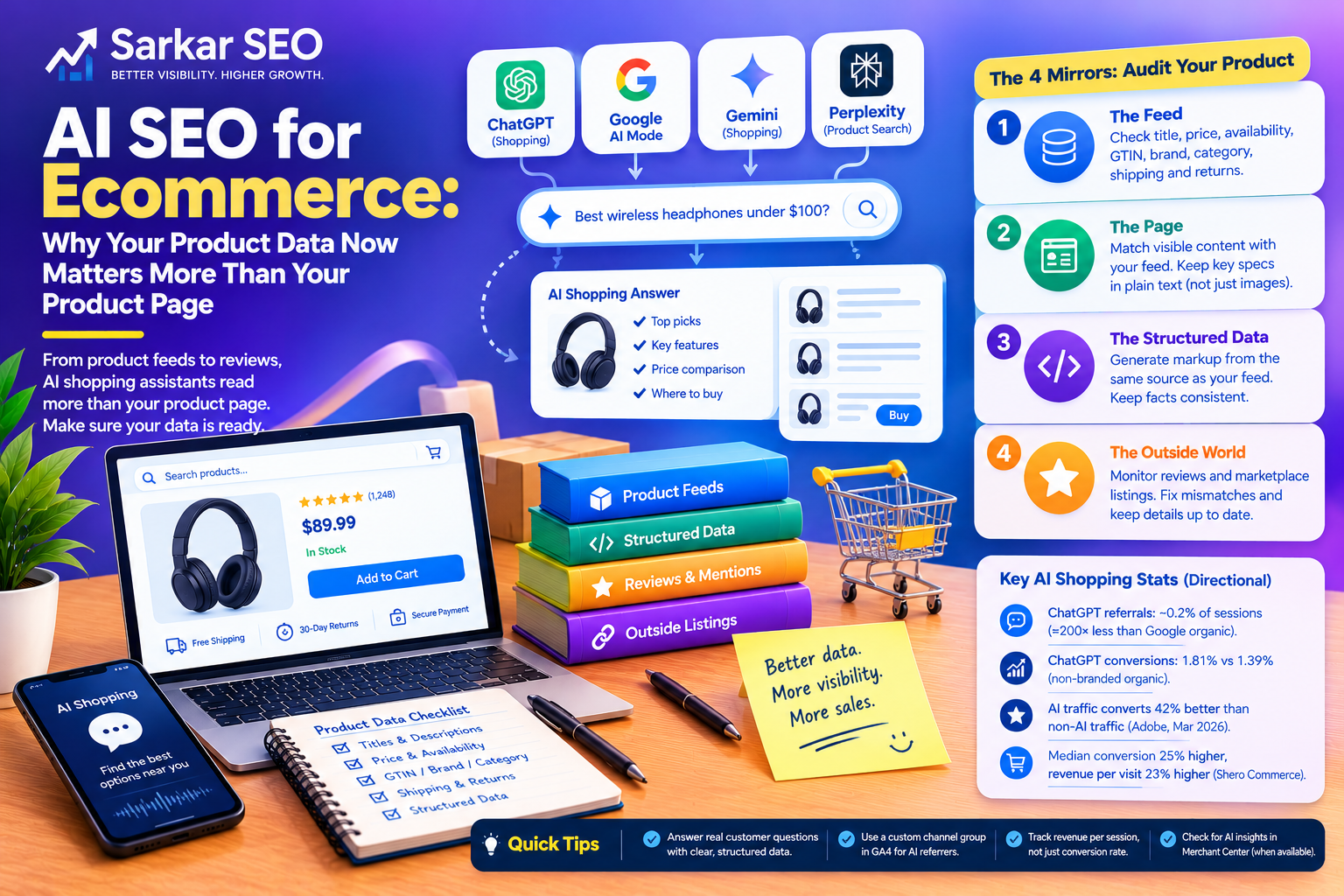
AI SEO for an online store starts somewhere unexpected. It is not the blog or the backlinks but the structured product data that shopping assistants read. ChatGPT, Google’s AI SEO Mode and the Gemini app build product answers largely from merchant feeds and product databases. This article explains where that data comes from, how to audit it and how to judge the traffic it brings.
How AI Shopping Assistants Get Product Information
Google’s AI Mode and Gemini draw on the Shopping Graph, which receives most merchant data through Merchant Center. ChatGPT takes a product feed submitted to OpenAI by approved merchants who apply, with Shopify merchants routed through Shopify Catalog. Google’s guide to generative AI features names Merchant Center feeds as one way to help products appear in AI responses. Merchant guides also report that free listings can appear in AI Mode without paid campaigns, which is worth confirming in your account.
In May 2026, Google added six conversational attributes to Merchant Center, built around how people phrase requests to AI. Google’s help pages include fields for product highlights, structured product details and question-and-answer content. Rollout varies by market and merchant eligibility, so check what your country and account support.
The One Product, Four Mirrors Audit
Sarkar SEO uses a simple audit built from this idea. Pick your best-selling product and compare four places where AI systems can see it. Every mismatch is a visibility leak.
- The feed. Check title, price, availability, GTIN, brand, category, shipping and returns. Disapproved products can drop out of Shopping surfaces, so clear the errors. One merchant guide reports that Google’s legacy Content API for Shopping was due to shut down on 18 August 2026, so confirm you have moved to the Merchant API.
- The page. Visible text should state the same facts as the feed. Adobe’s AI Content Visibility Checker, as cited in one merchant guide, scored US retail product pages at an average of 66%, implying roughly a third of page content is invisible to the language models behind AI shopping. Put key specifications in plain on-page text, not only in images, tabs that fail to load or scripts.
- The structured data. Google says markup must match what visitors see, and that structured data is not required for its generative AI features. Generate the markup from the same source as your feed so price and availability cannot drift apart.
- The outside world. Reviews and marketplace listings are a fourth mirror. Shoppers and assistants both see them, so stale or contradictory listings undermine otherwise clean data.
Sarkar SEO treats these mismatches as the first thing to fix, because a store can resolve them in days, whereas building authority takes months.
Write for the Questions Shoppers Ask
Conversational shopping produces small, specific questions: Will this fit my model? Is it waterproof? What is a cheaper alternative? Capture the answers in structured fields and on the page. The best raw material is your own: support tickets, pre-sale questions and return reasons. Use real answers and never invent specifications.
If you use AI to write descriptions at scale, note that a 2024 Merchant Center specification update required AI-generated titles and descriptions to be labeled with dedicated attributes. Check the current specification before relying on that detail.
Judging AI-Referred Traffic Honestly
The evidence has shifted, and the datasets disagree, so read them together.
- A study of 973 ecommerce sites over 12 months to July 2025 found ChatGPT referrals made up about 0.2% of sessions, roughly 200 times smaller than Google organic, and converted worse than most channels at that time.
- Visibility Labs analyzed 94 stores across 2025 and found ChatGPT referrals converting at 1.81% against 1.39% for non-branded organic search, a 31% advantage, though with smaller orders.
- Adobe reported that AI traffic to US retail sites converted 42% better than non-AI traffic in March 2026, after trailing by 38% a year earlier.
- A store-level benchmark of 61 stores by Shero Commerce found median conversion 25% higher and revenue per visit 23% higher than Google organic, with orders 15% smaller.
Definitions differ. Adobe groups many AI tools together, while the academic study isolates ChatGPT, and samples and dates vary too. The fair summary is that AI referral traffic is small and growing, often higher in intent, and may carry smaller baskets. Compare revenue per session, not conversion rate alone.
Measurement takes some setup. GA4 has no built-in AI channel, and ChatGPT offers little native reporting, so create a custom channel group from referrer sources such as chatgpt.com and perplexity.ai, and tag links wherever you control them. Google is also reportedly adding AI performance insights to Merchant Center, covering share of voice, funnel performance, conversational terms and attribute gaps. Check whether your account has them. Sarkar SEO recommends reviewing revenue per session by source each month and avoiding conclusions from a single week of data.
