



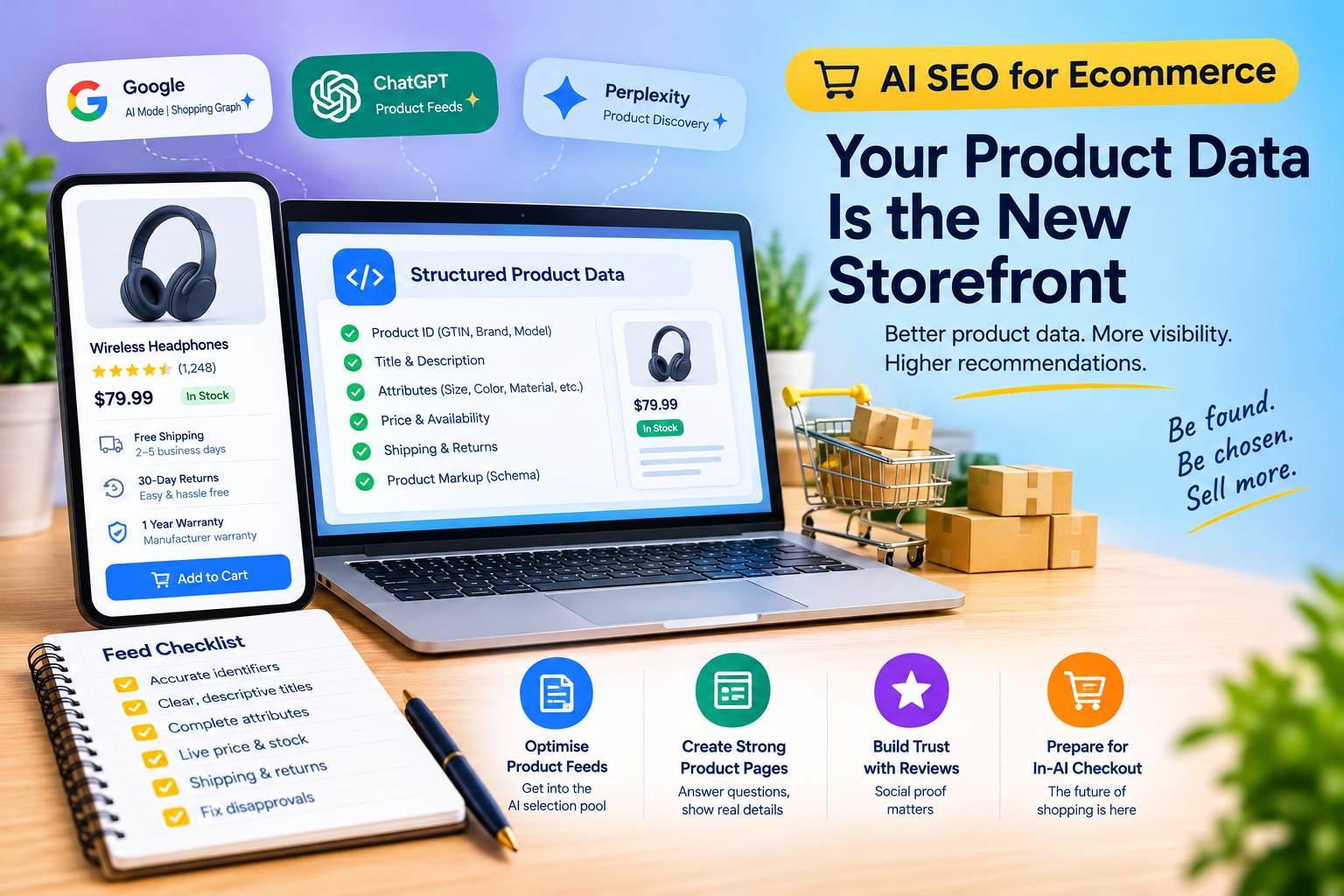
For online stores, AI SEO search changes the question from “will my product page rank?” to “will an assistant know enough about my product to recommend it?” Often, the answer depends less on your page copy than on the structured data behind it. At Sarkar SEO, we think many shops are polishing product pages while their product data quietly decides who gets recommended. Here is how the pieces fit together.
Where AI Shopping Gets Its Information
There is no single AI shopping channel, and treating it as one causes mistakes. One technical review warns that early advice often discussed AI shopping assistants as if they all consumed merchant data in the same way.
The documented paths today look like this:
- Google. Merchant Center is the system for submitting and maintaining product information, and Google says that data is used to match products to relevant queries, supporting ads and free listings, including AI-powered commerce experiences. One ecommerce guide describes AI Mode assembling recommendations from the Shopping Graph, which is fed by your Merchant Center feed and Product markup on your pages. lseoseoquick
- ChatGPT. According to the same technical review, ChatGPT now supports structured merchant product feeds through OpenAI’s Agentic Commerce Protocol. An agency guide says merchants can apply to a program that lets them submit feeds directly, so that ChatGPT does not have to crawl and interpret the site.
Programme availability, eligibility and terms vary by country and change often. Check each platform’s current documentation for your market before planning around it.
One Feed Strategy, Not an “AI Feed”
The sensible lesson from that technical review is to avoid inventing a universal AI feed. Its advice is to maintain strong underlying product data and map that data correctly to each platform’s documented requirements. Most work done for one destination carries over to others, so invest in the source data first.
One vendor guide makes a useful distinction: feed optimisation gets your products into the AI selection pool, but it is not enough on its own. That fits what we see in practice. A clean feed makes you eligible. Trust, reviews and clear pages help decide whether you are chosen. getpassionfruit
The Feed Checklist
This list is our own working suggestion, based on the sources above and common feed requirements. Confirm exact fields in each platform’s specification.
- Identifiers. Include accurate product identifiers such as GTINs where they exist, plus brand and model numbers. A ChatGPT feed overview lists GTIN, titles, attributes, price and availability, kept in sync.
- Descriptive titles. Put the product type, brand and key attributes in the title in the order shoppers use them, not marketing slogans.
- Complete attributes. Size, colour, material, compatibility, dimensions and age group. Missing attributes make products hard to match to specific questions.
- Live price and stock. Out-of-date availability sends shoppers to dead ends. One guide notes the ChatGPT feed specification supports refreshes every 15 minutes. Your update frequency should match how quickly your stock changes.
- Shipping and returns. Assistants are asked about delivery and returns constantly. One report says Google expanded its product data specification in 2026 with additional shipping fields and a product video attribute. Check what you can now supply.
- Fix disapprovals. Merchant Center reports show products excluded for data quality problems. Treat those as a to-do list, not noise.
Make Product Pages Back Up the Feed
Assistants and shoppers both compare your feed with your page. If the price, stock status or specification differs, you create doubt. Keep them aligned, and consider this page checklist:
- Facts above fluff. One strategy guide says shop optimisation for generative search means clear product descriptions, FAQ blocks, comparison tables and a distinct brand entity.
- Answer real buying questions. Does it fit, how long does it last, what is included, how does it compare with the alternative? Use questions from customer service chats.
- Visible policies. Delivery times, returns and warranty belong on the page in plain language.
- Structured data that matches. Product markup should reflect what is visible. Our article on schema explained that markup is useful infrastructure, but not a guaranteed citation lever.
The same guide notes that shopping assistants often pull structured facts, reviews and delivery information. That is a good prompt to check all three on your top sellers.
Reviews and Reputation Still Matter
Assistants lean on social proof. Collect genuine reviews with a simple follow-up email, show them on the page, and respond to problems publicly and politely. Never fake or incentivise reviews dishonestly, as marketplaces and Google can penalise this. Independent reviews on trusted sites also help, a theme we have covered elsewhere in this series.
Watch the Move Toward Buying Inside AI
Shopping is moving from recommendation toward completing the purchase inside an assistant. One ecommerce guide says Google’s Universal Commerce Protocol, introduced at NRF 2026, extends Merchant Center into cart and checkout inside AI Mode. I could only confirm this through that secondary guide, so verify the current status for your region. If checkout happens in an assistant, your product data, stock accuracy and policies carry even more weight, because the shopper may never see your site.
A Note on Numbers
Be careful with fast-moving statistics. One guide reports that AI Overviews now appear on roughly 14% of shopping queries, a 5.6× jump from 2.1% in November 2025. That is a single source, and such rates differ by tracker and by country. It shows direction, not a number to plan a budget around.
A Four-Week Starting Plan
Week one: audit your feed for missing identifiers, thin titles and disapproved items.
Week two: compare feed and page data for your 20 best-selling products and fix every mismatch.
Week three: rewrite those pages with clear specifications, a buyer’s FAQ and visible policies.
Week four: ask leading AI assistants the questions your customers ask, such as “best waterproof hiking boots under a set budget”, and record which products appear and why. Repeat monthly, since answers vary between sessions.
