



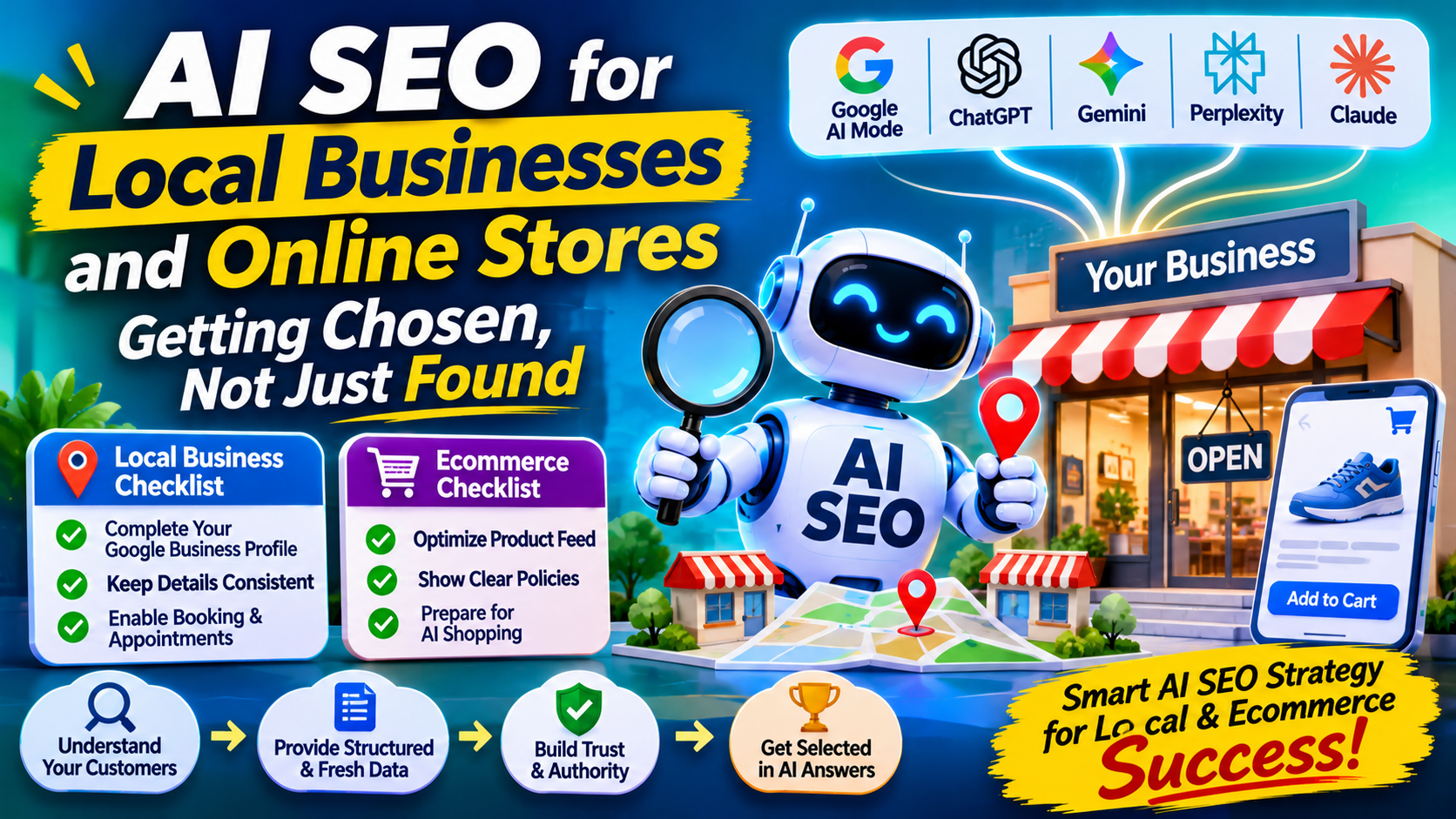
For years, local and ecommerce SEO meant earning a spot in a list. AI search is changing the job. A customer asks for a plumber, a salon or a pair of running shoes, and the system may return a shortlist, compare prices, or start a booking. If your business data is vague, stale or hard for a machine to act on, you may never make the shortlist. This guide covers AI SEO for businesses that sell or serve in the real world.
From Ranking to Being Selected
The scale of the shift is hard to ignore. Google said on May 19, 2026 that AI Mode had passed one billion monthly users, and described extending agentic booking to local experiences and services, pairing current pricing and availability with direct provider links. At the same event, Google confirmed that people can task its AI with calling local businesses to check pricing and availability, starting with categories such as home repair, beauty and pet care.
Rollout details matter here. Much of this began in the United States, and availability, categories and partners vary by country and platform. Treat the specifics below as a direction of travel, and check what applies in your market before investing.
Why Data Now Matters More Than Copy
A well-written service page still helps. But when an AI system is choosing between businesses, it needs facts it can verify and act on: hours, services, prices, availability and policies. One SEO practitioner put the risk bluntly: if a profile and website do not spell out granular details, an AI agent may guess or skip to a competitor that provides them. That is one practitioner’s warning, not Google’s statement, but it matches the logic of how grounded systems work.
Google’s own guidance points the same way. It says tools such as Merchant Center feeds and Google Business Profiles can help products and services appear in AI responses as well as other Search results. Sarkar SEO treats these as the most underrated assets in AI SEO, because they are structured, official and under your control. google
A Local Business Checklist
Complete and verify your Business Profile. Check categories, services, service area, hours (including holiday hours) and phone number. Unverified or half-filled profiles give AI systems little to work with.
Make booking a clean handoff. Google’s booking links for home services work through named partner platforms, and qualifying differs by platform. For example, one such platform requires a business to connect a Business Profile at the same address and assign a booking form to Google. If you use a scheduling tool, find out whether it integrates and what it requires. If you take bookings on your own site, make sure the booking page works on mobile and has a stable address.
Keep details consistent. Your name, address, phone number and hours should match across your website, profile and major directories. Contradictions are exactly what automated systems trip over.
Know your controls. Businesses can opt out of Google’s AI calling by changing their profile settings or notifying Google. Decide deliberately rather than by default. marketing4ecommerce
An Ecommerce Checklist
Feed quality first. Keep product titles, prices, availability, identifiers and images accurate in your product feed. Stale stock data creates exactly the mismatch that frustrates both shoppers and automated systems.
State policies plainly. Shipping times, return windows and costs should be easy to find on the page, in visible text, not buried in a PDF.
Prepare for browsing agents. Google notes that browser agents may read a site by analyzing screenshots, inspecting page structure and interpreting the accessibility tree. In practice, that means clear button labels, proper form fields, readable prices and no checkout steps that only a mouse can complete. These changes also help screen-reader users, which is a good reason to make them regardless of AI.
Watch emerging standards without chasing them. Google mentions the Universal Commerce Protocol as an emerging way for Search agents to do more, and suggests exploring agentic options if you have time. For most stores, clean feeds and a usable site come first.
A Simple Test You Can Run Today
Here is a quick audit method, offered as a practical suggestion rather than a proven formula. Write the ten questions a customer would ask before choosing you: “Are you open Sunday?”, “Do you cover my suburb?”, “What does a basic service cost?”, “Can I return this opened?” Ask them in two or three AI assistants and in Google, then compare each answer with the truth.
Mark every answer as correct, wrong, vague or missing. Wrong answers usually trace to outdated listings or conflicting pages. Vague or missing ones point to information you never published clearly. This gives you a prioritized fix list in an afternoon, and repeating it quarterly shows whether things improve.
Measure What You Can
Attribution is messy in this environment. One industry analysis warns that analytics stacks built around click-based attribution will miss a growing share of AI-assisted conversions, and suggests adding tracking parameters to Google-served links you control, such as those on your Business Profile and Merchant Center. Pair that with Search Console’s generative AI report, plus simple signals like calls, direction requests and booking counts. Expect imperfect data, and look at trends rather than single numbers.
What to Avoid
Do not create dozens of near-identical city or service pages hoping to cover every phrasing. Google has warned that producing content for query variations mainly to manipulate results can violate its scaled content abuse policy. Do not stuff your profile with keywords in the business name, and do not invent reviews or mentions. Accuracy is the strategy.
