



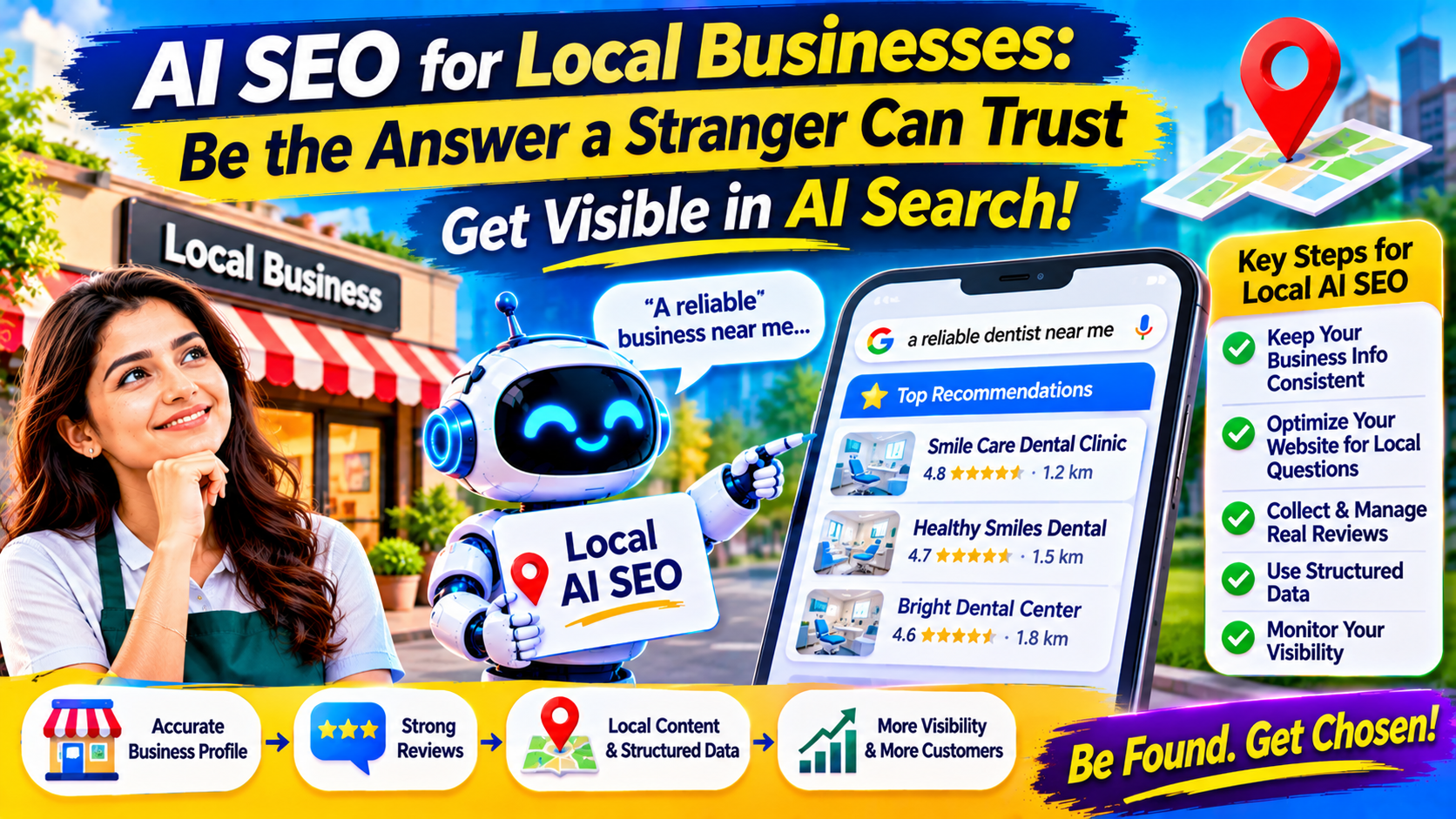
When someone asks an AI assistant for “a reliable dentist near me” or “the best wedding photographer in this city,” there’s no list of ten blue links to scroll. There’s a short answer, often naming a handful of businesses. Either you’re in it or you aren’t.
For local businesses, AI SEO is less about clever tactics and more about being easy to verify. Sarkar SEO’s view is that AI systems recommend businesses they can confirm, so the job is to make confirmation effortless.
The Shift Is Real, but Uneven
BrightLocal’s 2026 Local Consumer Review Survey found that 45% of consumers used generative AI tools for local recommendations in the past year, up from 6% the year before, according to several summaries. A follow-up cited by ClickGrow put ChatGPT at 31% of consumers and Google AI Mode at 23%.
But being used and being visible are different things. Local Falcon compared nearly 190,000 ChatGPT results with Google local results for restaurant queries in March 2026 and found 83% of restaurants invisible in ChatGPT, versus 14% in Google, as reported by Entrepreneur. SOCi’s 2026 Local Visibility Index, covering more than 350,000 locations, reportedly found ChatGPT recommends only about 1.2% of businesses when asked for a local option. That second figure reaches us through a secondary write-up, so treat it as directional.
Meanwhile, classic local search hasn’t disappeared. Whitespark’s research, summarized by Entrepreneur, indicates that local-service searches are still dominated by Google’s Local Pack and Maps results. The opportunity is that most competitors haven’t adapted to the AI layer.
A Disagreement Worth Knowing About
The sources conflict on what AI engines trust most.
One camp says Google Business Profile comes first. A Five Insites article cites research claiming Google’s AI consults profile data before website content. Another camp points to SOCi’s study, covered by Search Engine Land and relayed by a Searchless write-up, which argues that for non-Google assistants the business website outranked the profile as the source that decided whether a business appeared and how accurately it was described.
Both can be partly right. Google’s own AI features can draw on Google’s local data, while ChatGPT, Perplexity, and others rely mainly on the open web. The practical conclusion is the same: don’t bet on one source. Make every source agree.
The Consistency Test
Take a blank sheet and write ten facts about your business: legal name, address, phone, opening hours, service area, services offered, price range or starting prices, languages spoken, booking method, and one-sentence description. Then check each place those facts appear:
- Your website, including the contact page and footer
- Google Business Profile
- Bing Places and Apple’s business tools
- Major review platforms
- Industry directories and regional listings your customers actually use
- Social profiles
Mismatches matter more than gaps. A hotel listed with two different phone numbers or a clinic with outdated hours gives an AI system a reason to hedge or skip you. Fix the source you control first, then correct the others.
Google has also tightened its local enforcement, according to Insites, targeting keyword-stuffed business names, inflated service areas, and duplicate listings. Honest, accurate details are both the safest and the most effective approach.
Make Your Website Answer Local Questions Directly
Because AI engines read websites, a thin location page is a missed chance. For each location or service area, include:
- Specifics, not boilerplate. Neighborhoods served, typical travel time, parking, accessibility, and what a first visit looks like.
- Named people. Staff names, credentials, and experience, with real photos.
- Real prices or ranges where possible. Pages that avoid price entirely often lose to those that answer “how much?”
- Plain-language FAQs drawn from calls and messages you actually receive.
- Structured data such as local business markup that matches your visible content. Google says no special markup is needed specifically for AI features, so use it for general search clarity, not as an AI trick.
Reviews: Quantity Helps, Content Matters More
Whitespark’s 2026 Local Search Ranking Factors report, summarized by Whitehat SEO, shows reviews now account for about 20% of local pack factors, up four points from 2023. For AI answers, the text inside reviews appears to matter, since assistants summarize what customers say, not just the star count.
Two ideas to put into practice:
- Prompt specifics, ethically. Ask customers what they hired you for and what stood out. Don’t script, incentivize, or filter reviews, because Google restricts those practices.
- Respond to everything. ClickGrow’s summary of a January 2026 Search Atlas study of over 100,000 citations found reply rate was the strongest review signal in that sample. It’s a single vendor study, so it’s a reason to test, not a guarantee.
Also spread your reviews sensibly. Different assistants read different platforms, and Five Insites reports that businesses surfaced by AI averaged 133 Google reviews versus 11 for invisible ones. That’s correlation from a vendor’s analysis. A busy business may simply collect more reviews and more mentions.
A Simple Monthly Routine
- Run ten real customer questions in three or four assistants, including Google AI Mode. Record who is named and why.
- Compare the facts they state about you with your fact sheet.
- Fix any wrong detail at its source.
- Reply to new reviews and ask recent customers for honest feedback.
- Add one genuinely useful page or FAQ based on what you learned.
Keep notes dated. AI answers vary, so look for patterns across months, not a single result.
Know Your Limits
No one can guarantee a recommendation. Local AI search is still young, studies conflict, and results differ by country, language, and category. Businesses in markets with strong regional directories or messaging platforms should include those in their consistency check.
