



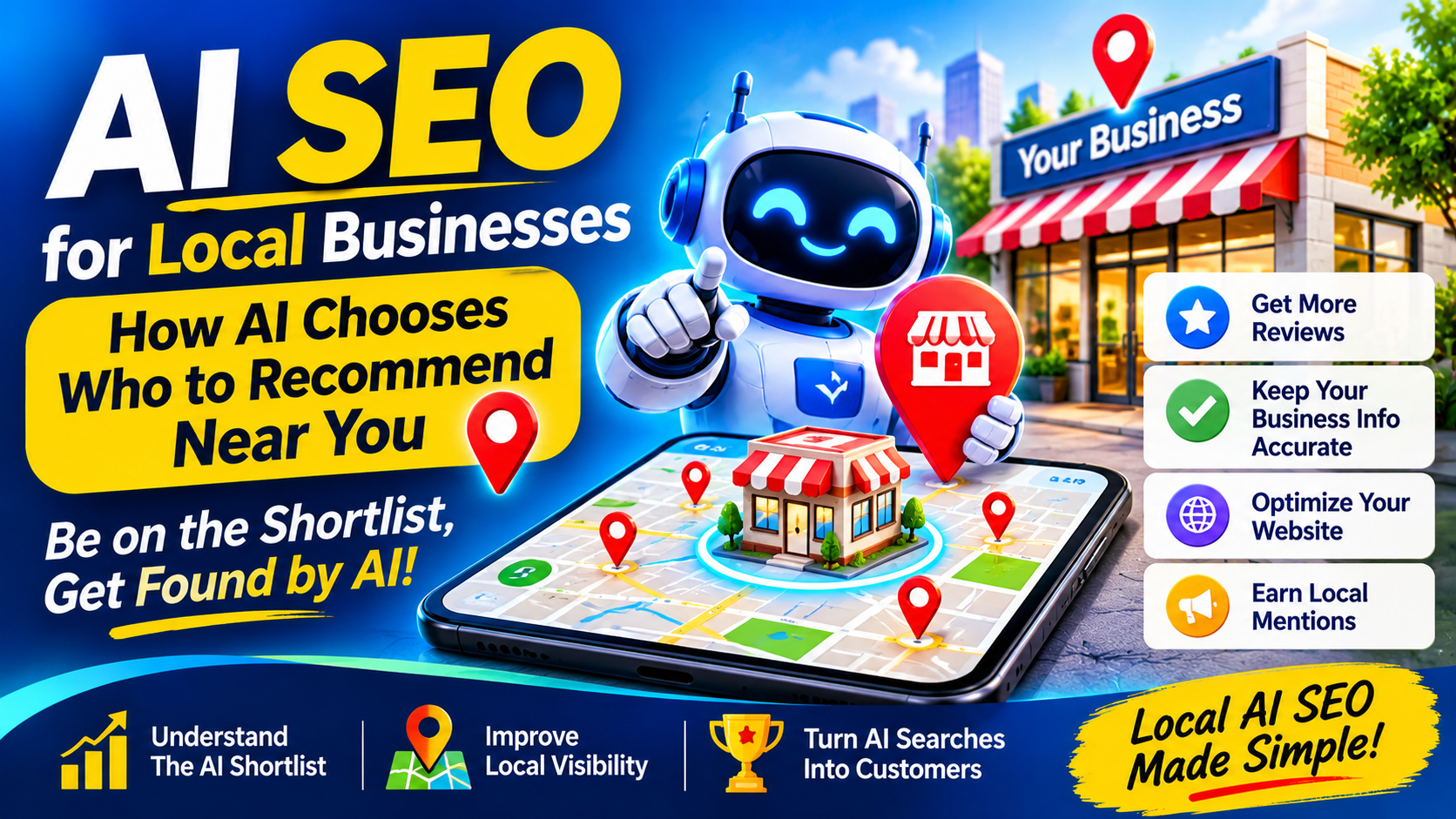
When someone asks an AI assistant for “a good dentist near me,” it does not show ten blue links. It names a few businesses, and everyone else disappears. For local companies, AI SEO is therefore less about ranking and more about being on the shortlist at all.
The short answer: AI assistants appear to treat ratings and consistent business data as a filter, then pull supporting detail from your own website and from third-party mentions. Winning a Google Maps position does not guarantee you are recommended.
The Shortlist Is Much Smaller Than the Map Pack
SOCi’s 2026 Local Visibility Index, reported by Search Engine Land, examined nearly 350,000 locations across 2,751 multi-location brands. Google’s local 3-pack surfaced 35.9% of locations. AI platforms were far stingier: Gemini recommended 11%, Perplexity 7.4% and ChatGPT 1.2%. SOCi estimates that AI visibility is three to thirty times harder to achieve than a good local ranking.
Two cautions apply. The sample is multi-location brands, so a single-shop business may see a different picture. And the report gives no publication date beyond its 2026 label.
Even so, the pattern is clear. Fewer than half of the top Google local brands also appeared among the most-recommended AI brands.
Reviews Act Like a Gate, Not a Tiebreaker
SOCi found that locations recommended by ChatGPT averaged 4.3 stars, versus 4.1 on Perplexity and 3.9 on Gemini. Its reading is that AI uses reviews as a filter, so middling businesses are often excluded entirely. Financial brands averaging about 3.4 stars, with review response rates below 5%, were effectively invisible.
That is correlation from one report, not proof of a rule. But it supports a practical priority: fix the reputation problem before polishing anything else. A well-written page cannot offset a weak public record.
Accuracy Is Where Small Gaps Cost You
SOCi measured business profile information as roughly 68% accurate on ChatGPT and Perplexity, but 100% accurate on Gemini, which draws on Google Maps. For you, this means a wrong phone number, outdated hours or a closed branch can persist in some assistants after you have fixed Google.
Sarkar SEO begins local audits with a simple test: ask each major assistant what your business is, where it is and when it opens, then compare the answers to the truth. Every mismatch becomes a repair task with a named source to correct.
Your Own Website Does More Work Than You Think
Steady Demand analyzed 14,472 citations from 1,487 Gemini local queries across 50 large US metro areas and 10 service categories (reported by MarTech on August 20, 2026). Nearly 60% of citations pointed to businesses’ own websites, more than directories, review platforms and forums combined. Reddit came second at 13.7%, ahead of the whole category of lead-generation directories such as Angi and Thumbtack.
An earlier BrightLocal study of 800 ChatGPT Search queries, collected in November 2024, found a similar tilt: 58% business websites, 27% business mentions and 15% directories. But Reddit and Quora did not appear at all then, while Steady Demand later saw ChatGPT leaning heavily on Reddit and directories. Sources shift quickly, so treat any one study as a snapshot.
The lesson is durable: your site is a primary source. Give it what an assistant needs to describe you correctly.
- A page for each core service, with who it is for, what it costs or how pricing works, and how long it takes.
- Real service-area detail, such as neighborhoods you actually serve, not a list of towns.
- Named staff, licenses or credentials you genuinely hold.
- Direct answers to the questions customers ask before calling.
Expect Inconsistency, and Test Accordingly
Steady Demand found that repeating a Gemini query reproduced overlapping cited sources only about 40% of the time, and Gemini named the same top business about 7% of the time. In a control test, Google’s local pack returned the same top listing about 90% of the time. ChatGPT and Gemini shared the same top business only 4.2% of the time.
The study’s co-founder called a single AI search a snapshot, not a reliable measure. So never judge your visibility from one query. Run each test several times, on different days, with different phrasings.
A Practical Local AI SEO Checklist
- Fix the facts. Make your name, address, phone, hours and categories identical on Google, Bing, Apple Maps, Facebook and major directories for your market.
- Raise the floor on reviews. Ask every satisfied customer, respond to every review, and address recurring complaints in the operation, not just in replies.
- Rewrite service pages around real customer questions and specifics.
- Earn mentions you can verify, such as local press, chamber of commerce listings, supplier pages and community sponsorships.
- Run the monthly test. Record each assistant’s answer to five “best near me” questions, then compare changes. Sarkar SEO advises saving each answer word for word, so any improvement is provable.
Skip schema markup shortcuts as a substitute for these steps. Nothing in the sources above shows that markup alone makes an assistant recommend you.
