



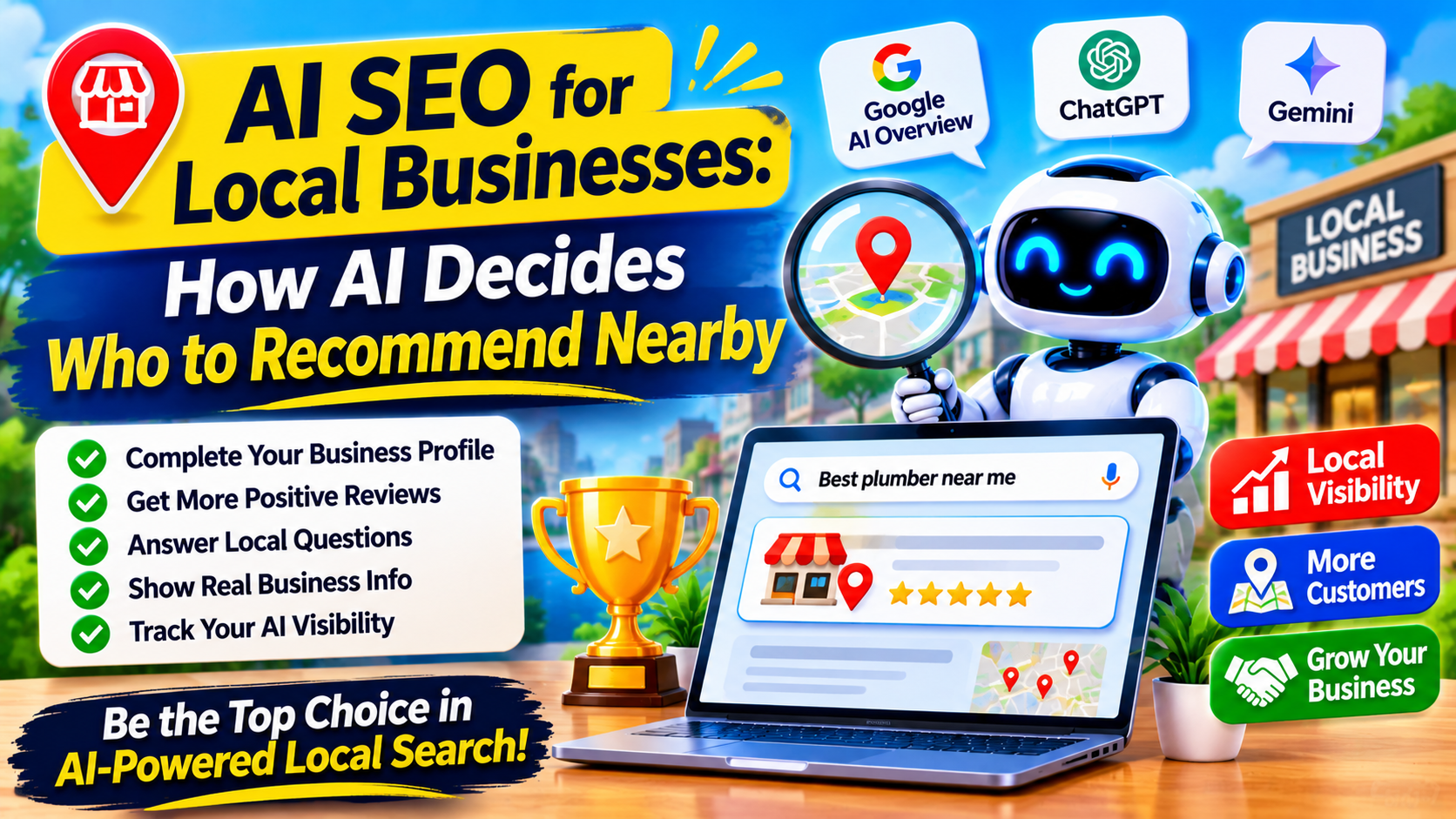
Ask an AI SEO assistant for a dentist, plumber, or restaurant and you often get a short list, sometimes just one or two names. Local competition has become a contest for those few slots. This guide explains what the evidence says about how AI picks nearby businesses, where it is uncertain, and what a small business can do first.
Adoption Is Real, but the Data Is US-Heavy
BrightLocal’s 2026 Local Consumer Review Survey found that 45% of consumers used AI tools for local business recommendations, up from 6% a year earlier. That made AI the third most common source, behind Google and Facebook. ChatGPT was the most used tool (31%), followed by Google’s AI Mode (23%).
Trust is growing. About 63% of active AI users said they trust the recommendations, yet 97% of people who use AI at least sometimes reported checking answers against real reviews. The survey covered 1,002 US adults, so treat the percentages as a US snapshot. Your market may differ.
AI Is Far Pickier Than Maps
Being listed locally does not mean being recommended. SOCi’s 2026 Local Visibility Index, covering roughly 350,000 locations of multi-location brands, found ChatGPT recommended about 1.2% of them, Gemini about 11%, and Google’s local pack about 36%. Single-location businesses may behave differently, since that study focused on larger brands.
BrightLocal’s own analysis of about 200,000 local searches across ChatGPT, AI Mode, and AI Overviews found that Google Maps mentioned a tracked business in 66% of searches, versus 32 to 38% on the AI surfaces. Across platforms, answers named only two to four businesses on average. Strong map visibility helps but does not transfer automatically.
The Business Profile Is the Fact Sheet
Google Business Profile was the single most important source in BrightLocal’s data, especially on AI Mode and AI Overviews. A separate BrightLocal analysis of 1,355 locations in the US, UK, and Australia put it at 28.5% of all AI citations for local businesses.
Google’s own May 2026 guide points to Business Profiles and Merchant Center as ways to help products and local business details appear in generative responses. One careful write-up notes what Google has not published: which Profile fields appear in AI Mode answers, how a set of businesses is chosen, or how reviews are weighted there. So advice claiming exact weightings is guesswork.
Sensible priorities are still clear. Fill in every relevant category, service, service area, opening hour, and photo, then keep them current.
Reviews Act as Filter and Evidence
SOCi found that locations ChatGPT recommended averaged 4.3 stars, only 0.1 above the 4.2 average for all locations in its study. In other words, ratings may act as a floor rather than a ranking boost. One local-business study of 1,851 businesses reported that those named by AI had a median of 444 Google reviews versus 192 for those skipped, and that all ranked in Google’s top 20 locally. That comes from a small vendor study, so read it as directional.
Consumer behavior points the same way. BrightLocal reports that 47% of consumers won’t use a business with fewer than 20 reviews, and 74% care mainly about reviews from the last three months. It also found that consistent sentiment across many reviews is the most important review factor.
That makes a steady review habit more valuable than occasional campaigns. Ask recent customers, make it easy, reply to feedback, and never fabricate or buy reviews. Besides violating platform rules, invented praise can contradict what customers say elsewhere.
The Engines Disagree
Don’t optimize for one assistant and assume the rest agree. Steady Demand reported that when Gemini and ChatGPT both named a business for the same local search, they picked the same one first only 4.9% of the time. SOCi measured ChatGPT’s profile information as 68.3% accurate for multi-location locations versus 100% for Gemini, which suggests ChatGPT may repeat outdated details more often.
Sarkar SEO’s view is that this variation is a reason to maintain one clean, accurate set of facts that every engine can find, rather than chasing platform quirks.
Write Pages That Answer Local Questions
Your website still matters. The BrightLocal study title itself stresses that your website matters, and Google’s guide frames local visibility as the combination of a well-optimized site and a complete Business Profile. Useful local pages typically:
- Give each core service its own page, with clear scope, process, and typical price ranges where you can state them.
- Name the towns or neighborhoods you actually serve, in plain text.
- Answer the questions customers ask before booking, such as timing, guarantees, and what to prepare.
- Show real work, with photos, outcomes, and named staff where appropriate.
Avoid creating dozens of near-identical “service in [town]” pages. Google’s guide says building separate content for every variation primarily to manipulate rankings or AI responses violates its scaled content abuse policy.
Measure Presence as a Rate
AI answers vary from run to run. BrightLocal found the list of recommended businesses changes when the same prompt is repeated, though businesses reappeared more than half the time. So a single check proves little.
A better method: pick five or six customer-style prompts (“emergency plumber open on Sunday near [area]”), run each several times on the assistants your customers use, and record how often you appear. Repeat monthly and compare. Note any wrong details, such as an old phone number, and trace them to their source.
A Sensible Order of Work
- Complete and verify your Business Profile.
- Fix any wrong details in the other places AI answers are reading, such as directories and social profiles.
- Build a steady, honest review routine.
- Upgrade your main service pages with local specifics and clear answers.
- Track appearance rate monthly.
Sarkar SEO suggests working in that order, because each step makes the next one more effective.
