



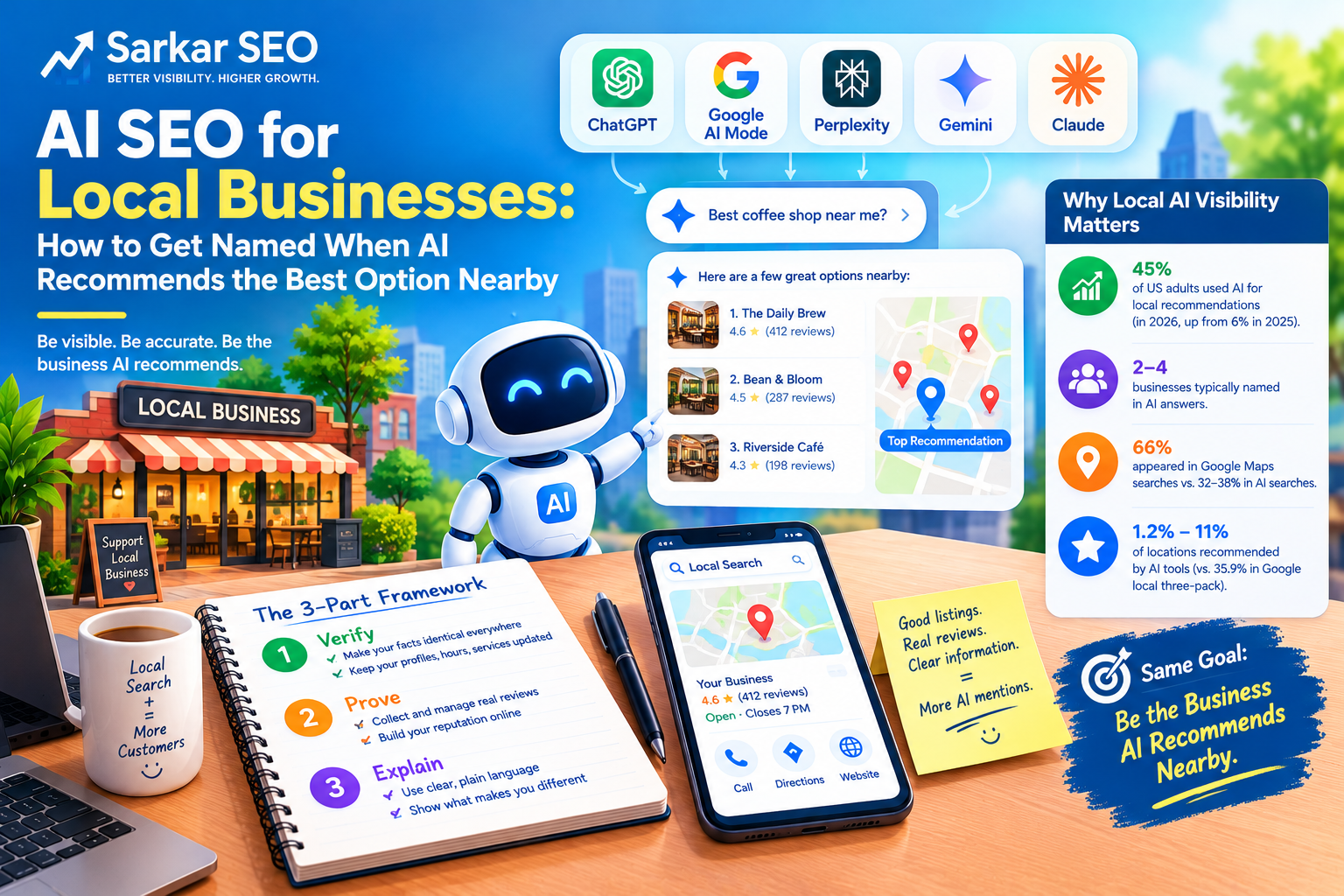
AI SEO for a local business means making sure AI assistants name you, and describe you accurately, when someone asks for the best provider in your area. The challenge is that AI SEO answers do not list ten links. They name a handful of businesses, and most never make the shortlist. This article focuses on a three-part approach: verify your facts, prove your reputation and explain your services.
Why Local AI Visibility Is a Smaller Game
Consumer habits are moving quickly. BrightLocal’s early 2026 survey of 1,002 US adults found 45% had used an AI tool for local recommendations in the past year, up from 6% the year before.
Yet the shortlists are short. BrightLocal’s analysis of 200,085 localized searches across ChatGPT, Google AI Mode and AI Overviews found these tools typically named two to four businesses per answer. A tracked business appeared in 66% of Google Maps searches but only 32% to 38% of AI searches. Repeating the same prompt changed the list, though businesses reappeared more than half the time.
Other studies point the same way. SOCi’s 2026 index, covering about 350,000 locations of multi-location brands, reported ChatGPT recommending 1.2% of them, Perplexity 7.4% and Gemini 11%, against 35.9% for Google’s local three-pack. These figures come through secondary summaries, so treat them as directional.
The picture is not limited to the US. An arXiv study in Bali asked ChatGPT, Claude, Gemini and Perplexity 96 customer-style questions about 4,776 cafes, restaurants and bars. About 85.6% were never recommended by any of the four tools, including 72.6% of well-known places with 50 or more ratings.
Estimates of how often AI Overviews appear on local queries vary widely, from 40.2% in one Local Falcon snapshot to 68% in a Whitespark study, to 6% to 9% on one agency’s Vancouver client queries. The lesson is to measure your own market rather than trust a global average.
The Verify, Prove, Explain Framework
This is our own working model, not a research finding. Sarkar SEO uses it to organize local AI work in the order that tends to matter most.
Verify: make your facts identical everywhere
SOCi found that business details in ChatGPT and Perplexity matched the Business Profile only about 68% of the time, while Gemini, grounded in Google Maps, reported full accuracy. Google’s own generative AI guidance points local businesses to Business Profile accuracy, among other inputs.
So audit your name, address, phone, hours, categories and services across your profile, your website and the main directories in your country. Local testing summarized by Search Engine Land suggests ChatGPT leans on Bing-indexed pages rather than Google reviews directly, so do not neglect Bing Places or regional directories.
Prove: let reviews work as evidence
In an August 2026 study of 1,851 local businesses, those named by AI had a median of 444 Google reviews against 192 for those skipped, and every named business already ranked in Google’s top 20 locally. SOCi found ChatGPT-recommended locations averaged 4.3 stars, against 4.2 across all locations.
These are correlations. Larger, busier businesses may simply attract both reviews and recommendations. The practical response is steady, recent, detailed reviews and prompt replies to all of them. Never buy or fabricate reviews, because platforms actively enforce against it.
Explain: say what you do in plain text
Reported BrightLocal data suggests business websites made up about 42% of citations in AI local answers, with the Business Profile at 28.5%. Your site matters as much as your profile.
Write service pages in plain language that name the services, areas covered, process and details only you know. Create separate pages for separate services or locations only when each is genuinely different, because templated near-duplicates add nothing. Use the language your customers use, and have a fluent speaker check it.
Ask AI About Yourself: A 20-Minute Audit
- Ask each major assistant about your business by name. Note anything wrong: hours, address, services, reviews.
- Ask five customer-style questions in your customers’ language, such as “best [service] in [area].” Record who is named and which sources appear.
- Repeat on a different day. Lists shift, so look for names that recur.
- Trace every error to its source, whether an old directory entry, an outdated page or a profile field, and fix it there. You cannot edit an AI answer directly, but you can correct what feeds it.
- Check Search Console for the generative AI reports mentioned earlier, and confirm what your property shows.
Sarkar SEO suggests repeating this quarterly and keeping dated notes, so that changes in recommendations can be tied to specific fixes.
What to Expect
Nobody can guarantee a recommendation. AI visibility appears to build on local fundamentals rather than replace them, and the 1,851-business study found no named business outside the local top 20. Strengthen the basics first, then use the audit to find gaps the old reports never showed.
If you want an experienced second pair of eyes on your listings, reviews and service pages, Sarkar SEO can run the audit with you and turn the findings into a prioritized fix list for your market.
