



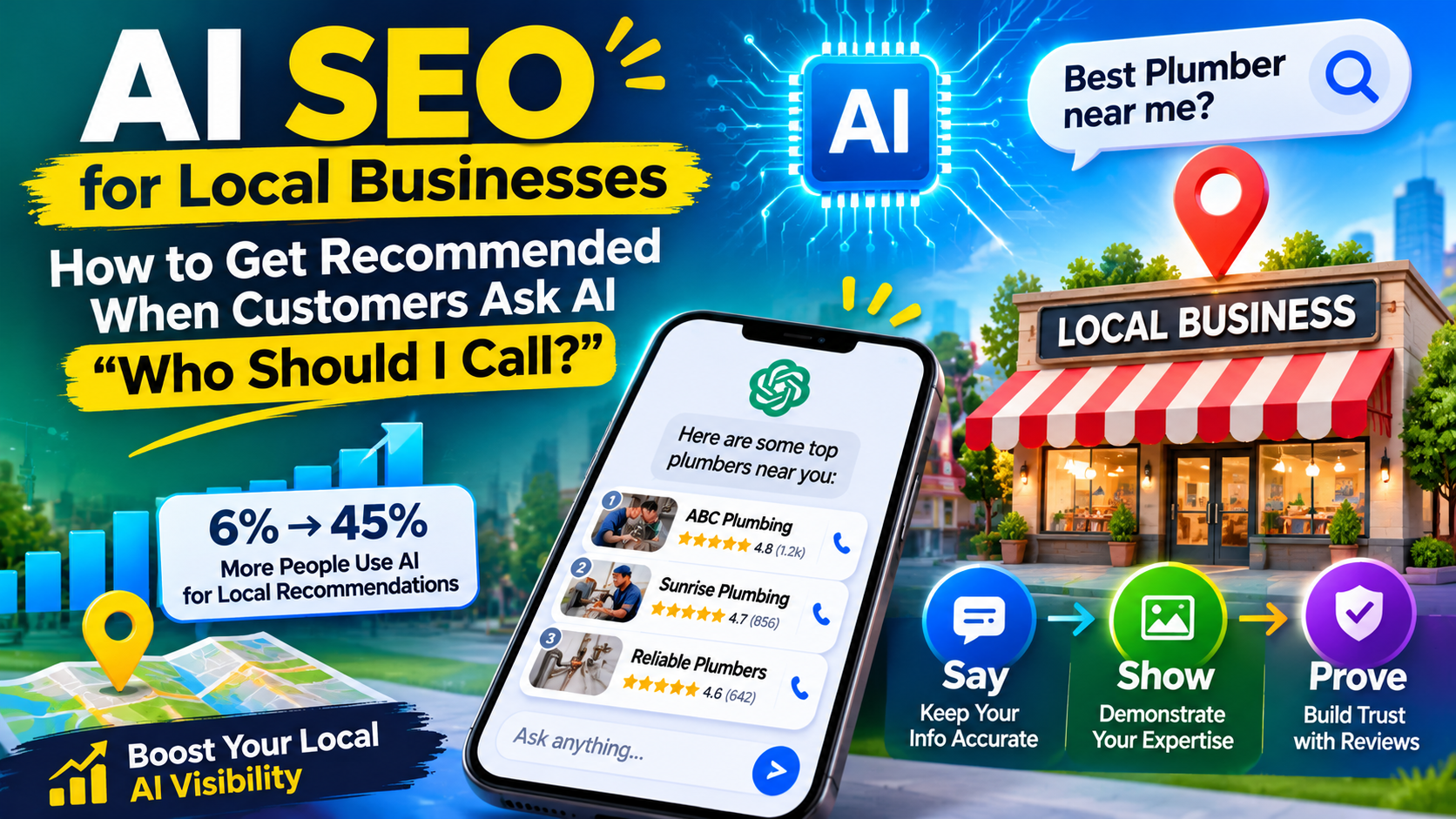
A customer asks an AI SEO assistant for a plumber, dentist or restaurant nearby. The answer names two or three businesses. Everyone else is invisible. Local AI search works differently from the map results most owners have optimised for, and the early data shows large gaps between Google visibility and AI recommendations. This article explains what is happening, what the research suggests, and how a local business can respond. Sarkar SEO sees local AI SEO as a data-quality problem first and a content problem second.
Why local search is shifting
BrightLocal’s 2026 Local Consumer Review Survey, based on 1,002 US adults, reported a sharp change. One summary of the results says use of ChatGPT and other generative AI tools for local recommendations jumped from 6% to 45%, while Google fell from 83% to 71%. It is a self-reported US survey, so treat it as directional for other markets. Still, the same coverage notes that most consumers who use AI for local search still cross-check a recommendation before contacting a business. AI is becoming a shortlist tool, not the final decision-maker. designrushdesignrush
Ranking on Google does not guarantee an AI mention
The gap is large. SOCi’s 2026 Local Visibility Index analysed over 350,000 locations. One report of it states that ChatGPT recommends just 1.2 percent of local businesses, Gemini 11 percent and Perplexity 7.4 percent, versus roughly 35.9 percent visibility in Google’s traditional local results. A separate summary says only 45% of brands that perform well in traditional local search also appear in AI recommendations.
Other studies give different figures. Local Falcon, analysing restaurant searches, reported that 86% of restaurants appear in at least one Google local result, but only 17% ever appear in ChatGPT recommendations. Notably, a page from the same vendor cites SOCi at 12.3% rather than 1.2%, so the headline figure is inconsistent between sources. Do not quote a single percentage. The reliable message is that AI recommends far fewer businesses than Google lists.
What seems to separate the businesses AI names
An analysis of 10,000 businesses across ChatGPT and Perplexity found that Google review volume showed the strongest correlation with AI visibility: businesses found by both engines averaged 133 reviews, versus 11 for invisible ones. That is a correlation from one vendor’s dataset. Larger or older businesses may simply have more of everything.
Other signals appear in the research:
- Profile completeness. One study reports that businesses with a fully filled-out Google Business Profile were 70% more likely to appear in AI recommendations than those with a bare-bones listing.
- Website depth. Whitespark’s 2026 factors, as summarised by one source, show on-page signals at 24% for AI visibility, ahead of Google Business Profile at 12%, compared with roughly 32% for the profile in the traditional map pack. Another source says the profile is consulted first. Studies disagree here, so work on both.
- Directory coverage. One analysis found a business with moderate presence across several sources can beat one with a strong profile and nothing elsewhere.
The cautious conclusion: no one factor wins. Consistent evidence across several places seems to matter.
The accuracy problem nobody talks about
Being named is not the same as being described correctly. In the 10,000-business benchmark, only 55.58% of ChatGPT results, and 48.05% for Perplexity, fully matched the business’s actual Google Business Profile details. That means wrong opening hours, outdated phone numbers or missing services can appear in AI answers. For a local business, a wrong phone number is a lost customer.
A practical framework: the Say, Show, Prove audit
This is my own organising method, not an industry standard.
Say: what you state about yourself. Check that your name, address, phone number, hours, services and service areas are identical on your website, Google Business Profile and every directory. Update old listings. Remove duplicates.
Show: what your content demonstrates. Create specific pages for each service and each location you serve, with real details: pricing ranges where possible, common questions, photos of your own work and named staff. Avoid copying the same text across locations with only the place name changed.
Prove: what others say about you. Reviews, local press mentions, industry association listings and customer stories supply independent evidence. Ask real customers for honest reviews and respond to them thoughtfully. Describe the specific service they received, since review text gives engines detail to work with.
Ask AI about yourself first
Before changing anything, test what customers might see. Ask several AI tools questions such as “best [service] in [your area]” and “tell me about [your business name].” Record which businesses are named, what is said about you and what is wrong. Repeat monthly. Results vary between runs and between users, so look for patterns, not single answers.
What to avoid
Do not buy reviews or run bulk incentive schemes. One source notes that Google has tightened its review policies, targeting bulk solicitation, incentivised reviews and coordinated campaigns. Fake signals risk removal and reputational damage. Avoid mass-producing near-identical town pages as well. They add little for readers and can trigger quality concerns.
Multi-location businesses
Each location needs its own accurate profile and page. A report on multi-location brands states that each location page carries its own AI visibility profile. A strong head office does not lift a weak branch. Assign someone to own local data, reviews and updates for every site. natlawreview
Keep expectations realistic
AI visibility is volatile, and local results depend on location and phrasing. The relationship between a complete profile and an AI recommendation is still developing, as one analysis admits, noting that a profile does not directly cause a recommendation. Good local SEO remains the foundation. Treat AI as an extra scoreboard, not a replacement.
