



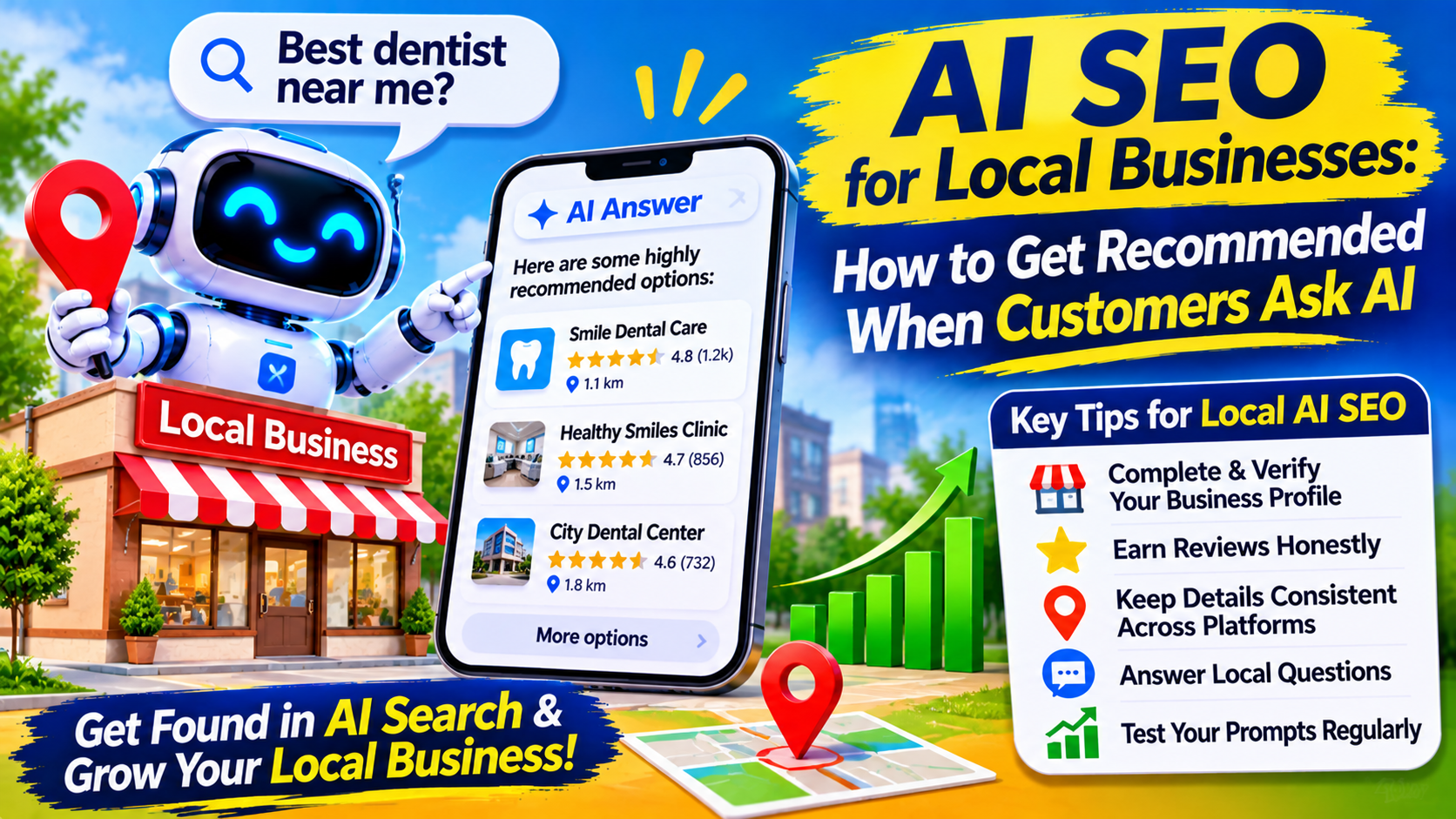
When someone asks an AI assistant for “a good dentist near me” or “the best wedding photographer in my city,” it does not return ten links. It names a few businesses, sometimes only one. For a local business, being named or left out can decide a month of enquiries.
This article looks at how AI SEO tools choose local businesses, why Google rankings do not guarantee a mention, and what to fix first, wherever your customers are.
Customers Are Already Asking AI
A BrightLocal survey of 1,002 US adults, as summarised by one agency, found that 45% had used an AI tool for local business recommendations in the past year, up from 6% in 2025. That is a single survey of one country, but the direction is hard to ignore. omnionlinestrategies
The competition for each recommendation is fierce, because AI names far fewer businesses than a map does. Figures from SOCi’s Local Visibility Index, reported by secondary sources, show ChatGPT recommended 1.2% of locations, Perplexity 7.4% and Gemini 11%, compared with 35.9% appearing in Google’s local 3-pack.
Ranking Well on Google Is Not Enough
It would be convenient if the local pack winners also won AI. The evidence says the overlap is partial. The same SOCi research found that in retail, fewer than half of the brands performing well in traditional local search also appeared in AI recommendations.
Still, strong local rankings help. A UK agency, Whito, compared its own October 2026 data and found businesses in the local top three were named by Google AI Mode in 54% of cases, against 8% for those ranked 11th to 20th. That is one agency’s dataset, so treat it as a pattern, not a rule. It suggests that good local SEO and AI visibility travel together, with exceptions.
Reviews Show the Strongest Signal
Insites analysed 10,000 US local businesses across ChatGPT and Perplexity. Of all the signals it examined, Google review volume showed the strongest correlation with AI visibility: businesses found by both tools averaged 133 reviews, while invisible ones averaged 11.
Correlation is not proof. Busy, well-run businesses naturally collect more reviews and also do more of everything else right. Reviews may be a marker of overall health, not a button you can press. One summary of the evidence puts the effect cautiously, saying reviews influence AI recommendations mostly indirectly.
The platforms also differ. One analysis notes that Gemini and Google AI Overviews lean on Google’s own index and your Google Business Profile, while Perplexity draws on vertical directories, reviews and Reddit threads, and it cites Search Engine Land testing indicating ChatGPT relies on Bing-indexed web results, not on your Google reviews directly. I read that through a secondary source, so verify it before building a plan around it. omnionlinestrategiesomnionlinestrategies
AI Often Gets Local Facts Wrong
Being mentioned is only half the problem. In the Insites benchmark, only 55.58% of ChatGPT results, and 48.05% for Perplexity, fully matched the business’s actual Google Business Profile details. An AI that names you with the wrong hours or address can send customers away disappointed.
This is why accurate, consistent information across the web matters as much as volume.
What Google Itself Says
Google’s guidance is blunt: there are no additional requirements to appear in AI Overviews or AI Mode, nor other special optimizations necessary. For local businesses, that means the proven basics are the strategy. You do not need a secret “AI package.”
A Local AI SEO Plan
- Complete and verify your Business Profile. One study of 31,495 prompts across ChatGPT, Gemini, Perplexity and Claude reported that businesses with a fully completed Google Business Profile, including categories, services, hours, photos and a description, were 70% more likely to appear in AI recommendations than those with a bare-bones listing. That is a vendor study, but the advice is sound regardless. Fill every field, choose accurate categories, and keep hours current, including holidays.
- Earn reviews honestly and steadily. Ask satisfied customers right after a job is done, make it easy, and respond to every review. Never buy reviews or offer rewards for them. Insites notes that Google has tightened its review policies, cracking down on bulk solicitation, incentivised reviews and coordinated campaigns. Specific reviews that mention the service, the neighborhood and the result give AI richer material than “great place.”
- Make your details identical everywhere. Match your name, address, phone number and opening hours across your website, maps, social profiles and industry directories. Check Bing Places too, since some assistants lean on Bing’s data. In markets where other platforms dominate local discovery, give the same care to whichever maps and directories your customers actually use.
- Build pages with real local substance. A genuine service page should describe what you do, who it suits, typical price ranges, how long it takes, and what your process looks like, with local examples and photos of your own work. Avoid cloning one page across fifty suburbs with the place name swapped.
- Answer the questions customers really ask. Add a clear FAQ based on calls and messages: cost, availability, emergencies, payment, warranties. Short, direct answers are easy for AI to lift.
- Test the prompts a customer would type. Ask several AI tools the way a real customer would, in the local language, and note who is named, what is said about them, and whether the details are right. Repeat monthly, since answers vary between runs.
What to Skip
- Paying for “AI listing” schemes with no clear mechanism.
- Chasing a single AI result. Answers change between runs.
- Neglecting ordinary local SEO because AI feels more exciting.
How Sarkar SEO Approaches Local AI Visibility
At Sarkar SEO, we begin local projects with a simple audit: how each major AI tool describes the business today, what it gets wrong, and which sources it relies on. Sarkar SEO usually finds that the fixes are practical, such as an incomplete profile, inconsistent listings or too few specific reviews.
We resist selling local clients a separate “AI service” when the basics are not yet done. Sarkar SEO fixes the foundations first, then tests whether the engines respond, because what works depends on your category, your competitors and your country.
