



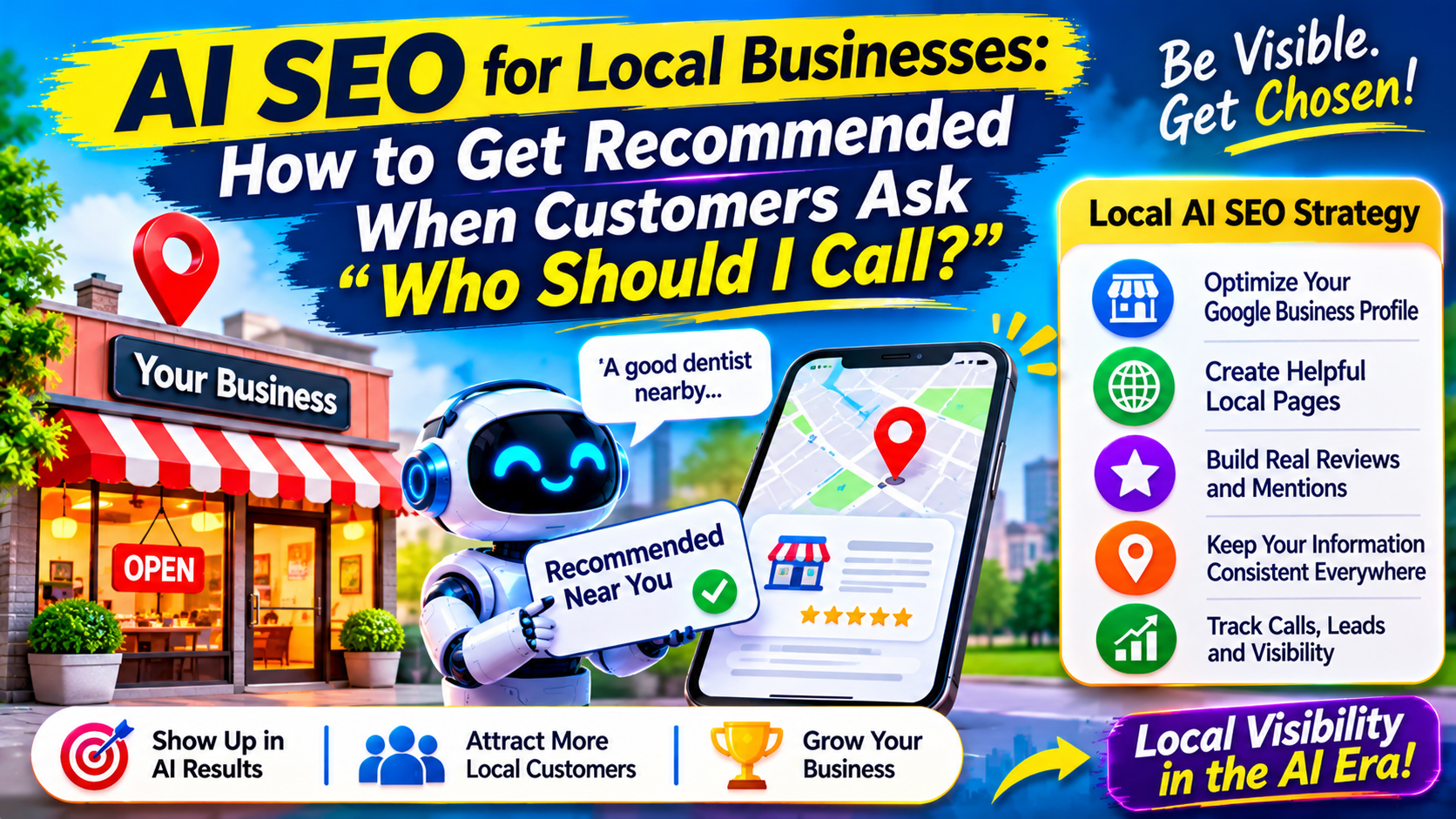
When someone asks an AI assistant for “a good dentist nearby” or “an emergency plumber open now,” the answer is usually a short list of names, not ten links. For a local business, being on that list matters more than ranking for a keyword.
Most AI SEO advice is written for publishers and software companies. Local businesses face a different situation. Their visibility depends less on blog posts and more on the data and reputation that surround the business. This guide covers what that means in practice, in any country.
Local Search Hasn’t Been Replaced
Start with a reality check. Whitespark’s research, reported by Entrepreneur, found that AI Overviews appeared on just 15% of traditional local-intent queries, while Local Packs appeared on 93%. In other words, when people search for a nearby business, the map-based results still dominate. Entrepreneur
Not every analysis agrees. Some industry write-ups claim AI Overviews appear on up to 68% of local search queries. The gap likely reflects how each study defines a “local query,” since questions like “what should I check before hiring a roofer” are very different from “roofer near me.” Treat all such figures as directional and test your own market rather than trusting a single number.
The takeaway is practical: don’t abandon classic local optimization to chase AI. It remains the foundation.
What Local Rankings Are Built On
Google’s documentation names relevance, distance and prominence as the primary local ranking factors, and Whitespark’s 2026 survey indicates proximity remains a major signal. You can’t move your business closer to the searcher, so the other two factors are where effort pays off.
Relevance means your profile and website clearly state what you do. Prominence means the wider world confirms it, through reviews, mentions and links.
The same report notes AI-generated local recommendations often drew on public information from Google Maps, reviews, ratings and Business Profiles, though it cautions that this doesn’t mean a profile directly causes an AI recommendation, because the relationship is still developing. That honesty is worth keeping in mind. Nobody outside the platforms knows the exact recipe. EntrepreneurEntrepreneur
The Three-Layer Local Visibility Model
A useful way to think about this is in layers. This is a planning model, not a published standard.
Layer 1: Your verified profile. Your Business Profile on Google, plus equivalents such as Apple Business Connect or Bing Places, is the most structured record of who you are. Choose accurate categories, list real services, keep hours current, and add genuine photos. Avoid stuffing keywords into the business name or listing areas you can’t realistically serve. Those shortcuts risk suspension.
Layer 2: Your website. One analysis describes AI pulling from the profile, site, reviews, photos and third-party sites together: the website provides context and authority, the profile supplies structured signals, and reviews deliver trust and relevance. Your site’s job is depth. Create a distinct page for each core service and each area you truly serve, with real details, such as typical timelines, pricing approach, and answers to questions customers ask on the phone.
Layer 3: Your reputation footprint. Reviews, directory listings, local press, sponsorships and community mentions form the outside evidence that you exist and are trusted.
Weakness in any layer limits the others.
Reviews Deserve Real Attention
BrightLocal’s 2026 survey, cited by Entrepreneur, found that 97% of consumers read online reviews for local businesses, and 71% use Google for those reviews. Whatever AI systems do with this data, people clearly rely on it. Entrepreneur
Good review practice is simple but easy to neglect:
- Ask consistently. Request reviews right after a successful job, through a short direct link.
- Reply to everyone. Thank positive reviewers specifically. Respond to negative ones calmly with facts and an offer to resolve.
- Never buy or fake reviews. It violates platform rules and can destroy trust overnight.
- Read your reviews as content. Customers often describe your strengths in their own words. Those phrases reveal what you should emphasize on your site.
Sarkar SEO encourages local clients to treat reviews as customer research first and a ranking signal second, because the insight is useful even when rankings don’t move.
Consistency Across the Web
AI systems and map platforms cross-check information. If your name is written three ways, your phone number differs between directories, or an old address lingers on a forgotten listing, you create doubt.
Run a simple consistency audit:
- Write down your official business name, address, phone number, website and hours.
- Search for your business on major platforms and directories.
- Correct every mismatch, and remove or merge duplicates.
- Repeat every quarter, and whenever anything changes.
It’s tedious work, yet few competitors do it thoroughly.
Write Pages That Answer Real Customer Questions
Local customers rarely ask abstract questions. They ask practical ones: how much, how long, are you licensed, do you serve my area, what happens if something goes wrong.
Create service pages that answer these plainly. Include your credentials, your process, what affects the price, and honest limits, such as what you don’t do. Add local specifics only when they’re real, like regional regulations, climate-related issues or neighborhood details. Copying the same page across ten towns with different place names is precisely the thin approach to avoid.
Measure What Matters Locally
Rankings on a map shift by the block, so a single position check is misleading. Track:
- Calls, direction requests and website clicks from your profile
- Review count, average rating and review recency
- Leads by source, asking new customers “How did you find us?”
- Branded searches for your business name
- Manual checks of AI assistants with the questions customers ask, recorded monthly
Remember that people increasingly decide before they click. A call from a profile may never show up as a website visit.
