



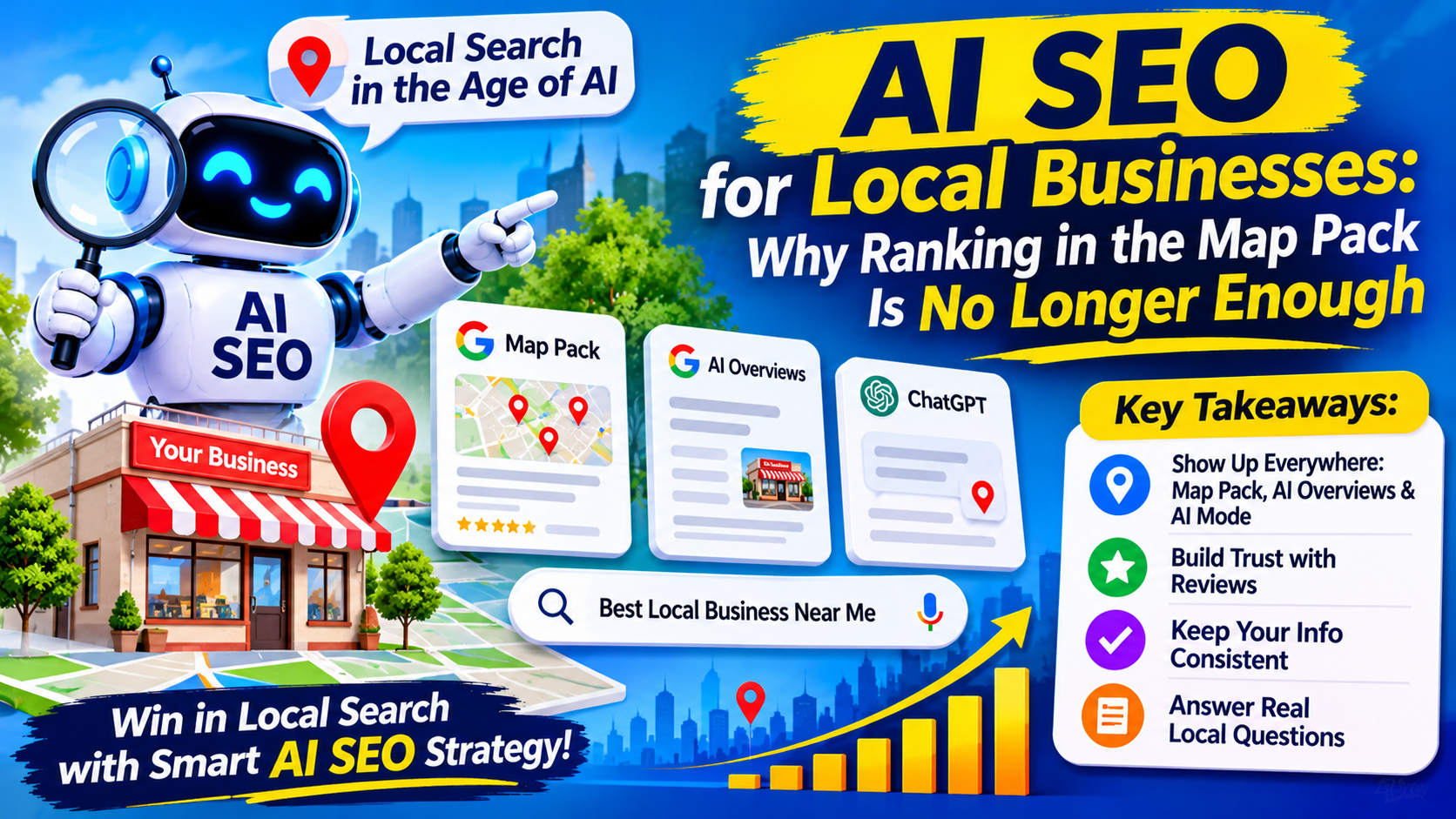
For years, local visibility had a clear scoreboard: the three-business map pack. Rank in it and the phone rings. That scoreboard is now only one of several, and the others don’t always agree.
This guide explains how AI SEO search treats local businesses, what recent data says about who gets recommended, and how to check your own position.
Visibility Has Split Into Several Surfaces
One local SEO firm describes the shift this way: visibility has splintered into the traditional local pack, the organic results below it, AI Overviews, and increasingly AI Mode conversational results that cite specific businesses by name. A business can do well on one surface and be missing from another.
The numbers on how often AI shows up for local queries are inconsistent, and you should be skeptical of any single figure. Depending on the source, AI Overviews appear on only about 8% of local searches, 47% of local queries, or up to 68%. Methods, keywords, and dates differ. The sensible conclusion is that prevalence varies by industry and query, so measure your own keywords. ThinkProfits logo +2
The Most Useful Finding: AI Mode and the Map Pack Disagree
A June 2026 study from Local SEO Data compared the two systems directly. It found that Google’s AI Mode and the traditional Local Pack are two separate systems that show different businesses for the same local search.
The details are worth noting:
- For the same search, 28.5% of Local Pack businesses were missing from AI Mode.
- Comparing only the top three results from each source, overlap dropped to 48%.
- In consumer categories, businesses that appeared only in AI Mode had 49% more reviews at the median, and among plumbers the gap reached 337%.
- The pattern changed for expert services: for lawyers and medical specialists, businesses in AI Mode had fewer reviews, and AI Mode more often skipped listings in favor of educational content.
Keep one caveat in mind: the study’s author sells local SEO data tools, and the results describe correlation. Still, the lesson is practical. Ranking in the pack does not guarantee a mention in AI Mode.
Reviews Matter, But for Different Reasons
Reviews act as proof of trust in AI answers. One vendor analysis reported that businesses surfaced by AI averaged 133 Google reviews versus 11 for invisible ones. That is a vendor figure and not an independent benchmark, and review counts also reflect how long a business has operated and how large it is.
Reviews also do their traditional job. According to BrightLocal’s 2026 survey, 97% of consumers read online reviews for local businesses, and 71% use Google for those reviews. Reviews therefore help twice: they may influence whether AI mentions you, and they influence whether a person chooses you once they see you. Entrepreneur
Google has been tightening enforcement here. One report says it has tightened Business Profile review policies, cracking down on bulk solicitation, incentivized reviews, and coordinated campaigns. Ask real customers for honest feedback, and never buy it.
What AI Appears to Draw On
Evidence on exact inputs is still thin, and anyone claiming certainty is overreaching. One careful analysis notes that AI-generated local recommendations often drew on public information from Google Maps, reviews, ratings, and Business Profiles, though that doesn’t mean a profile directly causes a recommendation, since the relationship is still developing.
A reasonable working model is that AI systems assemble a picture from several places. Another source describes AI pulling from the Google Business Profile, the website, reviews, photos, and third-party sites at once, with the website providing context and authority, the profile supplying structured signals, and reviews delivering trust and relevance.
The Sarkar SEO Three-Surface Check
We use a simple routine at Sarkar SEO to see where a local business stands. You can run it in about an hour.
- Pick five customer questions, such as “best emergency plumber in [your area]” or “who fixes [problem] near me.”
- Test each on three surfaces: the Google map pack, Google AI Mode, and one chat assistant such as ChatGPT or Perplexity.
- Record who appears, in what order, and which sources are cited.
- Compare yourself to the businesses that appear everywhere. Note differences in review count, review wording, category choice, photos, and service pages.
- Repeat monthly. One research team advises tracking AI Mode visibility regularly rather than relying on a single check.
Results can shift between runs, so treat each test as a sample and not a verdict.
Practical Fixes, In Priority Order
Clean up your profile first. Pick accurate primary and secondary categories, complete every field, add current photos, list services, and keep hours correct. Many local SEO specialists still treat the profile as the single most valuable local asset.
Make details consistent everywhere. Name, address, phone, and hours should match across your site, directories, and maps. Inconsistency makes it harder for any system to trust you.
Build pages that answer real questions. A service page should explain what you do, where, for whom, and at what typical price or timeframe, using details that only a real local business would know. Avoid templated pages for each suburb. Reports on Google’s enforcement describe a push away from keyword-stuffed business names, inflated service areas, and duplicate listings.
Earn review text, not just stars. Reviews that mention the service, the problem, and the neighborhood give AI more to work with. You can encourage detail by asking customers what job you did for them.
Add educational content for expert services. The study above suggests AI Mode often prefers explanatory content over listings for professions like law and medicine. Guides, FAQs, and plain-language explanations may earn visibility there.
What to Avoid
- Don’t abandon the map pack. It still carries high local intent, and the data shows the surfaces differ.
- Don’t fake locations or reviews. The penalties are real and growing.
- Don’t assume schema markup fixes everything. Structured data helps machines read your details, but one claim that AI models “rely” on it comes from a podcast summary and is not established fact.
- Don’t trust one-off screenshots. AI answers vary by prompt, location, and day.
