



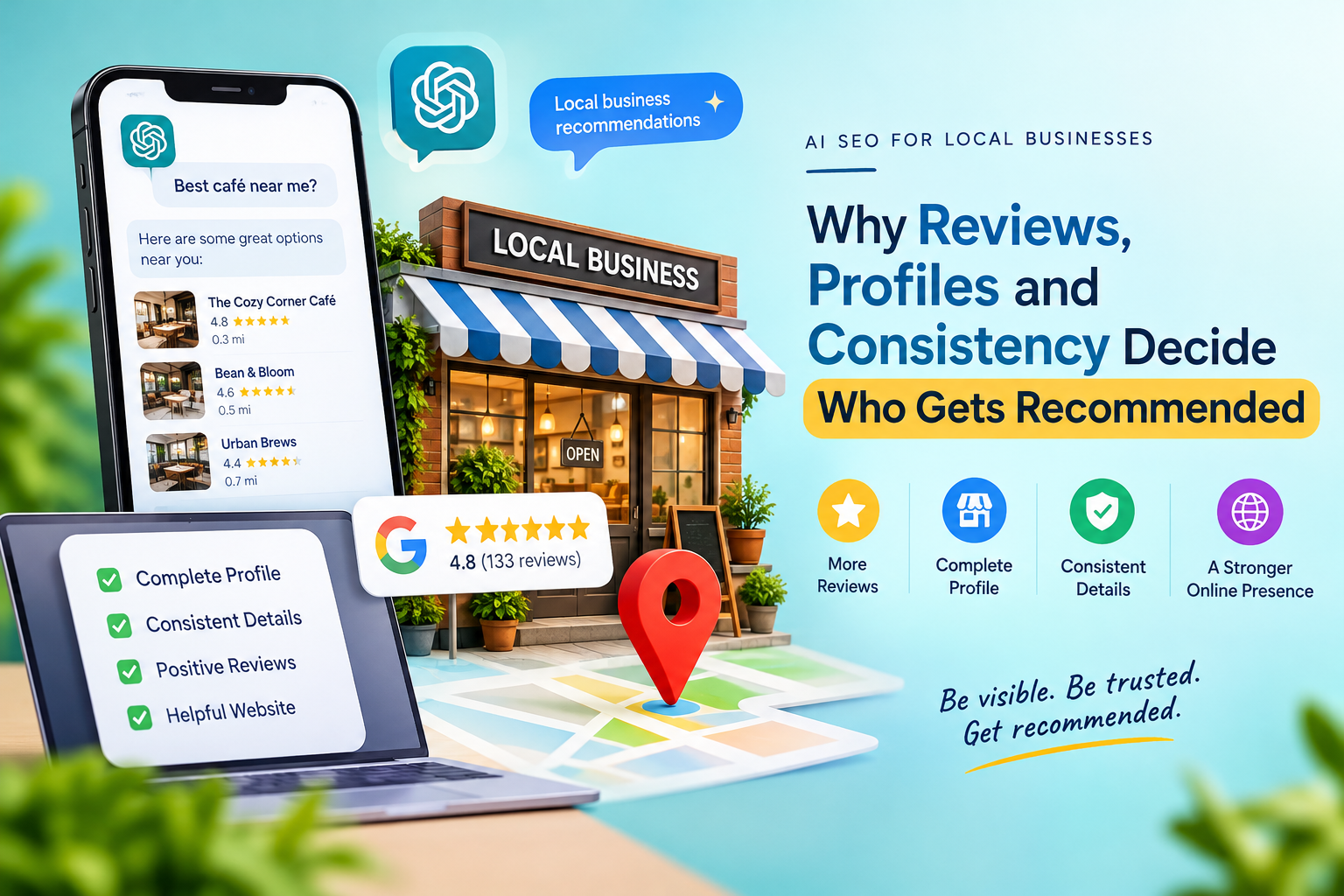
When someone asks an AI assistant for a good dentist, plumber or café nearby, it names a handful of businesses and ignores the rest. For a local business, that shortlist is the new first page. Sarkar SEO sees many small firms preparing for AI SEO search by chasing advanced tactics while skipping the basics that the data says matter most. This article covers those basics.
Why Local Businesses Cannot Ignore This
Customer habits are moving quickly. BrightLocal’s 2026 survey, as reported by others, found that 45% of consumers now use AI tools for local business recommendations, up from 6% a year earlier. In that survey, ChatGPT is used by 31% of consumers for this purpose, with Google’s AI Mode at 23%. These are consumer-survey figures, with the US as the main focus, so your market may differ. emulentemulent
Meanwhile, visibility is thin. SOCi’s study of more than 350,000 locations reportedly found that ChatGPT recommends just 1.2% of them. Demand is arriving faster than most businesses are prepared for.
Good Local SEO Does Not Guarantee AI Visibility
You might assume strong local rankings carry over. The evidence says not automatically. One summary of the SOCi study notes that in retail, fewer than half the brands performing well in traditional local search also appeared in AI recommendations.
So treat AI visibility as a separate result to check, not a free by-product of ranking well.
What Appears to Separate Recommended Businesses from Ignored Ones
The most detailed public dataset is Insites’ study of 10,000 US businesses across ChatGPT and Perplexity. Remember that Insites sells AI visibility tools, and the study measures correlation, not cause. With that in mind, the gaps are large:
- Reviews: businesses AI recommended averaged 133 Google reviews, against about 11 for those it ignored.
- Profile completeness: 77.8% of recommended businesses had a fully complete Google Business Profile, versus 31.5% of ignored ones.
- Local Pack presence: businesses appearing there were recommended 3.5 times more often than those that were not.
- Your own website: it was the most frequently cited source across the entire study.
The report also claims that technical SEO showed no meaningful relationship with AI recommendations. That fits a wider pattern in this series: the checks they ran were basic ones, so I would read it as “technical tidiness alone will not win recommendations”, not “ignore technical SEO”.
The Profile Comes First
For local queries, one source after another points to the Google Business Profile as the anchor. One local marketing firm notes that the majority of the most important local ranking factors come directly from the profile, and that data feeds AI summaries across every major platform. Complete every field you can:
- Choose the most accurate primary category, then add secondary ones that genuinely apply.
- List services with short, plain descriptions.
- Add current opening hours, including holidays.
- Upload real, recent photos of your premises, team and work.
- Keep your business name honest. Google’s enforcement is reportedly pushing small businesses away from keyword-stuffed names, inflated service areas and duplicate listings.
Consistency Is a Hidden Filter
Inconsistent details give AI systems reasons to doubt you. SOCi reportedly found that only 68% of business contact information surfaced by ChatGPT and Perplexity matches the details on the corresponding Google Business Profile. A wrong phone number or old address is more than an annoyance, because it may lead to you being skipped or sending customers elsewhere.
Here is a simple three-point consistency check we suggest. It is our own working method, not a standard. Compare your name, address and phone number across your website, your Google profile and your three most important third-party listings. Then compare your opening hours and service list across the same places. Finally, search your business name and check what the first page claims about you. Fix any mismatch at the source.
Reviews: Earn Them Properly
Review volume was the strongest signal in the Insites data, which makes honest, steady review collection a priority. Ask satisfied customers after a job is done, make the process easy with a direct link, and reply to every review, including critical ones, politely and specifically.
Do not cut corners. One roundup reports that Google has tightened its review policies, cracking down on bulk solicitation, incentivised reviews and coordinated campaigns. Buying reviews or offering rewards risks penalties and damages trust.
Where reviews live also matters by platform. One source reports that ChatGPT search draws on Bing’s index and, since July 2026, on licensed Yelp reviews, ratings and photos. Yelp is not equally strong everywhere, so find out which review platforms matter in your country. eclincher
Make Your Website Answer Local Questions
Since your website is a leading cited source, give it real local substance:
- A page for each core service, written in plain language, with who it is for and what it costs or how pricing works.
- Clear details of the areas you serve, without listing dozens of towns on thin duplicate pages. Earlier in this series we covered why mass-produced pages carry risk.
- Real examples: a recent job, a customer problem and how you solved it, with permission.
- Straight answers to the questions customers ask on the phone, such as timelines, guarantees and what to prepare.
This is where small businesses can beat bigger competitors, because genuine local knowledge is hard to copy.
Adapt for Your Country
Most of the studies above are US-based. If you operate elsewhere, check which map, review and directory platforms customers use, and which AI tools are popular. In some countries, other platforms matter more than Google’s tools. The principles of a complete profile, consistent details, genuine reviews and a useful website still apply.
Check Your Position Monthly
Open the main AI tools in separate sessions and ask the questions your customers ask, such as “best [service] in [your area]”. Note whether you appear and what is said. Do this monthly and keep a record, because answers vary between sessions.
