



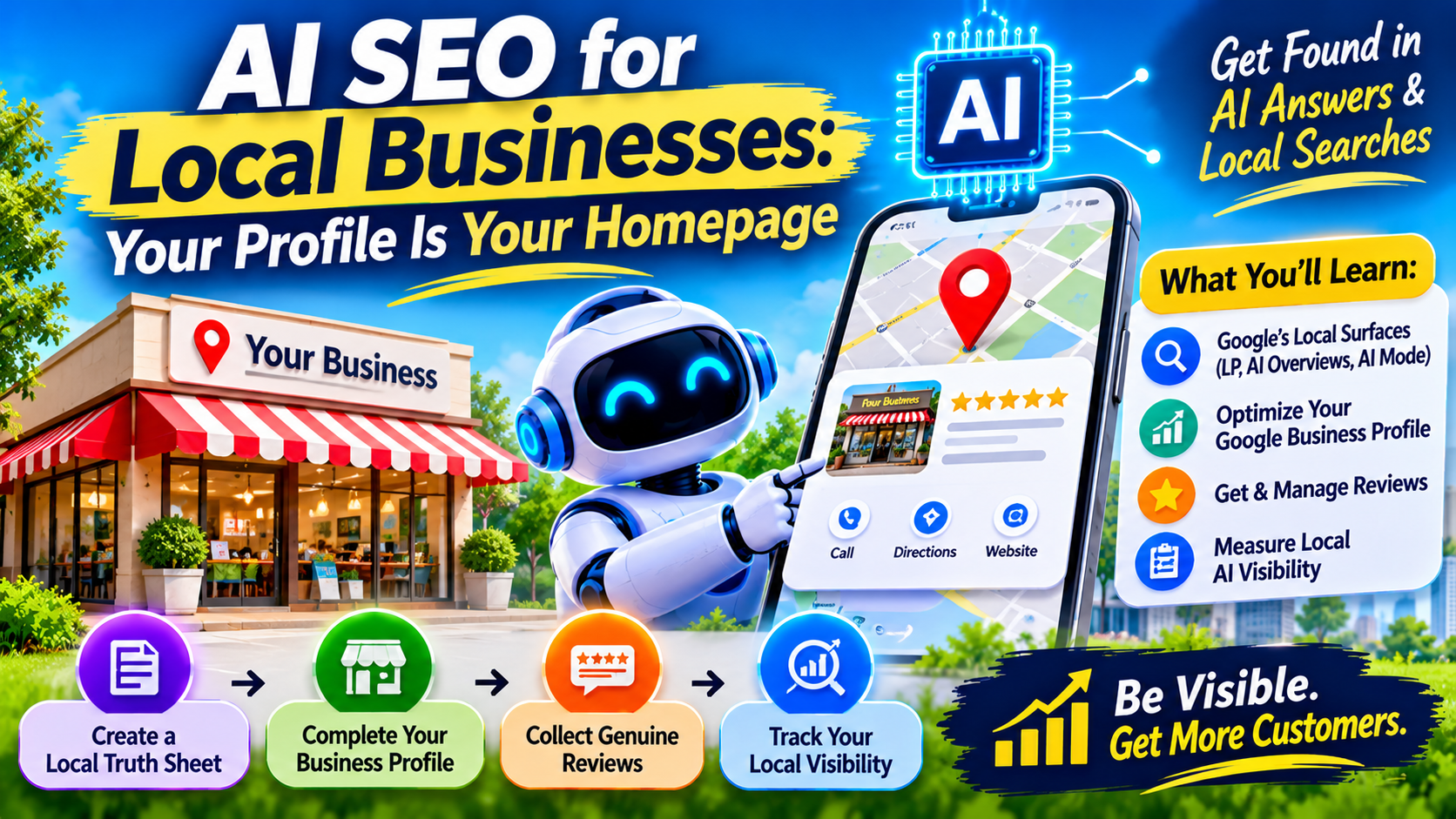
If you run a clinic, restaurant, law practice or repair shop, you may have noticed that people increasingly meet your business before they ever see your website. An AI answer names a few options, shows ratings and hours, and the customer picks one. For local businesses, AI SEO is mostly about making sure those summaries are built from accurate, convincing information about you. Here is what recent research suggests, and where the evidence is weaker than the headlines.
Google’s Surfaces Don’t Treat You the Same
Local visibility now spans at least three places: the traditional Local Pack, AI Overviews and AI Mode. They don’t behave alike. A June 2026 study by Local SEO Data, published through a press release, found that AI Mode and the Local Pack are two separate systems that show different businesses for the same local search, and that AI Mode results shift from day to day. The study covered 1,120 query executions across seven business types in 13 U.S. cities. Its headline figure was that 28.5% of Local Pack businesses did not appear in AI Mode. Note that the authors sell local SEO data tools, and the sample is limited to the United States over three days, so treat it as a signal rather than a rule. prweb
A separate analysis, reported as the Steady Demand local citations study, found the surfaces cite local businesses in almost opposite ways. On local-intent queries, AI Overviews sent 73.5% of citations to the business’s own website, while AI Mode sent 79.8% to Google Maps and Business Profile URLs. I only saw a secondary write-up of this study, so verify it before quoting it elsewhere. The practical reading is still sensible: your website and your Business Profile may both be read, depending on the surface.
Be Careful With the Prevalence Numbers
Estimates of how often AI Overviews appear on local searches vary wildly. One agency report puts it at up to 68%. Another audit says AI Overviews trigger on 21% of local commercial queries in the U.S. A podcast summary claims 47%. These differences likely reflect different query sets, dates and definitions of “local.” Rather than trusting any one figure, check your own market by searching the questions your customers ask and observing what appears.
What Appears to Matter Most
Entrepreneur’s summary of Whitespark research gives a balanced view. When someone needs a business, the Local 3-Pack is still shown, and so do AI Overviews when they appear; that result is built from Google Business Profile data. The article adds an honest caveat: AI recommendations often drew on public information from Maps, reviews, ratings and profiles, but that doesn’t mean a profile directly causes an AI recommendation; the relationship is still developing. EntrepreneurEntrepreneur
The sensible conclusion is that accurate profile data, strong service pages, genuine reviews and consistent third-party listings help wherever customers find you. You don’t have to choose between local SEO and AI optimization, because they overlap heavily.
The Local Truth Sheet
Here is a method I’d suggest, which is my own framework rather than an industry standard. Before touching any listing, write a single document that holds the facts about your business. Every profile, page and directory then draws from it.
Include:
- Exact business name, address and phone number, formatted one way.
- Opening hours, including holiday exceptions.
- Primary and secondary categories that honestly describe what you do.
- Services, each with a one-sentence description and, where sensible, a starting price or range.
- Service areas you actually cover, not wishful ones.
- Five to ten real customer questions with short, accurate answers.
- Proof points: licenses, certifications, years in operation, named staff.
Sarkar SEO treats this sheet as the starting point for any local project, because conflicting details are one of the quickest ways to confuse both customers and machines. When something changes, update the sheet first, then push the change everywhere.
Making the Profile Work Harder
With the sheet ready, fill out your Google Business Profile completely: categories, services, hours, photos, description and attributes. Add current photos of your premises, team and work. Post updates when something genuinely changes, such as a new service or seasonal hours.
Then check the other places where your details live, including Apple Maps, Bing Places, industry directories and any review platforms your customers use. A podcast summary suggests ChatGPT draws on Google Business Profiles, Bing Places and review aggregates, but I could not verify that against a primary source, so treat it as plausible rather than proven. Consistency is the safe approach regardless.
Reviews: Earn Them, Don’t Engineer Them
Reviews influence both rankings and customer trust, but the rules are tightening. One local SEO firm reports that Google has tightened its Business Profile review policies, cracking down on bulk solicitation, incentivised reviews and coordinated campaigns. Ask satisfied customers for honest feedback at a natural moment, make it easy, and reply to every review, including the critical ones. Specific replies show future customers how you handle problems. Never buy, trade or pressure for reviews.
Your Website Still Has a Job
Even where AI Mode leans on profiles, the website supplies depth. Give each core service its own page with original detail: process, typical timelines, photos of real jobs, local examples and honest limits. Avoid cloning near-identical pages for every suburb. As the earlier guidance on scaled content makes clear, pages that exist only to catch location variations are a risk. Create a location page only when you genuinely serve and understand that place.
Measuring Local AI Visibility
Run a monthly check. Choose ten searches a real customer might type, such as “emergency plumber near me” or “family dentist accepting new patients.” Search each in the Local Pack, AI Overviews and AI Mode, and note whether you appear, how you’re described, and whether the details are right. Record calls, direction requests and booked enquiries, since many local searches end without a website visit. Sarkar SEO suggests adding a “How did you find us?” question to your booking process, because it reveals paths that analytics can’t.
A Four-Week Plan
Week one: Write the Local Truth Sheet and audit every listing against it.
Week two: Complete and correct your Business Profile and major directories.
Week three: Improve your top three service pages with real photos, answers and proof.
Week four: Start a steady, ethical review routine and run your first ten-search check.
