



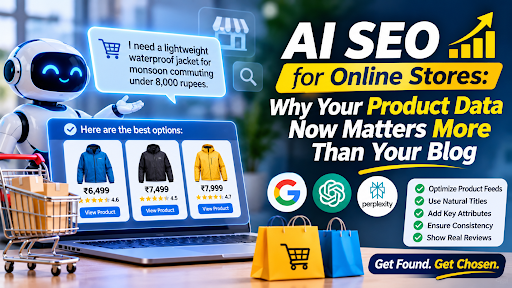
A shopper types, “I need a lightweight waterproof jacket for monsoon commuting under 8,000 rupees.” An assistant replies with a handful of products, prices and reasons. The shopper may never see your category page, your homepage or the blog post you spent a month writing.
For online stores, AI SEO is increasingly a data problem. The question is less “does my content rank?” and more “can a machine read my product facts, trust them, and match them to what this buyer asked for?” This guide covers what the research says and how to prepare, without chasing every new protocol.
Discovery Moved to the Assistant, Checkout Stayed With You
Last year’s big promise was buying inside the chat. That has softened. According to one commerce publication, ChatGPT Shopping launched in November 2024 and pivoted in March 2026 toward discovery and comparison, with payment taking place on the merchant’s own site. Another report says Forrester confirmed in April 2026 that Instant Checkout had been pulled back because of lacklustre performance. pazecommercefastlane
Treat the details as moving targets, since these platforms change quickly, and some sources still describe the older checkout flow. The durable lesson is one commentator’s summary: AI platforms won product discovery, while merchants kept checkout. Your job is to be found and chosen. The sale still happens on your site.
Google’s Product Data Sits Under Most of It
Here is the fact that simplifies planning. A Peec AI study of more than 43,000 product listings found that 83% of ChatGPT’s product carousel matched Google Shopping’s organic results. That is a vendor-reported figure and I could not find the original study, so confirm it before quoting it. The logic holds up, though. One guide explains that ChatGPT fires shopping sub-queries to Google Shopping and then assembles the results.
Google’s own AI features read the same foundation. AI Mode sits on top of existing infrastructure, so a store’s current Google Merchant Center feed is already part of the system. One merchant guide adds that free product listings are eligible, so you do not necessarily need to run Shopping ads to appear. Perplexity differs. It leans more on web crawling, editorial citations and review sites. So one feed covers much of Google and ChatGPT, while Perplexity rewards off-site coverage. • Explore. Learn. Thrive. Fastlane Media Network +2
The Product Data That Gets You Matched
Assistants answer descriptive questions, so descriptive data wins. Start with the attributes that let a system tell similar items apart:
- Identifiers. Audit GTIN coverage, clear Merchant Center disapprovals, and fill in material, dimensions and colour variants. A missing barcode makes your item harder to recognise as the same product sold elsewhere.
- Natural titles. AI systems understand natural language better than abbreviated keyword formats. Compare “Rain JKT BLK M WP” with “Men’s waterproof rain jacket, black, taped seams, medium.” The second matches how people ask.
- Real differentiators. State fabric, weight, capacity, compatibility, warranty, care instructions and who the product suits. Vague adjectives like “premium” give a system nothing to match.
- Use cases. Add a sentence for the situations buyers describe: commuting, gifting, sensitive skin, small apartments.
Google is formalising this. Merchant Center now recognises six attributes designed for AI-driven discovery, which Google calls Conversational Attributes, since a global rollout in May 2026. Check Merchant Center for the current list, because I only saw it described secondhand.
Mismatches Quietly Cost You
Consistency matters as much as completeness. One guide warns that when structured data on a product page contradicts the Merchant Center feed, such as a different price, availability or rating, Google may deprioritise both. That claim comes from a feed-software vendor, so weigh it accordingly, but the practical advice is cheap to follow.
Run a monthly spot check on twenty products: compare the price and stock shown on the page, in the page’s product markup and in the feed. Fix the source of the mismatch, not each symptom. Often a sale price updates on the page while the feed lags.
Freshness is part of this. Google is rolling out an AI Performance Insights report in Merchant Center that benchmarks your share of voice on AI surfaces and flags missing attributes. If your account has it, use it as a to-do list rather than a scoreboard.
Do Not Neglect the Words on the Page
A feed gets you listed. The page persuades. Add content that answers pre-purchase questions your support team hears repeatedly:
- A short comparison against your own nearby products, so buyers can self-select.
- Honest limitations, such as “not suitable for heavy downpours over two hours.”
- Size, fit or compatibility guidance with real measurements.
- Shipping, returns and warranty terms in plain text.
- Reviews that mention specific uses, which supply language assistants can echo.
For Perplexity and similar systems, extend this outward. Independent reviews, buying guides that include your product, and retailer pages all feed the picture. Ask suppliers and review sites to describe your product accurately.
Prepare for Agentic Buying Without Overbuilding
Google is pushing a Universal Commerce Protocol for checkout inside its own surfaces. It published a formal onboarding guide in Merchant Center in April 2026, and partners like Salesforce and Stripe are building integrations. The same source concludes that the practical preparation is the same as for ChatGPT visibility: richer, more structured product data in your feed. ecommercefastlaneecommercefastlane
Platforms like Shopify handle some of this for you. If you use one, check which channels are switched on and what data each is sending. Smaller sellers should resist building custom integrations until the market settles.
Where Sarkar SEO Fits
Most stores we would expect to review at Sarkar SEO have the same pattern: good products, thin descriptions, patchy identifiers and a feed that disagrees with the site. Cleaning that up is unglamorous work, but it supports Google Shopping, AI Mode and ChatGPT at the same time, which makes it one of the better returns in AI SEO.
