



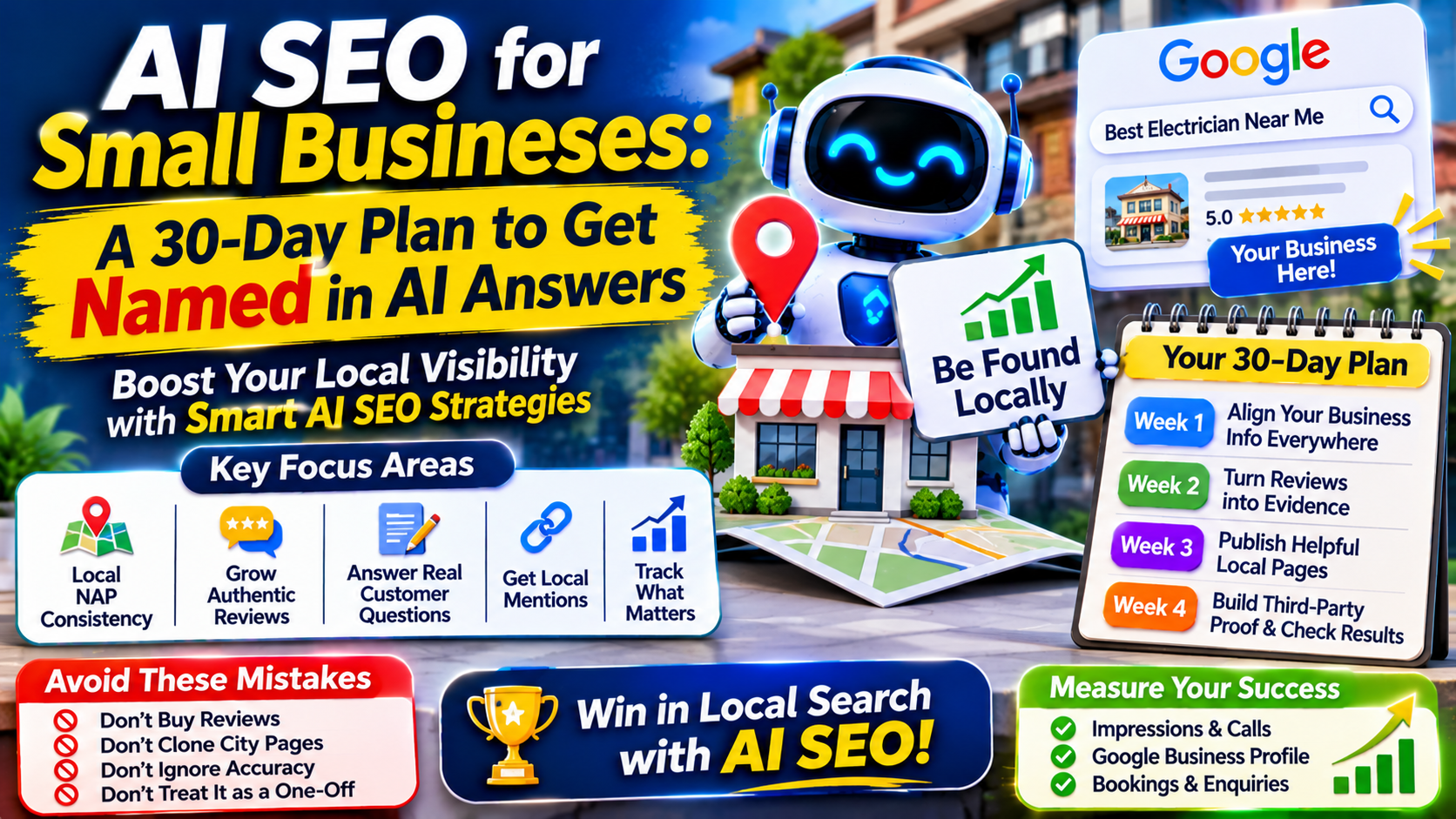
Ask an AI assistant for a reliable electrician or a good dentist nearby and you rarely get ten options. You get a short list, sometimes two or three names. One local-marketing source argues that local businesses lose visibility because AI tools surface only a small number of recommended businesses per query, and most operators lack the consistent signals needed to qualify. That is a vendor-side claim, so treat it as directional. It does explain why AI SEO for a small business looks different from AI SEO for a publisher. This plan covers four weeks.
Why Small Businesses Play a Different Game
Publishers compete on content. Local businesses compete on identity and trust. Research from SOCi, as summarized by SEO agency SEOprofy, found that ChatGPT builds local recommendations mainly from a brand’s own website, its Google Business Profile, and high-traffic consumer platforms such as Yelp.
Nobody outside these companies knows the exact formula. One analysis of local AI search says none of the five major AI surfaces publishes a ranking formula for local recommendations, and anyone quoting one has invented it.
Exposure also varies widely. Local Falcon measured AI Overviews on 40.2% of 60,000 local-business queries on one day in 2025, while a separate study reported a 68% average. The same source puts the gap down to wording, industry, geography and intent. Your own sector may look quite different, which is why the plan ends with testing.
Week 1: Make Your Business Facts Identical Everywhere
AI systems cross-check. If your website says “Smith & Sons Plumbing, open 8 to 6” and a directory says “Smith and Son Plumbers, open 9 to 5,” you create doubt. One local-SEO guide advises that Business Profile data, website content, reviews, structured information and third-party references should all agree.
Build a single master record: legal name, address, phone, hours (including holidays), primary category, services and service areas. Then check it against your website, Google Business Profile, Yelp, Apple Maps and any directory you can find. Fix every mismatch. Choose your primary category with care, because it frames how you are understood.
Sarkar SEO’s view is that this spreadsheet is the most valuable AI SEO asset a small business owns, and it costs nothing.
Week 2: Turn Reviews into Evidence
Reviews are likely the heaviest local signal. Search Engine Journal’s local-visibility guide lists review volume, recency, sentiment, and the actual language customers use as the heaviest signal for local intent. searchenginejournal
That last part is practical. A review that says “replaced our boiler in one morning, tidy and on time” gives a system more to work with than “great service.”
- Ask every customer, soon after the job, and mention that a few words about the service help future customers.
- Never write, buy or filter reviews. Follow each platform’s rules.
- Reply to reviews, positive and negative, in plain language that names the service.
Week 3: Publish Pages That Answer Real Customer Questions
Create one page for each core service. Add pages for each area you serve only where you have something real to say about it. Open each page with a direct answer to the question a buyer would ask: what it is, who it suits, how long it takes, and a price range you actually charge.
Add what only you can: photos of real work, the technician’s name, a short note from a recent job. This is your information gain, and competitors cannot copy it.
Avoid cloning one template across fifty towns. Analysis of Google’s guidance notes that spam policies such as scaled content abuse are formally in scope for AI Overviews and AI Mode citations.
Week 4: Build Third-Party Proof, Then Check Results
Seek mentions beyond your own site: your chamber of commerce, trade associations, suppliers who list their installers, local press and community sponsorships. SEOprofy cautions against forgetting your profile on these platforms once you are listed there. Keep each one accurate.
Then test. Ask ChatGPT, Gemini, Perplexity and Google ten questions your customers would ask, such as “who fixes [problem] in [your town]?” Note two things: whether you are named, and whether the facts are right. A wrong phone number or closing time costs you customers even when you are recommended.
Measure beyond clicks. One local-SEO practitioner notes that AI Overviews often reduce click-through rates while leaving search visibility largely intact. So also track impressions, branded searches, Google Business Profile interactions, calls, direction requests and bookings. designrushdesignrush
Mistakes That Waste the Month
- Paying for guaranteed citations. No one controls AI answers.
- Cloned city pages. They add volume and no value.
- Ignoring accuracy. Check what AI says about you, not only whether it mentions you.
- Treating it as a one-off. Hours change, staff change, services change. Update your master record whenever they do.
The Honest Limits
Most of what is published on local AI visibility comes from tool vendors and agencies. Statistics conflict, platforms update constantly, and a four-week plan builds a foundation, not a guarantee. Sarkar SEO recommends measuring small changes against your own baseline before drawing conclusions.
