



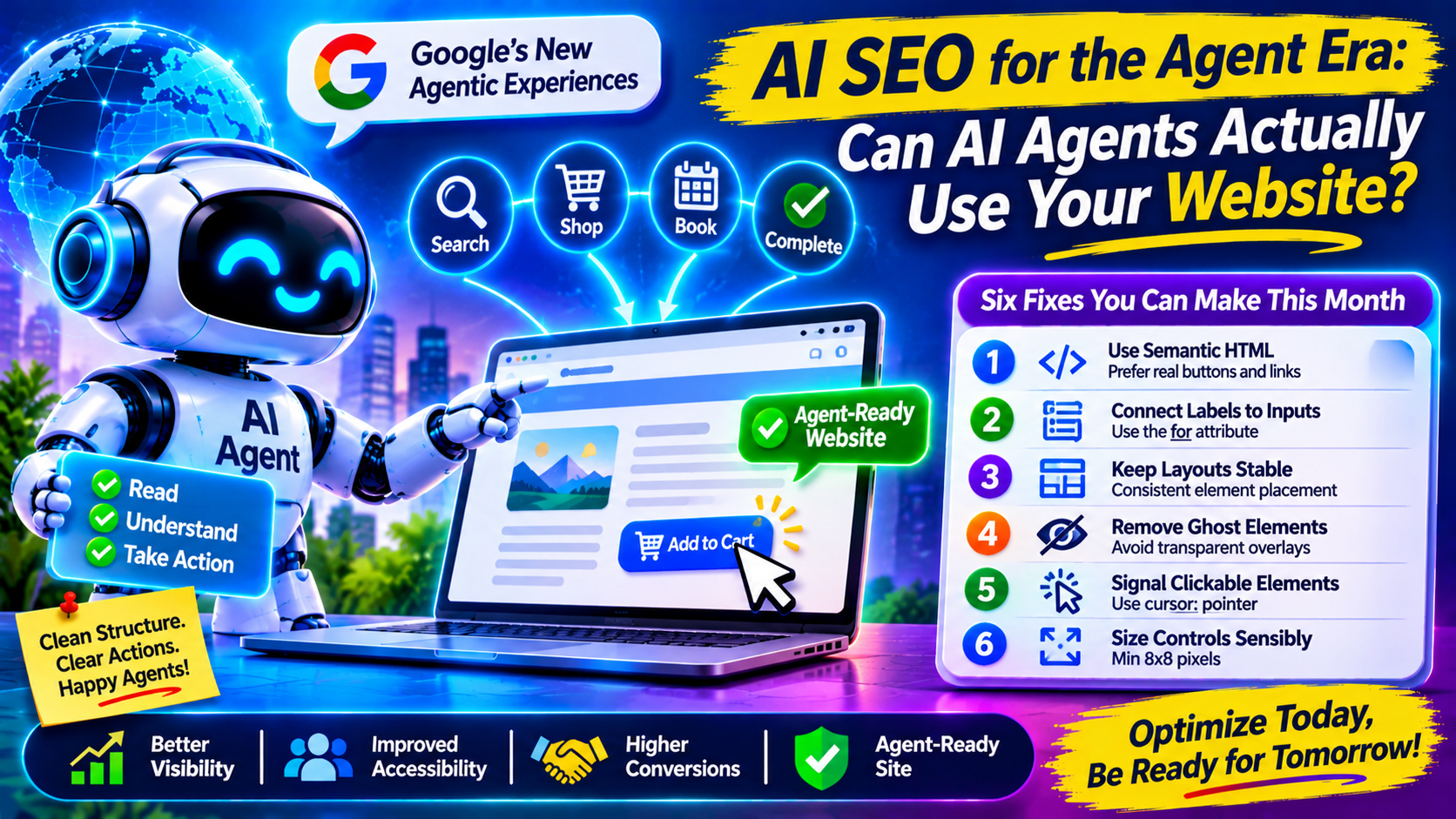
For years, AI SEO has meant helping machines read your content. A newer question is whether machines can use your website. Some people now hand tasks to AI agents, such as comparing products or completing a booking, and those agents visit sites on their behalf. Sarkar SEO sees this as the next practical layer of AI SEO. The good news is that most of the fixes are things a well-built site should already do.
A New Kind of Visitor
Google’s web.dev team describes it plainly. Some users are moving from manual navigation to delegating goal-oriented journeys to AI agents that can interpret input, plan and act for them. Agents don’t look at a monitor. They work from a machine-readable representation of your site, and the quality of that representation determines how well they perform.
According to the guidance, agents read a page in three main ways, and modern agents combine them. They use the page code and the accessibility tree to get a clean list of interactive elements, then cross-check it against a visual rendering.
Google’s own guide to generative AI search touches on the same idea. It notes that browser agents may analyze screenshots, inspect page structure and interpret the accessibility tree. It frames agentic experiences as something to explore if they are relevant to your business and you have extra time.
Six Fixes You Can Make This Month
web.dev’s best practices translate into a short checklist:
- Use semantic HTML. Prefer button and link elements over modified div and span tags. If you cannot, give the element a proper role and a tabindex.
- Connect labels to inputs. Adding the for attribute to a label tells an agent exactly what a field is for.
- Keep layouts stable. web.dev’s example is an Add to cart button that sits in a different place for each product category. That inconsistency confuses screenshot-based agents.
- Remove ghost elements. Transparent overlays covering interactive items may cause visual analysis to discard the covered nodes.
- Signal that things are clickable. Setting cursor: pointer in CSS is described as a strong signal of actionability.
- Size controls sensibly. web.dev says interactive elements needed to complete an action should be larger than 8 square pixels, so visual analysis does not filter them out.
The guidance adds a broader warning. Many sites are built with complex hover states, shifting layouts and fluid motion, which it calls functionally broken for agents.
WebMCP and the Protocol Layer
WebMCP is a proposed web standard that lets a site share explicit tasks with agents through JavaScript or HTML annotations called tools. web.dev says agents interpret these tools faster and more accurately than standard actuation. The same guidance flags that WebMCP is in active development and may change. It suggests confirmation dialogs for sensitive actions such as purchases.
Google’s AI search guide also mentions the Universal Commerce Protocol as an emerging protocol that will let Search agents do more. For most sites, these are watch items rather than launch projects. The foundation underneath them is the same markup hygiene described above.
Why This Is an SEO Topic
web.dev states that everything it suggests for agent readiness also makes sites better for humans, and it frames the work as recommitting to well-structured, accessible, semantic pages. The accessibility tree is the page’s semantic summary, already used by assistive technology.
So the work serves three goals at once: screen reader users, conversion rates and agent readiness. That also makes it a shared job across SEO, development and design, rather than a task for one team.
A Simple Audit
Sarkar SEO would treat this as a one-page checklist, not a rebuild:
- Pick three journeys. For example: find a product, contact the business, complete checkout.
- Try each with a keyboard only. If you get stuck, an agent may too.
- Inspect the accessibility tree. Chrome DevTools can preview it. Look for buttons and links with no names.
- Compare templates. Check that key actions sit in consistent places across page types.
- Retest after releases. Design updates often reintroduce overlays and unlabelled controls.
Keeping It in Proportion
The evidence here is early. Google presents agentic experiences as optional, and its core message is still that quality content and sound SEO fundamentals come first. None of the sources reviewed for this article quantified how much agent traffic sites actually receive.
A sensible approach is to make the cheap fixes now, since they pay off through accessibility and usability regardless. Then watch how the standards develop, and invest more only when agent activity shows up in your own data. Sarkar SEO suggests resisting vendors who treat agent readiness as a separate, expensive discipline. The guidance itself says otherwise.
The Takeaway
AI SEO is widening from being found to being usable. A site that agents can read cleanly, and act on confidently, is also one that people find easier to use. Start with a short journey audit and fix what it reveals. If you would like a second pair of eyes on your site’s structure, Sarkar SEO is happy to help.
