



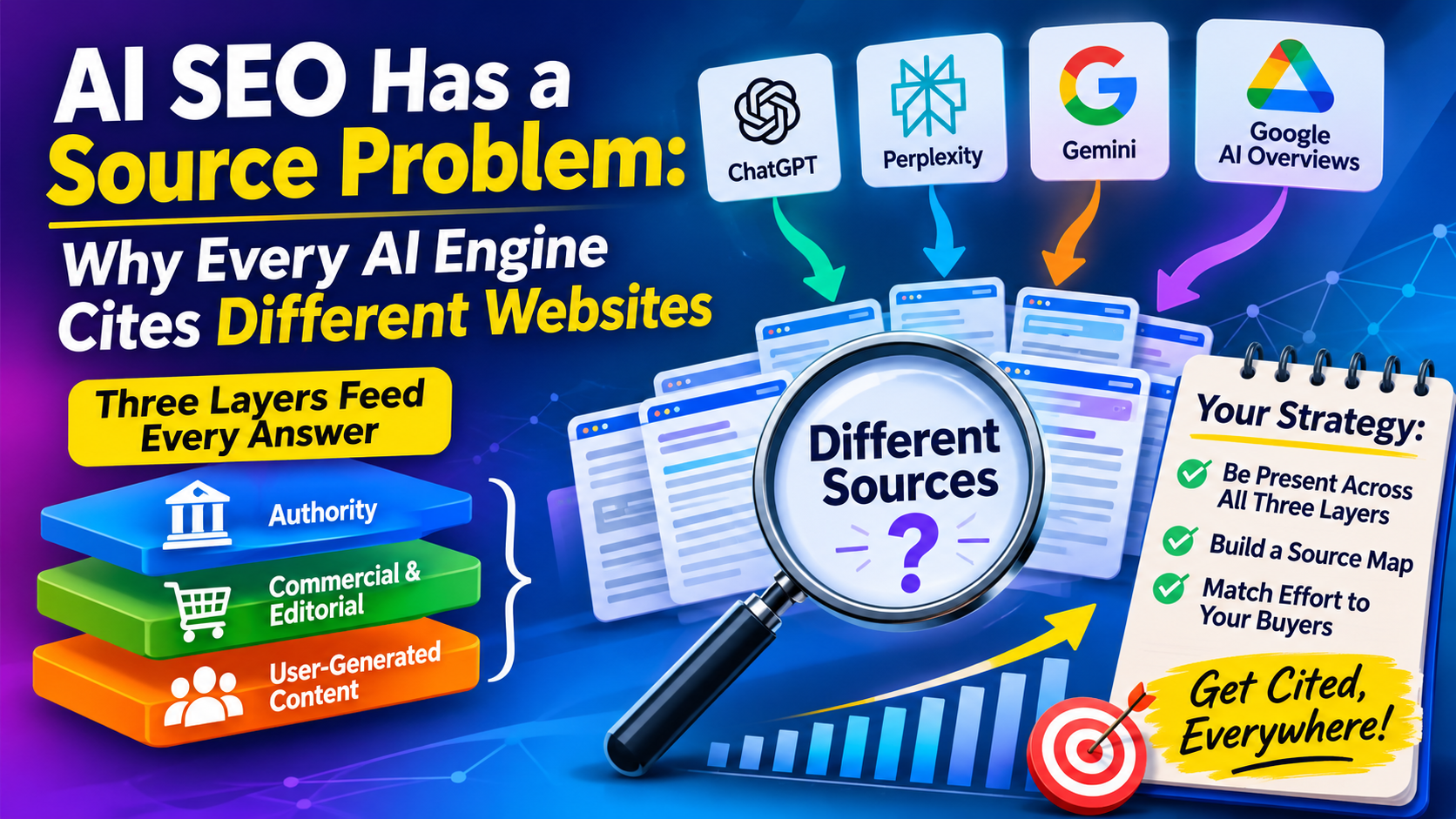
Ask ChatGPT, Perplexity and Google the same buying question, and you will often get three different sets of sources. Most AI SEO advice still assumes one playbook will win everywhere. The data suggests the real picture is more interesting, and more useful, because engines disagree about where to look but agree far more about who to recommend.
The Engines Barely Agree on Sources
In a Writesonic study of 161,286 prompts, overlap scores between engine pairs ranged from 0.12 to 0.24, so even the closest pair shared less than a quarter of its sources.
The relationship with classic Google rankings varies sharply by engine. Ahrefs compared citations with Google’s top 100 results for about 3,000 short queries. ChatGPT’s URL overlap was about 21%, while Perplexity’s was about 73%. Ahrefs’ own conclusion is that ChatGPT’s cited pages do not overlap much with what Google ranks, while Perplexity largely mirrors it.
Search Engine Journal reported a similar result by intent. Across ChatGPT, Perplexity and AI Overviews, universal overlap was 2.4% for commercial prompts and 2.0% for informational ones. searchenginejournal
A caution: these studies measure different things at different scales, and Writesonic notes that a single model update has shifted retrieval behavior before. Treat the exact percentages as snapshots and the pattern as the lesson.
Three Layers Feed Every Answer
BrightEdge analyzed ChatGPT, Perplexity, Gemini, Google AI Mode and AI Overviews, and sorted cited sources into three layers:
- Authority: government, academic and institutional sources.
- Commercial and editorial: review sites, trade press, news, comparison pages and retailer listings.
- User-generated content: video, forums and community discussion.
Every engine uses all three layers. They differ in how heavily they weight each one. The spread is wide. Authority sources made up between 10% and 26% of citations depending on the engine, while user-generated content ranged from 0.2% to 18%. brightedgebrightedge
Some examples from that study:
- Gemini leans on institutions, with about 26% of citations from authority sources and almost none from user-generated content.
- Google AI Overviews is the opposite. About 17.5% of its citations come from user-generated platforms, and one video platform alone accounts for roughly 10.6%.
- ChatGPT has the flattest distribution, with its top ten domains accounting for only 18.5% of citations.
- Perplexity commits to a short list, with 86% of its brand mentions landing in position five or earlier.
The surprise is that “Google AI” is not one thing. Gemini’s top-100 citation overlap with AI Mode was only 27%, and Gemini overlapped more with ChatGPT than with its Google siblings.
The Useful Twist: Brands Converge
Here is the finding that should shape your strategy. Pairwise overlap in named brands across engines stayed between 36% and 55%, while overlap in cited sources ranged from 16% to 59%. The engines take different routes but arrive at similar shortlists.
This suggests you probably do not need five separate playbooks. You need to be present, consistently, across all three layers, so that whichever route an engine takes, it finds you. One caveat applies: BrightEdge sells AI visibility tracking, so verify these patterns against your own category before committing a budget.
What Each Layer Asks of You
Authority is category-relative. You do not need a government citation. Every industry has its own trusted voices: trade associations, analyst firms, standards bodies and professional groups. Identify which ones AI engines lean on for your topic, then earn a place there through expert contributions, original data worth referencing, or accurate membership listings.
Commercial and editorial is the widest lever. In the BrightEdge data, this layer was the largest share of citations on every engine, from roughly 37% on Gemini to 51% on AI Overviews. Reviews, comparison articles, trade press and directory profiles all feed it. Keep your facts consistent everywhere, because conflicting descriptions give an engine reasons to hedge or skip you.
User-generated content needs a real presence. That does not mean flooding forums with promotion. It means finding the videos and threads already cited in your category and contributing useful, honest expertise. Fake mentions are a poor shortcut, and Google’s own AI search guidance lists inauthentic mentions among the tactics to avoid.
Your own site still matters. Conductor found that for navigational queries, brand-owned domains took the top citation slot for most of its study period. Your site is how engines confirm who you are, so keep it accurate and crawlable.
Match the Effort to Your Buyers
The three-layer idea is universal, but the weighting is not. A B2B software company whose buyers research in ChatGPT and Perplexity should lean toward authority and editorial coverage. A consumer brand competing in AI Overviews should lean toward video, community and review presence. Sarkar SEO’s approach is to start from where your buyers actually ask questions, then build the layers in that order.
Build a Source Map in One Afternoon
You can see your gaps without any paid tool.
- Write ten questions your customers genuinely ask, from broad to specific.
- Run each in ChatGPT, Perplexity, Gemini and Google AI Mode.
- Log every domain cited and every brand named.
- Label each domain as authority, commercial or user-generated.
- Mark where competitors appear and you do not.
The gaps, not the averages, become your plan. If your rivals dominate review sites and you have no listings there, that is a clearer priority than any technical tweak. Sarkar SEO can run this exercise with you and turn the findings into a sequenced roadmap. Repeat it quarterly, because the answers change as models update.
