



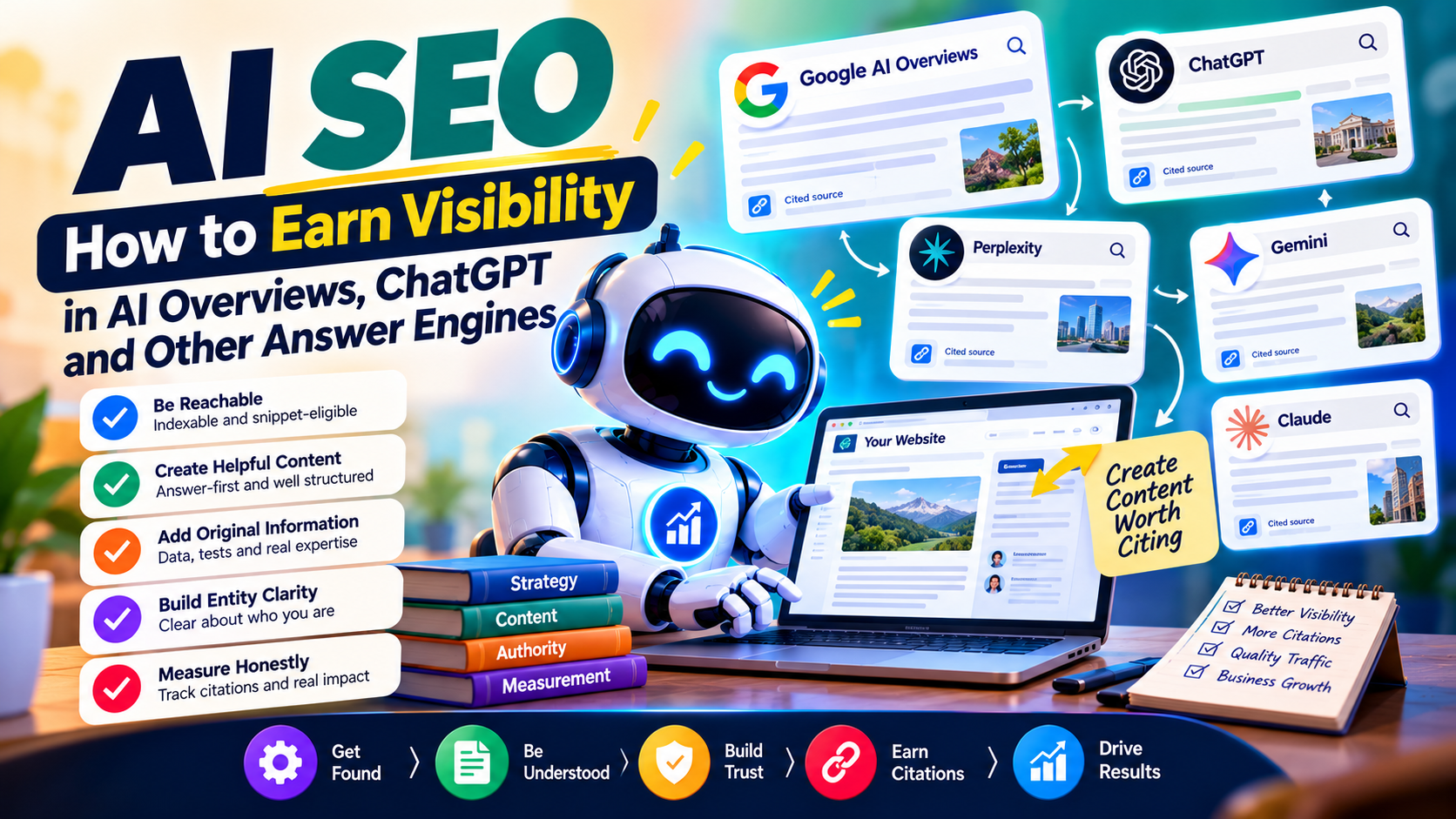
Search used to mean ten blue links. Now a person can type a question and get a written answer, with a few cited sources underneath. That shift has produced a lot of noise about “new” optimization disciplines. Much of it is confused, and some of it is wrong.
This article separates what actually changed from what didn’t, and shows where to spend effort.
What AI SEO Really Means
AI SEO is the work of making your content easy for AI-driven search systems to find, understand, trust and cite. Those systems include Google’s AI SEO Overviews and AI Mode, ChatGPT search, Perplexity, Gemini and Claude.
The useful insight is that AI SEO builds on classic SEO rather than replacing it. Google’s own guidance says there are no extra requirements for appearing in AI Overviews or AI Mode, and no special optimizations are necessary beyond the fundamentals. Its May 2026 guide on generative AI features goes further: it says structured data is not required and no special schema markup is needed for these features. Reporting on the guide also notes it explicitly rejects AEO and GEO as distinct disciplines. ai features +2
That’s Google’s position for Google’s products. Other platforms may weigh signals differently, which is why the rest of this article covers both.
Step One: Be Reachable
Quality content does nothing if a system can’t retrieve it. Google states that a page must be indexed and eligible to be shown with a snippet to appear as a supporting link in AI Overviews or AI Mode. A stray noindex or nosnippet directive quietly removes you from consideration.
ChatGPT adds a wrinkle: OpenAI runs separate crawlers for separate jobs. A site can allow OAI-SearchBot to appear in search results while disallowing GPTBot to keep its content out of model training. OpenAI’s documentation also says sites opted out of OAI-SearchBot won’t be shown in ChatGPT search answers, though they can still appear as navigational links.
Many robots.txt files were copied from 2024 “block the AI bots” advice, written before this split existed. Such a file may block more than you intended, or less. Spend ten minutes reading yours and decide deliberately. Note that changes can take around 24 hours to be reflected in OpenAI’s search systems.
One caution: OpenAI says rules in robots.txt may not apply when ChatGPT visits a page on behalf of a user. Robots.txt controls automated crawling, not every possible fetch.
Write for Passages, Not Just Pages
Answer engines rarely lift a whole article. They pull the part that answers a sub-question. Google has described that AI Mode and AI Overviews can use query fan-out, exploring subtopics and related sources. One user question becomes several smaller searches behind the scenes.
This changes how you should structure content:
- Answer first, then explain. Put a clear two- or three-sentence answer directly under each heading, then add nuance.
- Make each section self-contained. A passage that depends on “as mentioned above” is hard to reuse.
- Use headings that match real questions. “How long does a site migration take?” beats “Timeline Considerations.”
- Cover the neighboring questions. Think about what a reader would ask next, and what a comparison would require.
This isn’t a trick. It’s good editing, and it happens to suit both people and machines.
Give Systems Something Worth Citing
If your article restates what ten other pages already say, an AI system has no reason to choose yours. Information gain, meaning something genuinely new on the page, is the most durable advantage you can build.
Practical sources of it include:
- First-party data, such as your own Search Console trends, log files or survey results.
- Documented tests, including what you changed, what happened and what you can’t conclude.
- Specific examples with real constraints, rather than generic advice.
- Clearly attributed expert judgment from a named person with relevant experience.
Be honest about limits. A claim like “this worked on one site, so treat it as a hypothesis” is more credible, and more citable, than a confident universal rule.
Entity clarity matters too. Your site should state plainly who you are, what you do, who you serve and where. Vague positioning makes it harder for any system to classify and recommend you correctly. A consistent About page, author bios with real credentials, and matching business details across the web all help.
Don’t Chase Gimmicks
Be skeptical of anything sold as an “AI ranking hack.” Two examples:
- llms.txt. One summary of Google’s guidance says Google doesn’t treat LLMS.txt as a requirement for AI Overviews or AI Mode. It costs little to add, but don’t expect it to move results on its own.
- Special schema for AI. Structured data still helps machines interpret a page, but it doesn’t guarantee inclusion in AI Overviews. Use it for accuracy, not as a lever.
Content spun purely to mimic “AI-friendly” phrasing also tends to read as thin. Systems built to surface helpful pages are not easily fooled by it.
Measure What You Can, Honestly
Measurement is the weakest part of AI SEO right now. Google notes that sites appearing in AI features are counted in the overall search traffic in Search Console, so you can’t cleanly isolate AI Overview clicks there. Google also says clicks from pages with AI Overviews tend to be higher quality, with users more likely to spend longer on the site. That’s a claim from Google, so judge it against your own analytics. googlegoogle
A sensible measurement stack looks like this:
- Search Console for impressions, clicks and query patterns on informational pages.
- Server logs to see which AI crawlers actually visit, and which pages they request.
- Manual prompt testing. Ask the questions your customers ask across several assistants, record whether you’re cited, and repeat monthly. Treat results as directional, since answers vary between runs.
- Conversion data. Traffic from AI referrals may be smaller but more intent-rich. Check whether it converts.
At Sarkar SEO, the preference is to track a small, stable set of prompts over time rather than chase a single screenshot of a good result. One citation proves very little. A trend across weeks proves more.
A Simple Priority Order
If you’re unsure where to begin, work in this order:
- Confirm key pages are indexable and snippet-eligible.
- Set a deliberate robots.txt policy for search and training crawlers.
- Rework your top ten informational pages with answer-first sections.
- Add original evidence, such as data, tests or named expert input.
- Clarify your entity details across the site.
- Start a monthly prompt-tracking routine.
None of this requires new technology. It requires discipline, which is why it works.
