



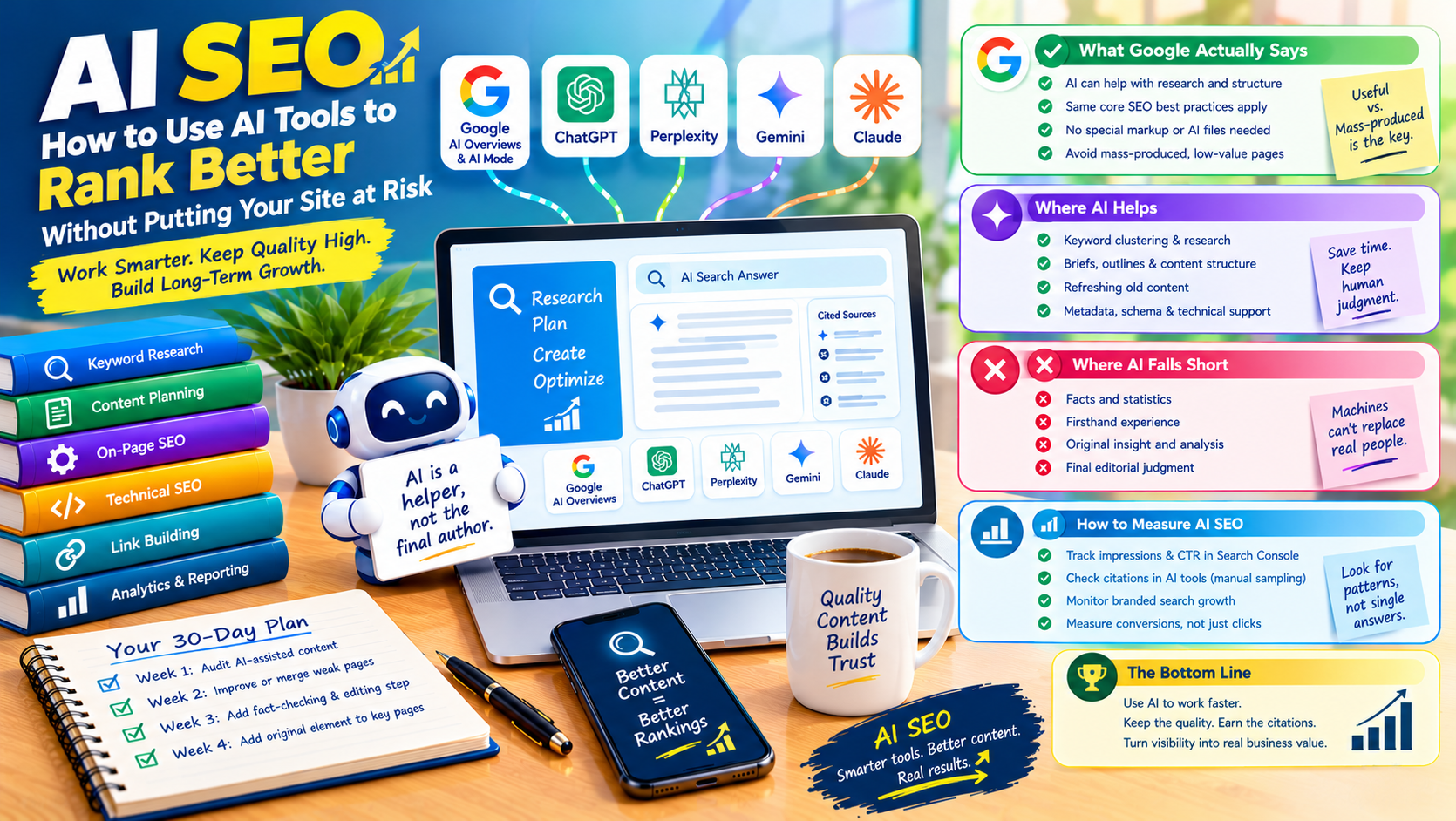
Most teams now use AI somewhere in their SEO workflow. Few have decided where it belongs and where it doesn’t. In this context, AI SEO means using AI tools to research, plan, produce and improve search content faster, while keeping the quality that search engines and readers expect.
The tools are not the hard part. The hard part is knowing which tasks to automate and which need a person.
What Google Actually Says About AI-Assisted Content
A common fear is that Google penalizes anything a machine helped write. Its own guidance is more balanced. Google says generative AI can be particularly useful for researching a topic and adding structure to original content. The warning attached to that is specific: using AI tools to generate many pages without adding value for users may violate Google’s spam policy on scaled content abuse. googlegoogle
The problem, then, is not the tool but the pattern. Google’s spam policy targets pages generated primarily to manipulate rankings without helping users, regardless of whether AI, humans, or both created them. Search Quality Rater guidance gives a concrete example: using automated tools, generative AI or otherwise, as a low-effort way to produce many pages that add little or no value compared with other pages on the topic. rankaiuserp
The practical lesson is that publishing volume is no longer a strategy. A site with fifty strong pages is safer than one with five hundred interchangeable ones.
Where AI Genuinely Helps
Used well, AI saves time on work that is tedious but not creative. These are the areas where it earns its place.
Research and clustering. AI can group hundreds of keywords by intent, summarize what the top results cover, and flag subtopics a draft has missed. You still need to confirm the findings against real search results.
Briefs and outlines. A good brief states the reader’s question, the angle, the sources to use and the evidence required. AI can draft one quickly. A strategist should then edit it.
Refreshing old content. Feed an existing article into a tool and ask what is outdated, thin or contradictory. This often produces better returns than writing something new.
Metadata and variations. Title tag and meta description options, FAQ drafts and internal link suggestions are low-risk uses, as long as someone reviews the output.
Technical support. AI can help write regex for Search Console filters, draft structured data, or explain a crawl error. Always test the result before it goes live.
Where AI Falls Short
AI is weakest where search quality is judged most strictly.
- Facts. Models can state wrong numbers and invented sources with total confidence. Every statistic, date and quotation needs checking against the original source.
- Firsthand experience. A tool cannot have tested a product, run a campaign or served a client. Anything presented as personal experience must come from a real person.
- Original insight. AI reproduces what already exists. If your article only restates the top results, readers and search engines have no reason to prefer it.
- Judgment. Deciding what to leave out, what to warn about, and what your audience actually needs remains an editorial skill.
At Sarkar SEO, we treat AI as a fast assistant for the first 60 percent of a task and never as the final author. That final stretch, covering verification, voice and real expertise, is where rankings are won.
A Review Checklist Before Anything Goes Live
Run each AI-assisted page through these questions.
- Does it answer one clear question better than competing pages? If not, don’t publish.
- Is every claim sourced and verified? Open the source. Don’t trust a summary of it.
- Is there something original? A real example, a data point of your own, a tested process, or an expert’s comment.
- Does it read like a person wrote it? Remove filler openings, repetitive phrasing and vague claims.
- Is there a named, accountable author? Readers trust people more than anonymous pages.
- Would this page deserve to exist if search engines didn’t? This is the most honest test.
Should You Disclose AI Use?
Google’s guidance notes that sharing information about how a piece of content was created can help give readers more context. Disclosure is useful when readers would reasonably wonder how something was made, for example with AI-generated images or synthetic media. A short editorial note is usually enough.
Ecommerce sites face stricter rules. Google Merchant Center requires that AI-generated images carry IPTC DigitalSourceType metadata, and that AI-generated product titles and descriptions be specified separately and labeled. If you run a store, check those policies before automating product copy.
Don’t Forget AI Search Visibility
AI SEO has a second meaning: being visible inside AI-generated answers. Content that is clear, accurate, well structured and original tends to serve both goals. You don’t need a separate set of tricks. Keep your technical foundations sound, write in direct language, and make each page easy to quote correctly.
It also helps to test your own visibility. Ask your target questions in several AI assistants, note which sources they cite, and compare their pages with yours. The results vary by session, so look for patterns, not single answers. We use this kind of testing at Sarkar SEO to find gaps that ranking reports miss.
A Simple Plan for the Next 30 Days
- Week 1: Audit your existing AI-assisted content. Mark pages that are thin, repetitive or unverified.
- Week 2: Merge or improve weak pages. Fewer, stronger pages beat many near-duplicates.
- Week 3: Create a fact-checking and editing step for every future draft, and name the person responsible.
- Week 4: Add one original element to your five most important pages, such as a case example, a small dataset or an expert quote.
