



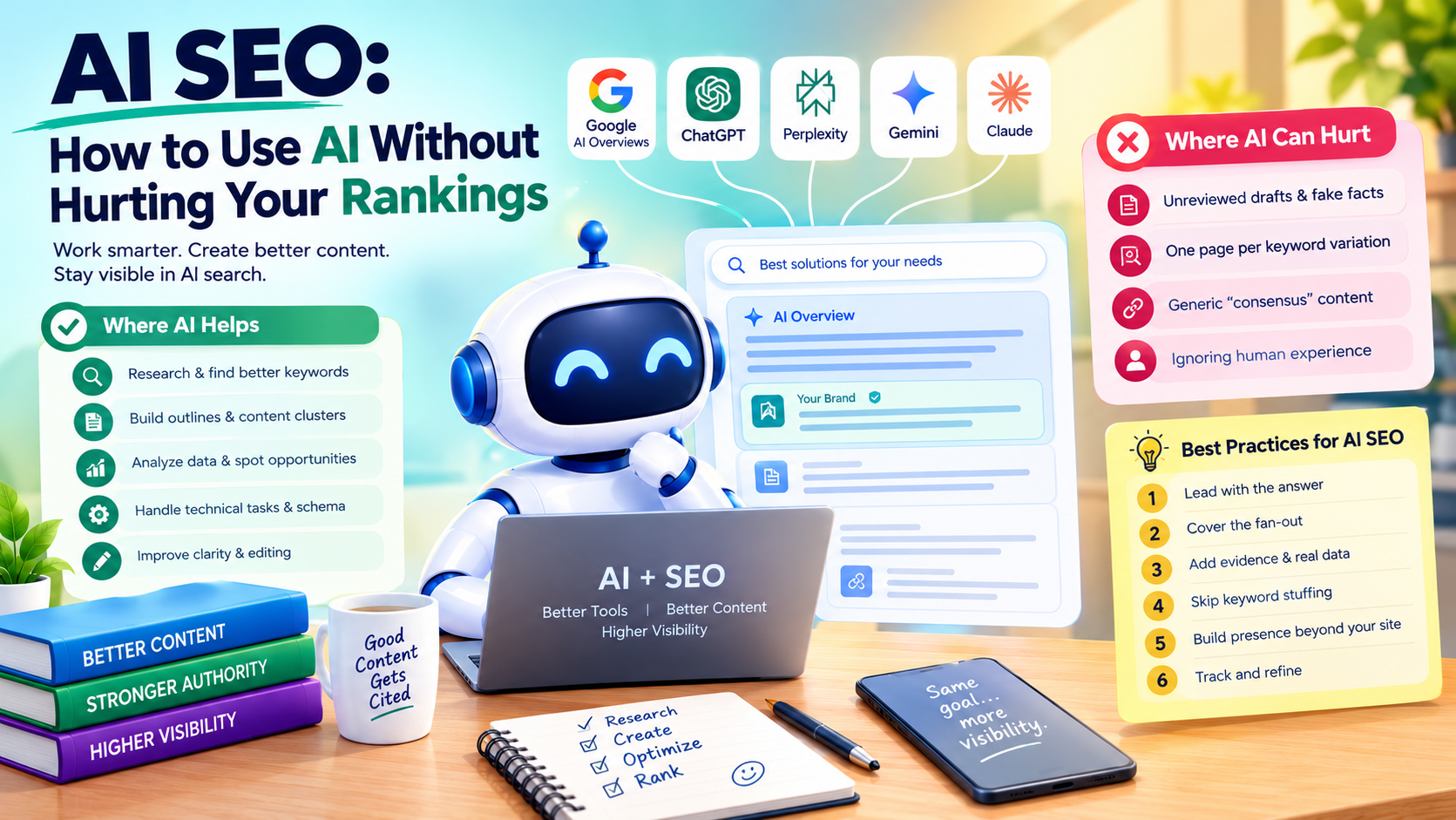
Few phrases in marketing are as slippery as “AI SEO.” Some people mean using AI tools to do SEO faster. Others mean optimizing a website so AI search engines cite it. Both matter, and mixing them up leads to expensive mistakes.
This guide covers both meanings: where AI helps your SEO workflow, where it can get you penalized, and how to build content that AI answers actually reference.
The two meanings of AI SEO
AI for SEO means using tools such as large language models to research keywords, outline content, cluster topics or analyze data.
SEO for AI means optimizing so Google AI Overviews, ChatGPT, Perplexity, Gemini and Claude retrieve and cite your pages.
The two connect through one question: is your content actually worth citing? An AI tool can speed up the work, but it cannot supply originality on its own.
What Google actually says about AI content
Google does not ban AI-assisted content, and it does not reward it for being AI-assisted either. Its guidance says generative AI can be useful for researching a topic and adding structure to original content, but using it to generate many pages without adding value may violate the scaled content abuse policy. google
Google’s Search Liaison made the logic plain. Google doesn’t care whether scaled content comes from AI, automation or human beings. The problem is the pattern: many pages, little value. searchenginejournal
The policy is also current. Google introduced its scaled content abuse policy on March 5, 2024, and reported that its spam policies apply to generative AI responses in Search, including AI Overviews and AI Mode, as of May 15, 2026. The same source notes the September 2026 spam update lists this policy among those in scope. Treat shortcuts as a live risk, not a historical one. ppc
Where AI genuinely helps your SEO
Used with human judgment, AI earns its place in these tasks:
- Research synthesis. Summarizing the top-ranking pages to see which subtopics they cover and which they skip.
- Structuring. Drafting outlines, heading hierarchies and FAQ candidates.
- Clustering. Grouping hundreds of queries by intent so you can plan pages instead of guessing.
- Technical chores. Generating regex, spotting redirect patterns, cleaning spreadsheets and drafting schema for you to verify.
- Editing. Tightening wording and flagging unclear sentences.
Where AI hurts
- Publishing unreviewed drafts. Fabricated statistics and invented citations are common model failures, and one false claim can destroy trust in a whole page.
- One page per keyword variation. Producing pages because a keyword list said so is the textbook route to scaled content abuse.
- Generic “consensus” content. If your article restates what ten others say, neither Google nor an AI assistant has a reason to prefer it.
- Ignoring the human layer. Experience, original data and real opinions are what a language model cannot generate honestly for you.
How to optimize for AI search
Google’s official position is that you don’t need a separate playbook. There are no additional requirements to appear in AI Overviews or AI Mode, and no special optimizations are necessary. Google says its generative features are rooted in its existing Search index, ranking systems and quality signals. googletechwyse
So the foundation stays familiar: crawlable pages, clear internal linking, accurate structured data and original content. Google calls unique, non-commodity content the first priority. ppc
Layer these practices on top:
- Lead with the answer. Start each section with a direct two-sentence response, then expand. Retrieval systems extract self-contained passages.
- Cover the fan-out. Google notes that its AI features may use “query fan-out,” issuing multiple related searches across subtopics to develop a response. A page that answers the adjacent questions, such as costs, comparisons and risks, has more chances to be retrieved. google
- Add evidence. The Princeton-led GEO study found that including citations, quotations from relevant sources and statistics can boost source visibility by over 40% across various queries. That result comes from a research benchmark, so treat it as a strong signal rather than a promise. arxiv
- Skip the stuffing. In one summary of those experiments, keyword stuffing reduced visibility on Perplexity compared with unoptimized content. Write naturally. everything-pr
- Build presence beyond your site. Google says its generative features may reflect what is said about products and services across blogs, videos and forums. Reviews, expert commentary and community discussion all shape how you are described. techwyse
A safe AI SEO workflow
- Research with AI, verify by hand. Use it to map subtopics, then confirm every fact against a primary source.
- Add something only you have. That might be client results, a proprietary benchmark, a screenshot of a real test or a practitioner’s opinion.
- Edit like a publisher. A named expert should review accuracy, tone and claims before anything goes live.
- Publish fewer, stronger pages. One authoritative hub beats thirty near-duplicates.
- Disclose where it helps readers. Google notes that sharing information about how content was created can give readers more context. google
- Track and refine. Monitor Search Console, referral traffic from AI platforms and a fixed list of priority prompts checked monthly. Google confirms that sites appearing in AI Overviews and AI Mode are included in overall search traffic in Search Console, so AI-specific clicks can’t be isolated cleanly. google
At Sarkar SEO, we treat AI as a research and editing assistant, never as the author of record. That approach keeps content accurate and defensible when algorithms change.
Will Google penalize my AI-assisted content?
Not for the method alone. The risk lies in low-value, mass-produced pages, which Google treats as spam however they were created.
Do I need llms.txt or special AI markup?
For Google’s AI features, no. Google says you don’t need new machine-readable files, AI text files or markup. Other engines may differ, but test claims before investing. google
Is AI SEO different from GEO?
GEO is the part of AI SEO focused on getting cited in generated answers. AI SEO also covers using AI to improve your own workflow.
AI SEO rewards the same thing great SEO always has: content that is accurate, original and useful to a real person. AI can compress the busywork, but it cannot replace expertise. Sarkar SEO helps brands pair smart tooling with human authority, so you can audit your pages, find gaps competitors missed and earn visibility across both search results and AI answers.
