



Search used to end with ten blue links. Now many queries end with a written answer, and your page either helps build that answer or it doesn’t. AI SEO is the work of making sure it does.
What AI SEO Actually Means
AI SEO is the practice of making content easy to find, understand, and cite in AI-driven search features such as Google AI Overviews and AI Mode. It also covers assistants like ChatGPT, Perplexity, Gemini, and Claude. You will see it called GEO or AEO. The labels differ, but the goal is the same: be a source an answer is built from.
Google’s Position: It’s Still SEO
Google published dedicated guidance for generative AI features in 2026. Its generative features pull from the same Search index and use the same ranking systems, so succeeding in them starts with succeeding in search. Google’s documentation adds that no specific optimization is required, and existing fundamentals still apply, including crawlable pages, internal links, and good page experience. wordstreamgoogle
Two details matter for strategy. First, both features may use “query fan-out,” issuing several related searches across subtopics to build a response. A page that covers only one narrow question has fewer chances to be pulled in than one that handles the related questions around it. Second, AI Overviews appear only when Google’s systems judge them additive, so they often don’t trigger.
Be careful with prevalence claims. One vendor reports that by some March 2026 measurement sets, AI Overviews appeared on about 48% of queries. Figures vary by dataset and query mix, so treat them as directional.
Other Assistants Behave Differently
Google’s guidance covers Google only. An analysis of 1,739 citations found that Perplexity and ChatGPT cite distinctly different sources for the same queries, and Reddit was cited only by Perplexity. A separate vendor study of 4,100 B2B queries reported 44% source overlap between ChatGPT and Perplexity. Both studies come from vendors, lean toward software and B2B topics, and don’t prove causation. They do support one cautious conclusion: no single tactic wins everywhere.
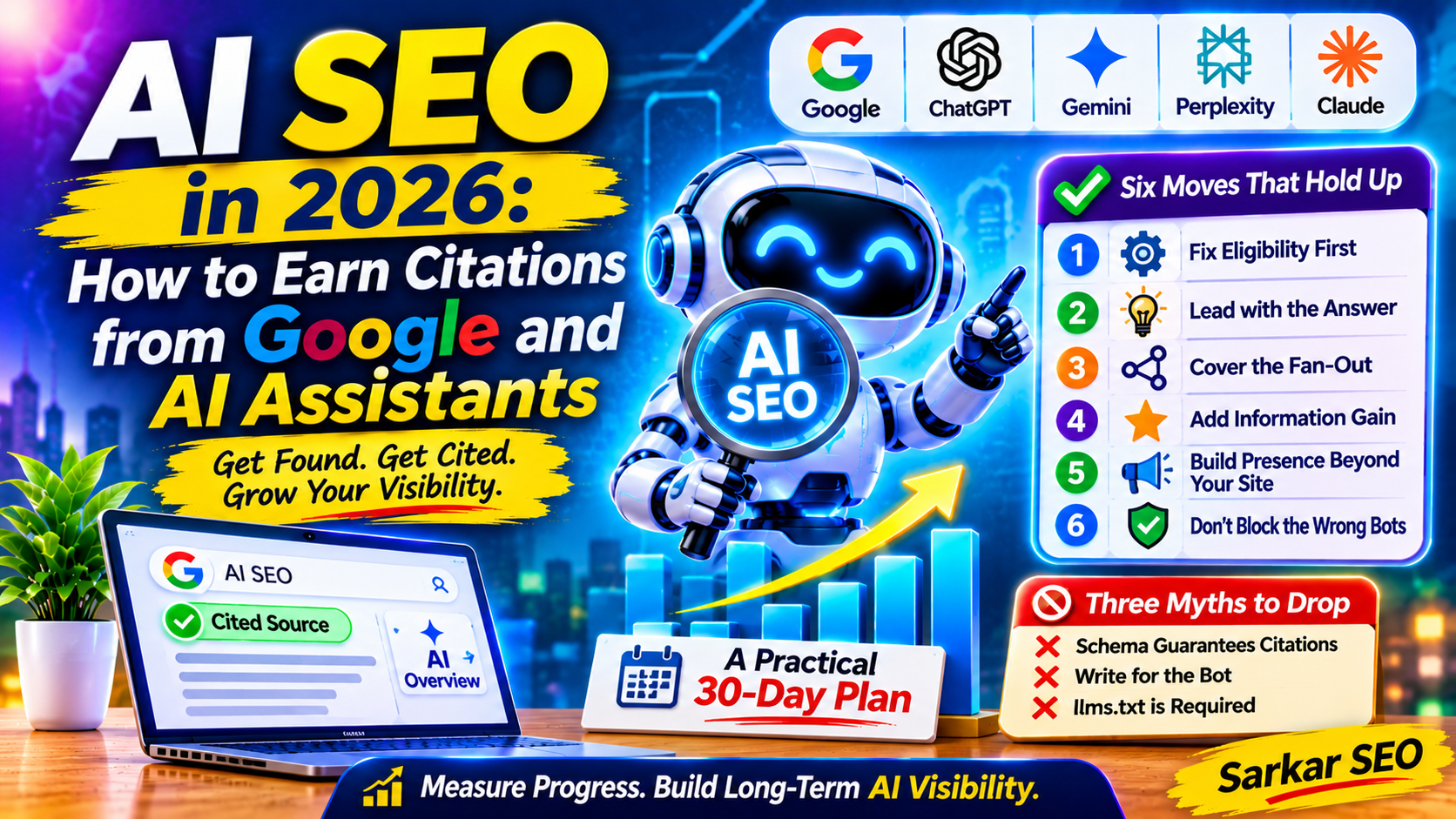
Six Moves That Hold Up Across Engines
- Fix eligibility first. A page that can’t be crawled, indexed, or shown with a snippet can’t be cited. Check robots.txt, CDN rules, and index status before anything else.
- Lead with the answer. Open each section with a direct, self-contained statement, then add nuance, examples, and exceptions. An assistant can lift that passage cleanly, and a human skimming gets value immediately.
- Cover the fan-out. Take your main question and list the follow-ups a careful buyer would ask: cost, risks, alternatives, timelines, edge cases. Answer them on the same page or in tightly linked supporting pages.
- Add information gain. If your page repeats what ten others say, there is no reason to cite it. Original data, real project observations, clear comparisons, and specific numbers give an answer something it cannot get elsewhere. One practitioner review of citation patterns notes that vague, generic content is cited less than content with specific data points, examples, or actionable insights. Only publish firsthand claims you can actually support.
- Build presence beyond your own site. One citation study found that domain authority, earned media, and user-generated content all shape what AI engines reference. Mentions in respected industry publications, genuine community participation, and consistent brand details across profiles help assistants recognize you as a real entity.
- Don’t block the wrong bots. Blocking training crawlers is a legitimate choice. Blocking search-related crawlers can make you invisible in AI answers. Note that Google-Extended controls Gemini training and grounding but has no effect on Google Search, including AI Overviews and AI Mode. Read each platform’s crawler documentation before editing robots.txt. demandsphere
How to Measure Progress
Traffic reports alone will mislead you. Sites appearing in AI features are counted in overall Search Console traffic, so AI visibility is not cleanly separated there. Build a simple tracking routine instead:
- Choose 20 to 30 queries that matter to your business.
- Run them monthly in Google, ChatGPT, Perplexity, and Gemini.
- Log whether you’re cited, which URL appears, and which competitors are named.
- Compare against branded search growth and assisted conversions.
At Sarkar SEO, this kind of query-level tracking is the baseline we recommend before changing any content, because without it you cannot tell what worked.
Three Myths to Drop
“Schema guarantees citations.” Structured data helps machines interpret a page, but Google says no special markup is needed for these features. Use schema for accuracy, not as a shortcut.
“Write for the bot.” Google’s advice is to organize content for your human audience, using clear paragraphs, logical sections, and descriptive headings. Contorting a page for machines usually weakens it for people.
“A special llms.txt file is required.” For Google, llms.txt is not necessary and won’t improve AI Overview visibility. Other engines may treat it differently, but there is no solid evidence that it is a deciding factor.
What About Clicks?
AI answers can reduce clicks on simple queries. Google says clicks from pages with AI Overviews tend to be higher quality, with users more likely to spend longer on the site. That is Google’s own claim, so verify it against your analytics. Either way, being named in an answer builds recognition even when no click follows.
A Practical 30-Day Plan
Week 1: Audit crawlability, indexing, and snippet settings on your ten most important pages.
Week 2: Rewrite openings so each section answers its question first.
Week 3: Add one original element per page, such as a data point, a comparison table, or a worked example.
Week 4: Start your query tracking log and pitch one credible external publication.
Repeat monthly. Teams at Sarkar SEO treat AI visibility as a compounding habit, not a one-time project.
