



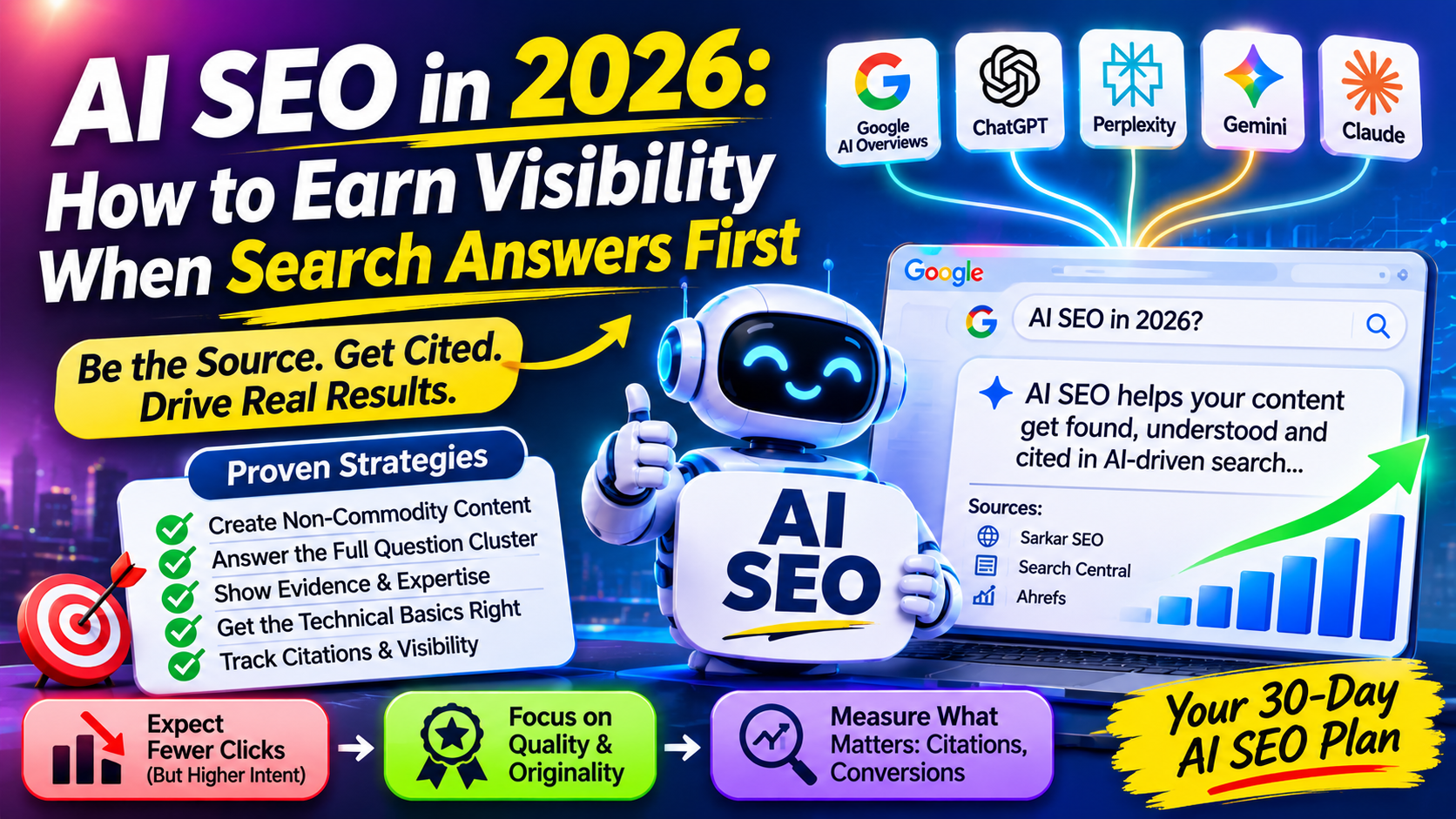
Search no longer ends with ten blue links. Google summarizes, assistants like ChatGPT and Perplexity cite sources, and many questions are settled before anyone visits a website. AI SEO is the work of staying findable, trusted and quotable in that environment. This guide separates what the evidence supports from what is hype, so your effort goes where it counts.
What AI SEO Actually Means
AI SEO means shaping your content so AI-driven search experiences can find, understand and cite it. It builds on classic SEO rather than replacing it. Google’s documentation says its generative features rest on its core ranking and quality systems, using retrieval-augmented generation to pull pages from the Search index and query fan-out to run several related searches for one question. Google also states that AEO and GEO, from its perspective, are still SEO.
Two practical consequences follow. A page that cannot be indexed cannot be cited. And because of fan-out, your page may be retrieved for sub-questions you never targeted directly.
The Click Problem, Stated Honestly
Visibility and traffic are no longer the same thing. Pew Research found users clicked a result about 8% of the time when an AI Overview appeared, against 15% without one. A randomized experiment found that removing Overviews raised outbound clicks per search from about 0.38 to 0.61. That study is a working paper that has not completed peer review, so treat its exact figures with caution. Google’s AI Overviews Cut Clicks Without Satisfaction Gain: Report +2
The picture is not uniformly bleak. Seer Interactive reported click-through on Overview queries rising from 1.3% in December 2025 to 2.4% in February 2026. Studies disagree on the size of the effect, but the direction is consistent: informational queries lose clicks. Expect fewer, more deliberate visitors. Judge success by citations, branded searches and conversions, not sessions alone.
Build Content That Isn’t a Commodity
Google says unique, genuinely useful content will likely influence your presence in generative search more than any other suggestion in its guide. It contrasts commodity content, such as generic tip lists built on common knowledge, with non-commodity content that offers real expertise or first-hand experience.
A useful test: could a language model write this page by summarizing the top results? If so, there is little reason for an AI system to cite you. Better options:
- Publish original numbers, such as your own survey, benchmark or anonymized data.
- Write from direct experience, including process, screenshots and mistakes.
- Take a clear position and defend it with reasoning.
- Add high-quality images or video where they help the reader.
Sarkar SEO’s editorial rule of thumb is simple: every article should contain at least one thing a reader cannot get from the top five results.
Cover the Question Cluster Without Spamming It
Fan-out rewards pages that anticipate follow-ups: cost, comparisons, risks, alternatives, timelines. Answer these inside one strong page instead of spinning off dozens of thin ones. Google warns that creating separate content for every query variation mainly to manipulate rankings or AI responses violates its scaled content abuse policy. Depth beats volume.
Get the Technical Basics Right
Nothing here is exotic, which is the point. To appear in generative features, a page must be indexed and eligible to show in Search with a snippet. That means:
- Content is crawlable and not accidentally blocked by robots rules or snippet restrictions.
- JavaScript-heavy pages follow standard rendering best practices.
- Pages load well on every device, and duplicate content is kept under control.
- Local and ecommerce businesses keep Google Business Profile and Merchant Center details accurate.
Verify the site in Search Console so problems surface quickly. Google also notes that meeting every requirement does not guarantee crawling, indexing or serving.
What You Can Safely Ignore for Google
Google’s guide lists several popular tactics it says you can skip: llms.txt files and special markup, chopping content into tiny “chunks,” rewriting pages just for AI, chasing inauthentic mentions, and over-investing in structured data. Structured data still helps with rich results, but no special schema exists for AI features. Maintaining llms.txt for other systems is harmless; it simply does nothing in Google Search.
One caveat matters. That guidance speaks only for Google. ChatGPT, Perplexity, Claude and others run their own retrieval systems, and public evidence about how they choose sources is thinner and changes quickly. Be skeptical of anyone selling a precise formula. The safest ground is content that is accurate, clearly organized and corroborated elsewhere on the web, which serves every engine.
Measure What Is Measurable
Google points site owners to the Generative AI performance report in Search Console for visibility in its AI features, and warns that no third-party tool has access to its internal ranking systems. For other assistants, run manual checks. Each month, ask your ten most important questions in several tools and log whether you are cited, how you are described, and whether the answer is accurate. Sarkar SEO recommends keeping this in a simple spreadsheet; the trend matters more than any single result. google
A Practical 30-Day Plan
- Audit your twenty most important pages and flag any that merely restate common knowledge.
- Add original insight to each: data, experience, a firm opinion.
- Confirm indexing, crawlability and snippet eligibility in Search Console.
- Expand your best pages to answer the obvious follow-up questions.
- Show who wrote each page and what it is based on, so readers can judge trust.
- Start the monthly citation log.
