



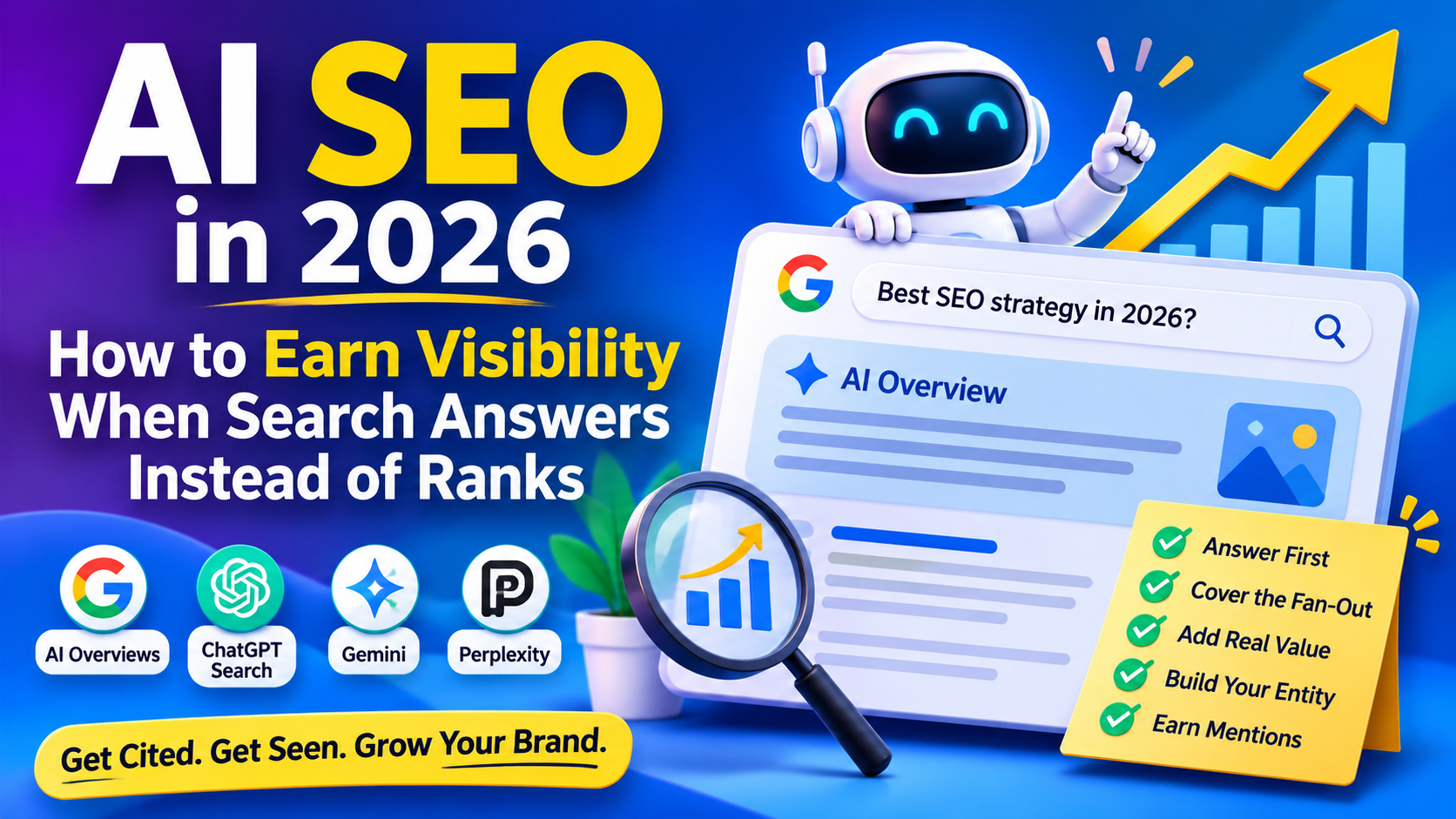
Ranking first used to guarantee a steady stream of visitors. That deal is weakening. When Google places an AI-generated answer above the results, even the top page loses a large share of its clicks, while the answer itself becomes the place where buyers first meet brands. AI SEO is the practice of earning visibility in both spaces: the classic results page and the generated answer. This guide explains what has changed, what the evidence supports, and how to adapt without chasing hype.
What AI SEO Actually Means
AI SEO is optimizing content so that answer-generating systems, including Google AI Overviews and AI Mode, ChatGPT search, Perplexity and Gemini, select, cite and recommend it. You will also see the labels GEO and AEO; they describe largely overlapping work. Traditional SEO asks whether a page can rank. AI SEO adds a second question: can a single passage from this page be lifted into an answer and credited to you?
Two mechanics shape the answer. Google says its AI features can use query fan-out, running several related searches across subtopics before composing a response. A page that covers only the head keyword therefore misses the neighboring questions the system actually asks. Google also says there are no separate technical requirements for appearing in these features beyond normal Search eligibility and sound SEO practice. There is no secret markup to add.
Why It Matters: What the Click Data Shows
Ahrefs analyzed 300,000 keywords and found that top-ranking pages had a 58% lower click-through rate when an AI Overview was present, compared with 34.5% in its April 2025 measurement. Position ten still lost nearly 20%. This is correlation measured on desktop data, but the direction is consistent.
Being cited changes the picture. Seer Interactive studied 53 brands and 5.47 million queries and found cited pages earned roughly 2.1% CTR, against about 0.9% for uncited pages and 3.3% on searches with no AI Overview. Exposure is also uneven: AI Overviews appeared on about 95% of comparison queries and 86% of question queries, but only around 5% of transactional ones. Informational, top-of-funnel traffic is most exposed; high-intent searches are least affected. More broadly, SparkToro estimated that 68% of US Google searches ended without a click in early 2026.
What Earns Citations
The most-cited research is the GEO paper from Princeton, Georgia Tech and IIT Delhi, presented at KDD 2024. It found that adding statistics, quotations and source citations improved visibility in generated answers by up to 40%, while keyword stuffing did little. One caveat: the live test covered only Perplexity, so treat the results as directional for other engines.
Platforms also behave differently. A University of Toronto study, as summarized by commentators, found that sourcing patterns differed across Claude, ChatGPT, Perplexity and Gemini, with a strong tilt toward earned, third-party media. A vendor benchmark from CiteLens claimed Google AI Mode and Perplexity drew roughly 90% of citations from Google’s top ten results, versus about 30% for ChatGPT. Vendor data deserves caution, but the lesson stands: ranking well helps on Google’s surfaces, yet it is not enough everywhere else.
A Five-Step AI SEO Framework
At Sarkar SEO, we think of AI SEO as five connected moves rather than a bag of tricks.
- Answer first, then prove. Open each section with a direct, self-contained answer, then support it. Passages that stand alone are easier to extract and attribute.
- Cover the fan-out. List the follow-up questions a buyer asks after the main one, and answer each under its own clear heading.
- Add real information gain. Publish something competitors cannot copy: original data, documented tests, named experts, first-hand screenshots. Name your sources in plain language.
- Make your entity unambiguous. Use one consistent brand name, real author bios, an accurate About page, and structured data that matches visible content.
- Earn mentions elsewhere. Reviews, expert quotes, partnerships and credible third-party coverage give answer engines independent reasons to trust you.
Keep the technical basics intact: crawlable pages, indexable content, fast loading, and no accidental blocking of the bots you want to reach.
Measure Differently
Rank tracking alone no longer tells the story. SerpApi reports that Google introduced a generative AI performance report in Search Console in June 2026, giving site owners a dedicated view of AI Overviews and AI Mode. Pair it with a monthly prompt audit: run twenty or so real customer questions across the major engines, record which domains are cited, and note whether you appear. Sarkar SEO recommends judging results by branded search growth, referral quality and conversions, since clicks understate the value of being named.
Mistakes to Avoid
- Stuffing keywords or mass-producing thin AI text; the research above shows neither helps.
- Treating AI visibility as one channel when each engine sources differently.
- Abandoning classic SEO. Strong rankings still tend to feed Google’s AI answers.
- Reporting only clicks. Brand mentions inside answers shape demand even when no click follows.
Start This Week
Pick your ten most valuable informational pages. Rewrite each opening to answer the question directly, add one original data point or named source, and list the follow-up questions you have missed. Then test the same ten topics in two or three answer engines and record the result as your baseline. Re-test in a month.
