



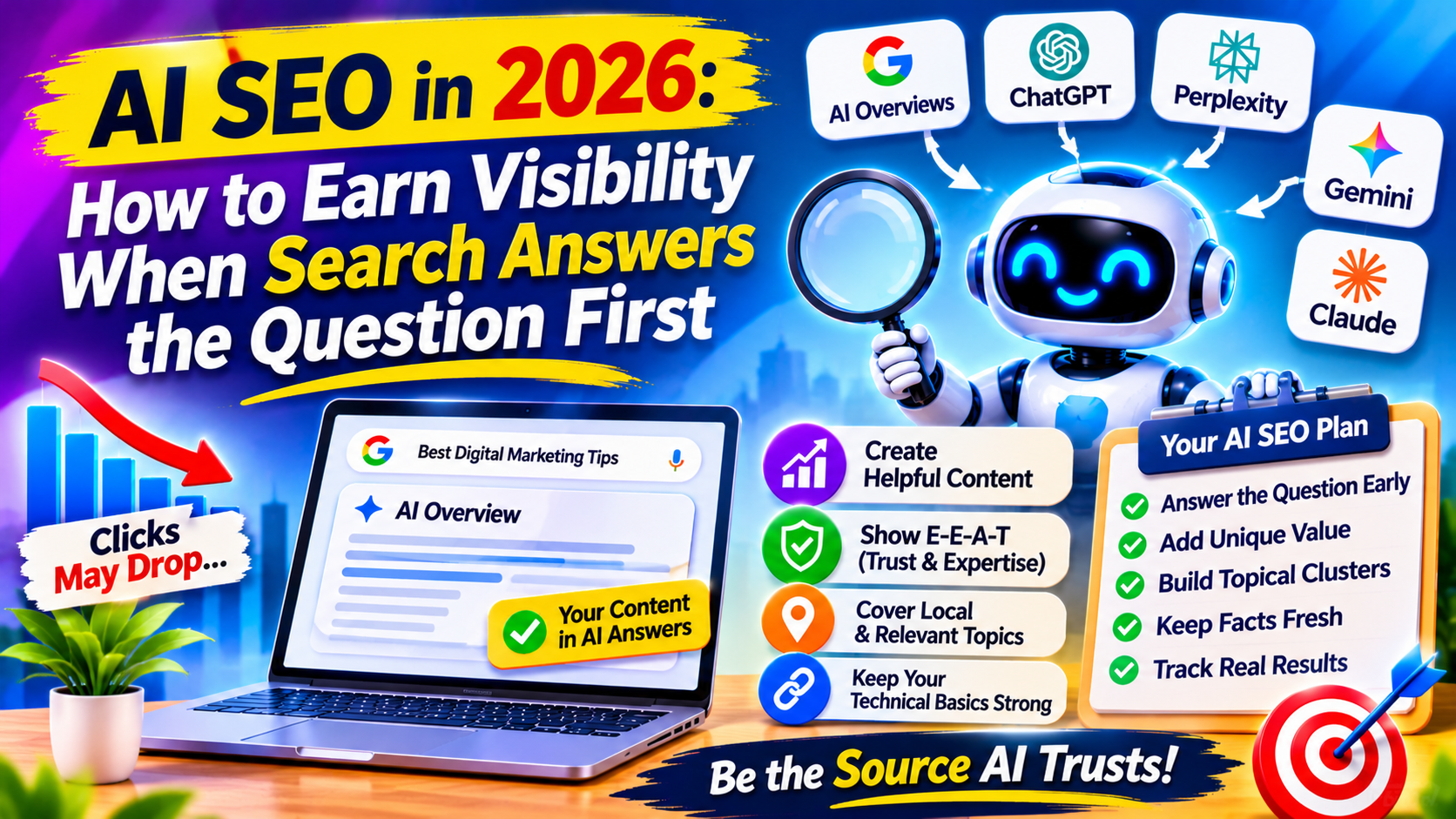
AI SEO is the practice of making your content findable, understandable and citable in search experiences that generate answers, such as Google AI SEO Overviews, AI Mode, ChatGPT, Perplexity, Gemini and Claude. Search no longer ends with ten blue links. It often ends with a paragraph, and your job is to be part of that paragraph.
Why AI SEO Matters Now
The click data explains the urgency. An Ahrefs study of 300,000 keywords found that AI Overviews correlate with a 58% lower clickthrough rate for the top-ranking page. The effect spreads down the page: pages in position two lost about half their clicks, and even tenth-place pages dropped nearly 20%.
A randomized field experiment, rather than a correlational study, points the same way. Researchers found that AI Overviews reduced outbound organic clicks by 38% on triggered queries, with zero-click searches rising from 54% to 72%. Pew Research reported that users click 8% of the time with AI Overviews, against 15% without. searchenginejournalsearchenginejournal
The picture is not purely bleak. Seer Interactive found that AI Overview click-through rates climbed from 1.3% in December 2025 to 2.4% in February 2026. Citation matters most: cited pages earned about 2.1% CTR, against roughly 0.9% for uncited pages on the same results page. Being the source is better than being invisible, though neither equals a classic top ranking in a results page with no AI answer.
Google’s Own Position: It Is Still SEO
Much of the “GEO” and “AEO” conversation has been loud. In May 2026, Google settled part of it. Its guide on generative AI features states that optimizing for generative AI search is optimizing for the search experience, and thus still SEO.
The guide also lists things you do not need for Google’s AI features: llms.txt files, content chunking, AI-specific rewrites, inauthentic brand mentions, and special structured data for AI. The one technical gate it names is that a page must be indexed and eligible to appear in Google Search with a snippet. seo-kreativlilachbullock
So the honest framing is this. AI SEO is not a separate trick. It is classic SEO plus a sharper focus on being the clearest, most trustworthy source on a topic. The same logic applies when you are targeting ChatGPT or Perplexity, since no one outside those companies publishes a guaranteed formula for them. Treat anyone selling certainty there with caution.
Know Which Queries Trigger AI Answers
Not every search carries equal risk. Seer’s data shows AI Overviews appear unevenly: about 95% of comparison queries, 86% of question queries, 36% of informational queries and only 5% of transactional queries.
That gives you a practical map:
- Question and comparison queries: expect an AI answer. Win by being cited.
- Transactional queries: AI answers are rare, so classic ranking and conversion work still dominate.
- Queries without an AI answer: Seer notes that CTR on these rose from 2.8% in early 2025 to 3.8% by February 2026, likely because quick answers are handled elsewhere and the remaining searchers want depth.
Audit your keyword set by these categories before writing anything new. At Sarkar SEO, this segmentation is usually the first step, because it shows where traffic is genuinely at risk and where it is not.
What to Do: A Practical AI SEO Framework
- Publish content that is not a commodity. If your article restates what ten others already say, an AI system has no reason to cite you. Add something only you can: first-party data, a tested process, original screenshots, a clear opinion backed by evidence, or a real case. Google’s guidance leans the same way, favoring helpful, non-commodity content.
- Answer the question early, then earn the click. Open each section with a direct, self-contained answer, then go deeper. Summaries get quoted, but depth is what makes a reader leave the AI answer and visit you. Give people a reason to click: a template, a calculator, a worked example, a comparison they cannot get in two sentences.
- Make entities and authorship obvious. Name the author, show credentials, and keep brand, product and service names consistent across your site and profiles. Machines resolve who you are through repeated, consistent signals. This builds trust, and it does not depend on any special markup.
- Protect technical eligibility. Confirm your pages are crawlable, indexable and not blocked from snippets. Keep important content in HTML text rather than buried in images or scripts. Use structured data where it supports ordinary rich results, not as an AI shortcut.
- Cover the topic as a connected cluster. Question-style queries branch into follow-ups. A cluster of linked pages covering definitions, comparisons, costs, mistakes and next steps signals real topical depth. It also lets answer engines pull the right passage for each follow-up.
- Keep facts fresh and sourced. Cite the studies you rely on, date your statistics, and update pages when the data changes. This quarter’s numbers will be stale by next year, as the swing between Ahrefs’ 34.5% and 58% figures shows.
Measure What Actually Changed
Rankings alone no longer tell the full story. Track a wider set of signals:
- Impressions versus clicks in Search Console, since rising impressions with flat clicks can mean you appear in AI answers without earning the visit.
- Citation and mention frequency across Google, ChatGPT, Perplexity and Gemini for a fixed list of your priority questions, tested monthly.
- Branded search growth, which often follows AI visibility.
- Conversions and leads per session, not just sessions.
Seer’s finding that lower CTR does not always mean worse results, because impressions can grow even as clicks fall is a reminder to read these metrics together. At Sarkar SEO, we treat engagement and conversion quality as the final judge rather than raw traffic.
Mistakes to Avoid
- Chasing formats instead of substance. Rewriting pages into bite-sized fragments for AI, or adding an llms.txt file for Google, buys no advantage according to Google’s guidance.
- Mass-producing AI-written pages. Volume without original value is the fastest route to being ignored.
- Extrapolating one year’s data. Seer’s own conclusion is that you cannot extrapolate from 2025 for your 2026 plans.
- Ignoring non-Google engines. Each assistant retrieves differently. Strong, well-sourced content that is easy to verify travels best across all of them.
