



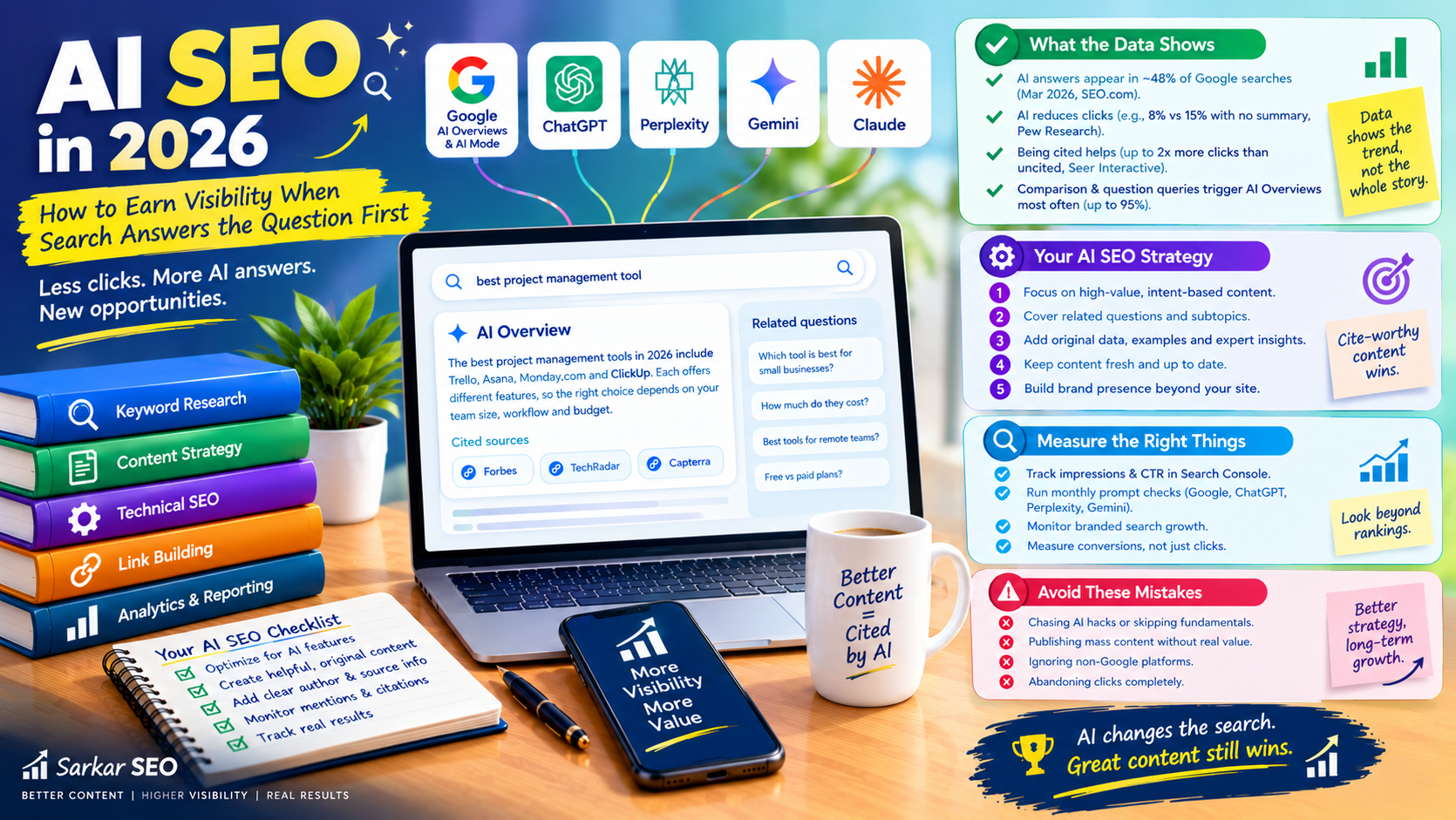
Ranking first used to mean winning the click. Now an AI-written answer often sits above the first result, and many searchers never scroll past it. AI SEO is the practice of adapting your content so it is found, trusted and cited in that environment.
This guide covers what has changed, what has not, and a practical way to plan content for it. It is written by the team at Sarkar SEO for site owners and marketers anywhere in the world.
What AI SEO actually means
AI SEO means optimizing for search experiences that generate answers: Google’s AI Overviews and AI Mode, ChatGPT, Perplexity, Gemini, Claude and similar tools. You may see it called GEO or AEO, but the goal is the same. Your page should be easy to retrieve, easy to understand and worth citing.
It is not a replacement for classic SEO. Google says its generative AI features rely on core Search ranking and quality systems, using retrieval-augmented generation and query fan-out to support responses with web content. Google’s own documentation says there are no additional requirements to appear in AI Overviews or AI Mode, and no special optimizations are necessary. You also don’t need to create new machine-readable files, AI text files or markup. Google’s New AI Search Guide Tells SEOs to Stop Chasing GEO Hacks +2
In practice, a page that cannot be crawled, indexed or trusted will not be cited by anyone. The fundamentals come first.
What the 2026 data says
The traffic impact is real, and the numbers are still moving.
An Ahrefs study of 300,000 keywords, published in February 2026, found that AI Overviews correlate with a 58% lower clickthrough rate for the top-ranking page. The same study measured a negative impact across the whole first page, from roughly -50.8% at position 2 to -19.4% at position 10. That is correlation, not proof of cause, but the direction is clear.
Seer Interactive’s data adds a more useful detail. Searches with no AI Overview averaged about 3.3% CTR, an AI Overview with a citation about 2.1%, and an AI Overview without a citation about 0.9%. Being cited more than doubles your click share on those results. Being absent is the worst outcome.
Where AI answers appear, and where they don’t
AI Overviews do not appear evenly. According to the same Seer analysis, comparison queries trigger them about 95% of the time and question queries about 86%, while transactional queries trigger them only about 5% of the time.
That split should shape your strategy:
- Comparison and question content is where AI answers dominate. Your goal here is citation and brand recall, not just clicks.
- Transactional and branded pages are still click-driven. Protect them with strong conversion pages and complete business profiles.
Sorting your keywords by this split is a better starting point than any generic “optimize for AI” checklist.
A content method built on query fan-out
Google states that both AI Overviews and AI Mode may use a “query fan-out” technique, issuing multiple related searches across subtopics and data sources to develop a response. One question becomes several hidden ones. Your page can be retrieved for any of them.
Here is the planning method Sarkar SEO recommends. It is our own working framework, not an industry standard.
- Pick one real question your customers ask, such as “Is X better than Y for a small business?”
- List the hidden sub-questions an AI would need to answer it: cost, setup time, risks, who it suits, and what the alternatives are.
- Answer each in a short, self-contained paragraph under a clear heading. Lead with the answer, then give the reasoning.
- Add what a summary cannot copy: your own test results, pricing data, screenshots, a worked example or an expert quote.
- Cut anything generic. Google’s guidance puts unique, non-commodity content at the center. It stresses providing valuable, unique content that AI systems cannot simply synthesize from elsewhere.
The last two steps matter most. If your page only restates what ten others say, an AI has no reason to cite you specifically.
Technical checks that still decide eligibility
Google’s guidance is plain on the basics. It recommends making content easy to find through internal links, supporting text with high-quality images and videos, and making sure structured data matches the visible text on the page.
A short audit list:
- Pages are indexable and not blocked by robots rules or stray noindex tags.
- Key pages are linked from related content, not orphaned.
- Structured data reflects what users actually see.
- Business Profile and Merchant Center details are current, where relevant.
- Preview controls match your intent. If you want less content shown in AI features, Google’s snippet controls apply.
None of this is glamorous, but it is where most sites lose eligibility before content quality even matters.
How to measure AI SEO honestly
Google notes that sites appearing in AI features are included in overall search traffic in Search Console. You cannot isolate AI Overview clicks cleanly there, so be careful about claiming precise attribution.
A more honest approach is to track four things together:
- Impressions and CTR trends for question and comparison queries in Search Console.
- Manual citation checks: run your target questions monthly in Google, ChatGPT, Perplexity and Gemini, and record whether you are cited.
- Branded search growth, which often rises when AI answers mention you.
- Conversions from organic visits, not just sessions. Fewer visits that convert better can be a healthy trade.
Sarkar SEO treats citation tracking as a leading indicator and revenue as the final one. Rankings alone no longer tell the full story.
Mistakes to avoid
Chasing hacks. Reports on Google’s May 2026 guidance note that it does not support treating GEO or AEO as replacements for technical SEO, content quality and Search eligibility. Tracking AI visibility separately is fine. Skipping the fundamentals is not.
Publishing at scale without substance. AI-assisted drafting is acceptable, but unedited, interchangeable pages are the least likely to be cited.
Ignoring non-Google platforms. Each assistant retrieves differently, and the evidence on what earns citations outside Google is thinner. Test rather than assume.
Abandoning clicks entirely. Informational traffic is shrinking, but transactional and branded searches still drive visits.
