



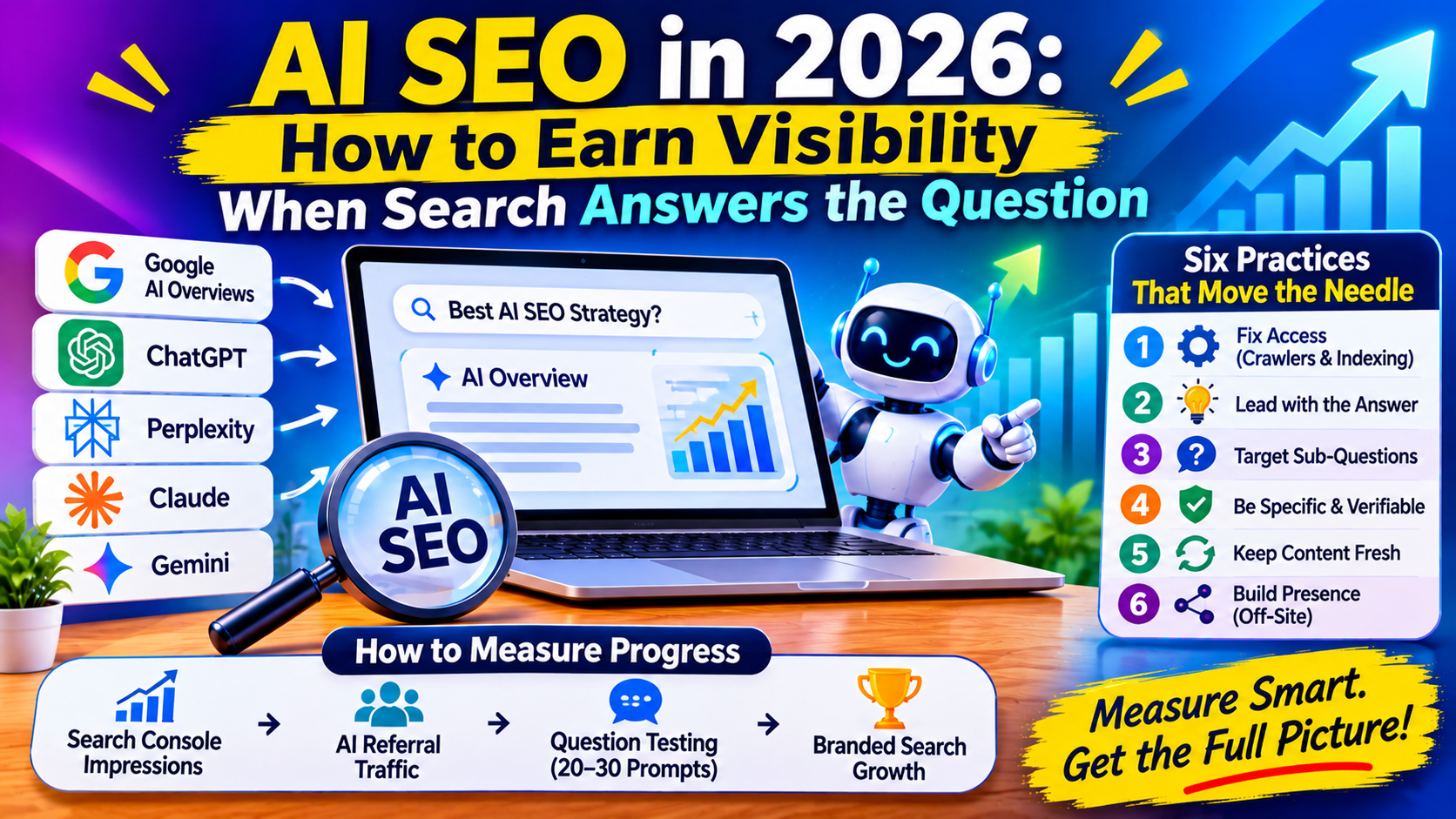
Search no longer ends with ten blue links. Google now summarizes answers on the results page, and ChatGPT, Perplexity, Gemini, and Claude respond to questions directly. AI SEO is the practice of making your content easy for these systems to find, trust, and cite, so your brand appears inside the answer itself. It extends traditional SEO rather than replacing it.
What Google Actually Says
The loudest advice online suggests AI search needs a secret playbook. Google’s own guidance says otherwise. Its documentation states that the best practices for SEO remain relevant for AI features such as AI Overviews and AI Mode, with no additional requirements or special optimizations necessary.
Eligibility is straightforward: a page must be indexed and eligible to be shown in Search to appear as a supporting link. Google also points to allowing crawling in robots.txt and through any CDN or hosting layer, making content findable through internal links, and providing a great page experience.
Two popular tactics are less necessary than vendors claim. Google does not treat llms.txt as a requirement for AI Overviews or AI Mode. And structured data is not required for generative AI search, nor is any special schema markup needed for AI features.
Why It Still Matters: The Click Data
Being visible in an AI answer and earning a visit are different things, and the data shows why strategy has to change.
An Ahrefs study of 300,000 keywords found that AI Overviews correlate with a 58% lower clickthrough rate for the top-ranking page. The effect reaches across the first page, from roughly 51% at position two down to about 19% at position ten. Separately, SparkToro data puts zero-click searches at about 68% of US Google searches in early 2026. Ahrefs: AI Overviews Cut the Top Result’s CTR by 58% +2
There is a counterpoint worth knowing. Seer Interactive found that pages cited inside an AI Overview earned more clicks than uncited pages on the same results page, roughly 2.1% versus 0.9%. Citation does not restore old traffic levels, but it clearly beats being invisible.
The effect also varies by intent. Seer reported AI Overviews appearing on about 36% of informational queries but only around 5% of transactional ones. Pages built to inform are hit hardest, while pages built to help someone decide or buy hold up better.
Six Practices That Move the Needle
- Fix access before anything else. If a crawler cannot reach a page, nothing else matters. Audit robots.txt, CDN rules, and firewall settings, and confirm key pages are indexed. Content hidden behind logins, paywalls, or accordion dropdowns may not be accessible to AI crawlers.
- Lead with the answer. Open each section with the direct response, then add nuance. AI systems pull the clearest sentence available, so burying it under three paragraphs of context costs you the citation. Keep paragraphs short and each heading focused on one question.
- Write for sub-questions, not just keywords. Google says AI Overviews and AI Mode can use query fan-out to explore subtopics and related sources. One broad query may trigger several hidden searches. Cover the follow-up questions a real buyer asks (cost, risks, alternatives, timelines) within a coherent cluster of pages.
- Be specific and verifiable. Vague references confuse machines and readers alike. Name the company, the year, and the source. Experience, expertise, authoritativeness, and trustworthiness remain the core credibility test for both Google and AI systems. Show real authors, real processes, and original data where you have it.
- Keep important pages fresh. Several industry sources report that older pages lose citations to updated competitors, though the exact decay rates come from vendor datasets and should be treated as directional. A sensible rule: review pages on fast-changing topics every few months and update facts, not just dates.
- Build presence beyond your own site. AI systems form impressions from the wider web. Consistent brand mentions, expert contributions, and accurate profiles on trusted platforms help them recognize who you are and what you are credible for.
Common Mistakes to Avoid
Do not chase tricks. Pages stuffed with keyword variations, auto-generated filler, or invented statistics fail on every front, and fabricated data can damage trust permanently. Do not assume one format wins everywhere either. Some vendors claim that ranked-list pages account for nearly all AI citations, but those findings come from small, self-reported datasets and are not independently verified.
Also avoid treating AI visibility as a ranking you can check once. Citations shift between prompts, platforms, and days. Track patterns over time rather than reacting to a single result.
How to Measure Progress
Google notes that sites appearing in AI features are included in overall search traffic in Search Console, so there is no separate AI report to rely on. Combine several signals:
- Search Console impressions and clicks by query type
- Referral traffic from AI platforms in your analytics
- A fixed list of 20 to 30 real customer questions, tested monthly across major AI tools
- Branded search growth, which often rises when you are cited repeatedly
This is where an experienced partner helps. At Sarkar SEO, we treat AI visibility as an extension of strong fundamentals: clean technical foundations first, then content structured around the questions customers genuinely ask.
A Simple 30-Day Plan
Week 1: Check crawlability and indexation for your 20 most valuable pages.
Week 2: Rewrite openings so each section answers its question first, and remove vague claims.
Week 3: Add missing sub-questions to your best pages, with sourced facts and clear authorship.
Week 4: Set up your question-tracking list and baseline the results.
Repeat monthly. Sarkar SEO recommends starting with commercial and comparison pages rather than purely informational ones, since those still send meaningful traffic.
