



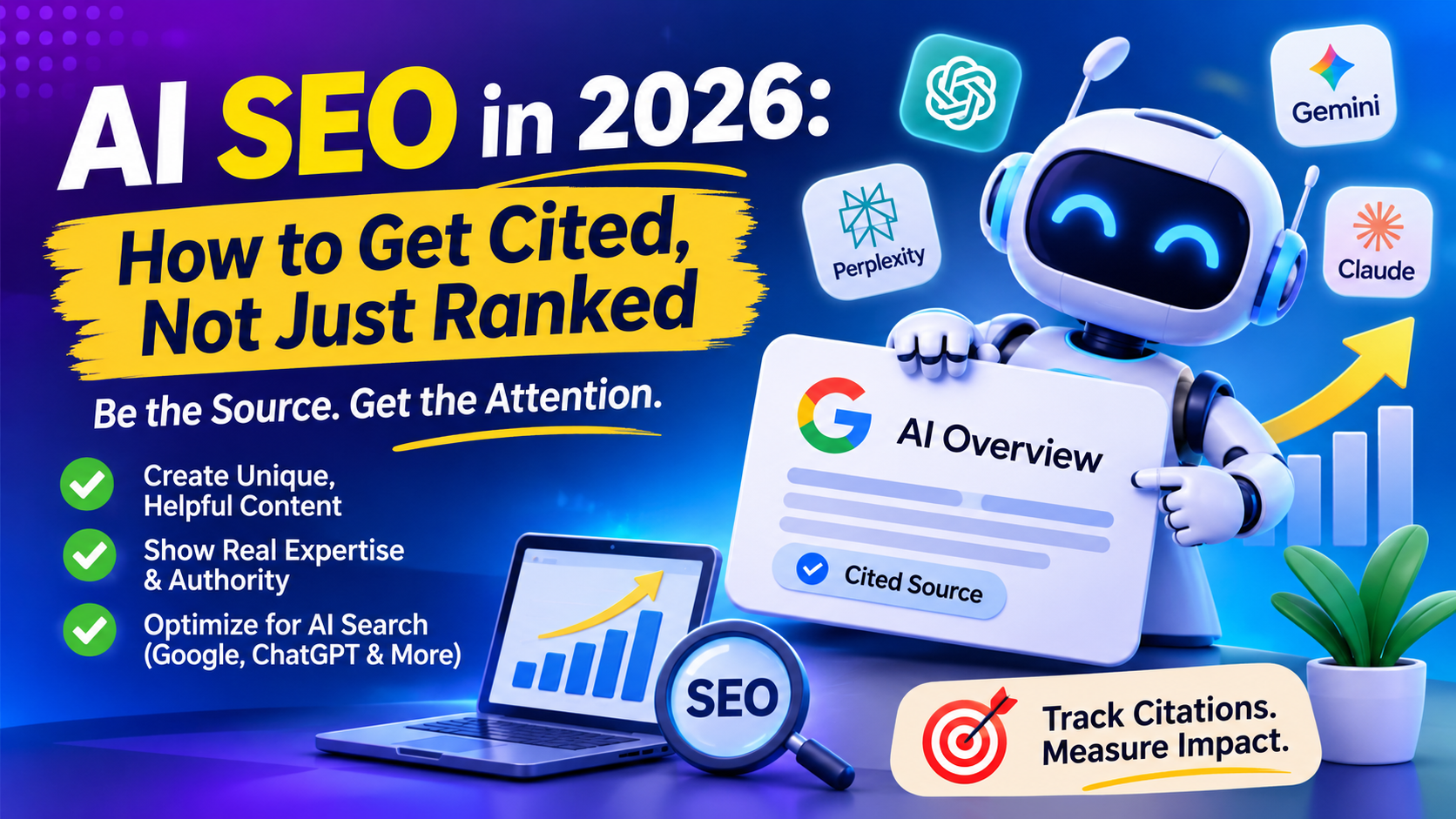
Search no longer ends with ten blue links. Google’s AI Overviews and AI Mode, ChatGPT, Perplexity, Gemini and Claude now give people a finished answer, and the sites they cite earn the attention. That shift is what people mean by AI SEO: making your content easy to find, trust and quote for both search engines and answer engines. At Sarkar SEO, we treat it as a refinement of good SEO rather than a replacement.
What AI SEO Actually Means
AI SEO covers two jobs. The first is being eligible, meaning crawlable, indexed and technically sound. The second is being worth citing, meaning your page contains something an AI system can’t get from a hundred near-identical pages.
Many teams chase the first and ignore the second, which is why so much AI-targeted content never gets cited.
What Google Has Said Officially
Google published its first dedicated guide on this topic on May 15, 2026, titled “Optimizing your website for generative AI features on Google Search,” announced by John Mueller. Its message is less dramatic than the industry hype around it.
Google’s earlier AI features documentation says that appearing in AI features depends on basics such as allowing crawling in robots.txt and any CDN or hosting layer, making content findable through internal links, and providing a great page experience. One summary of the guidance notes that the one technical gate Google names is that a page must be indexed and eligible to appear in Search with a snippet. googlelilachbullock
The most useful line in the guide concerns content. It states that creating content people find unique, compelling and useful will likely influence your presence in generative AI search more than any other suggestion in the guide.
Google also says you can skip some popular tactics. Coverage of the guide reports that llms.txt files are not necessary for Google Search and won’t improve AI Overview visibility. That applies to Google specifically. Other engines may behave differently.
Google is also testing more control. It announced a Search Console toggle that lets site owners decide whether their content appears in and helps ground generative AI responses, plus new Search Console insights on how pages appear in these features, starting with a subset of website owners in the UK. Availability may widen, so check your own Search Console account.
Every Engine Picks Sources Differently
Treating “AI search” as one system is a common mistake. A BrightEdge analysis of ChatGPT, Perplexity, Gemini, AI Mode and AI Overviews found that the overlap in top-100 cited sources between engines ranges from 16% to 59%. The same study reported that Google AI Overviews was the only engine where user-generated content citations outweighed those from authoritative institutions. brightedgebrightedge
Retrieval plumbing differs too. One analysis, citing OpenAI’s help documentation, says ChatGPT Search draws on a third-party search provider including Microsoft Bing, plus licensed publishers, so Bing visibility feeds ChatGPT. A developer write-up adds that OAI-SearchBot is separate from GPTBot, and blocking it can remove you from ChatGPT Search. Treat that as a reason to check your robots.txt, since these are secondary reports.
Citation volume varies as well. One study of 40,000 responses found Perplexity averaged about 6.6 citations per answer, Gemini about 6.1 and ChatGPT about 2.6. Fewer citations per answer means a harder fight for each slot.
Six Moves That Matter
- Fix eligibility first. Confirm that important pages are indexable, that your CDN or firewall isn’t blocking legitimate crawlers, and that Bing Webmaster Tools is set up. Many AI visibility problems turn out to be crawl problems.
- Publish information gain. Ask what your page adds that the top ten results don’t. Original data, a documented process, a real case or a defensible opinion all qualify. A rewritten version of existing articles does not.
- Answer the question early. Put a direct, self-contained answer under each heading. Research on citation behavior suggests discourse organization and information structure drive citations more than surface wording. Clear structure helps machines and people equally.
- Show real authorship. Use named authors, dated updates and sources you actually checked. For topics where mistakes hurt readers, such as health or finance, this separates a quotable page from a forgettable one.
- Build presence beyond your own site. AI engines lean on third-party material. A Yext study of 17.2 million citations found that verified, structured, directly distributed data made up 54.53% of distinct citation sources. Keep business listings, profiles and product data accurate and consistent everywhere they appear. Sarkar SEO advises clients to audit these external mentions before writing a single new blog post.
- Use structured data honestly. Mark up what is visibly on the page, such as Organization, Article, Product and Review. Never add markup for content users can’t see.
How to Measure Success
Rankings alone no longer tell the full story. Track these instead:
- Impressions and clicks in Search Console, including AI feature reporting once it reaches your account
- Citation presence for a fixed set of 20 to 30 priority questions, checked monthly across several engines
- Referral traffic from AI platforms in your analytics
- Brand and assisted conversions, since many users read an AI answer and visit later through a branded search
Run the prompt checks manually, or with a tool, using consistent wording. Because AI answers vary between runs, look at trends over several weeks rather than single results.
Common Mistakes
- Splitting every topic into tiny pages to match imagined AI queries. Google’s guidance, as one summary reports, calls a page for every fan-out query an ineffective long-term strategy.
- Publishing mass-produced AI text. Commodity content is exactly what generative systems can already produce, so it gives them no reason to cite you.
- Chasing every new file or format before the basics are fixed.
- Ignoring other engines. Strong Google rankings help, but they don’t guarantee visibility in ChatGPT or Perplexity.
A Simple 30-Day Plan
In week one, audit crawlability and robots rules. In week two, select your ten most valuable pages and add an original element to each, such as a statistic from your own work or a clear point of view. In week three, tighten structure and update authorship details. In week four, set up your citation tracking and record a baseline. Repeat quarterly.
Is AI SEO different from SEO? Largely no for Google. One industry report summarizing Google’s position says optimizing for generative AI search is optimizing for the search experience, and thus still SEO. Other engines add platform-specific considerations.
Do I need an llms.txt file? Google says it isn’t needed for its own features. It is harmless but not a priority.
Can small sites compete? Yes, if they offer firsthand knowledge larger publishers lack.
