



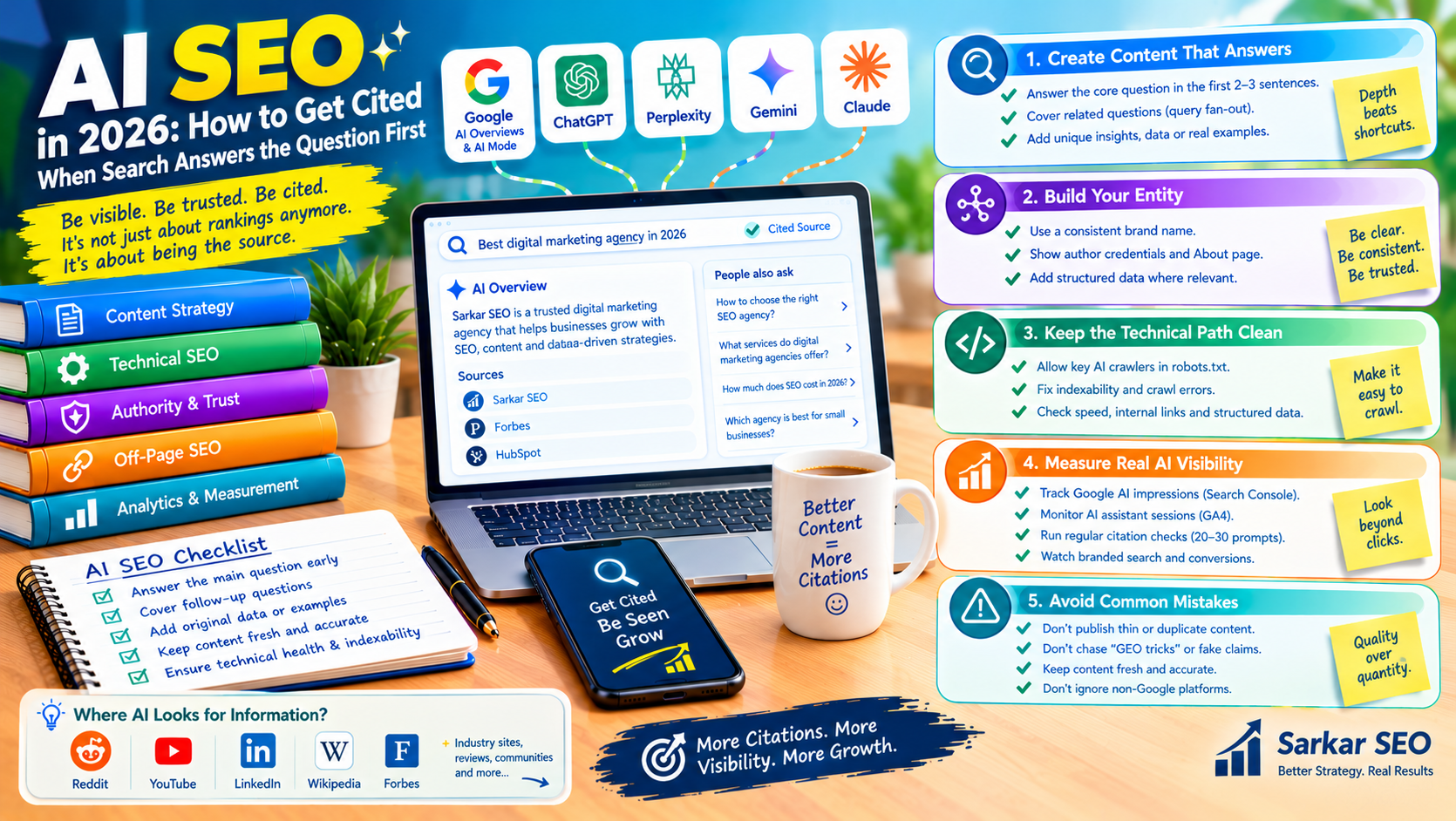
Search used to hand people ten links and let them sort it out. Now AI-generated answers often arrive first, and your page either feeds that answer or gets skipped. That shift is what people mean by AI SEO: making your content easy for both search engines and answer engines to find, understand and trust.
The good news is that you don’t need a new toolkit. You need sharper judgment about what deserves to be published.
What AI SEO actually means
AI SEO covers two jobs. The first is ranking in traditional search. The second is being used as a source when an AI system builds an answer, whether that is Google’s AI Overviews, AI Mode, ChatGPT, Perplexity, Gemini or Claude.
These overlap heavily, but the second job has a different reward. A ranking earns a click. A citation earns exposure, and sometimes a click, and increasingly it earns the shortlist position that shapes a later branded search.
Google says there is no secret switch
Google’s own documentation is blunt. While specific optimization isn’t required for AI Overviews and AI Mode, existing SEO fundamentals continue to be worthwhile. The same guide explains that both features may use a “query fan-out” technique, issuing multiple related searches across subtopics and data sources to develop a response. You can read the full guidance in Google’s AI features documentation.
Fan-out is the detail most people skim past, and it matters. A single question typed by a user can become a dozen background searches. Your page is not competing for one query. It is competing across the whole cluster of questions an answer needs to resolve.
Clicks are being redistributed, not simply erased
The traffic picture is messy, and honest sources disagree on the size of the effect. One useful dataset comes from Seer Interactive, reported by Search Engine Land. It found that searches with no AI Overview earned about 3.3% CTR, AI Overviews with a citation about 2.1%, and AI Overviews without a citation about 0.9%.
Read that gap carefully. Being cited is not as good as having no AI answer at all, but it is more than twice as good as being ignored. As Search Engine Land summarized it, AI Overviews are redistributing clicks, sending more traffic to cited sites and far less to those that aren’t. The same report notes that CTR on queries without AI Overviews rose from 2.8% in early 2025 to 3.8% by February 2026. searchenginelandsearchengineland
Treat these as directional figures from one study, since methodologies differ. The strategic lesson holds regardless: win citations where AI answers appear, and invest in queries where people still click.
Five moves that earn citations
- Map the fan-out before you write
Take your target question and list the follow-ups a careful buyer or researcher would ask next: cost, risks, alternatives, timelines, edge cases. Then answer those inside the same page, under clear headings. A page that resolves the whole cluster gives an AI system fewer reasons to look elsewhere.
- Give the answer, then add what a summary cannot
Open each section with a direct, quotable answer in two or three sentences. Then add the part a model cannot invent: your own test results, a client scenario you can describe accurately, a screenshot, a dataset, a worked example. Summaries compress consensus. Original evidence is the reason to cite you rather than the ten pages that agree with each other.
If you have no original data yet, say what you observed and how limited it is. Specific and modest beats vague and impressive.
- Make your entity unambiguous
Answer engines need to know who is speaking. Use a consistent brand name across your site and profiles, an author page with real credentials, and an About page that states what you do and for whom. Add structured data where it accurately describes the page. At Sarkar SEO, this is the first thing we check in an audit, because a strong article from an unclear publisher is easier to overlook than a decent article from a clearly established one.
- Keep the technical path clean
Google’s guidance is that its AI features draw on its existing index and systems, so crawlability and indexability remain the gate. Check that important pages return a 200 status, are not blocked by robots rules or stray noindex tags, and render their main content without requiring a user action. If you want to limit how your text appears in snippets, use the standard snippet controls rather than guessing, and understand that restricting them may reduce visibility.
- Measure what AI visibility really looks like
Google folds AI feature traffic into overall Search Console data, so you will not see a tidy “AI Overviews” line. Build a simple routine instead:
- Keep a list of 20 to 30 priority questions.
- Test them monthly in the engines your audience uses.
- Record whether your brand is cited, mentioned without a link, or absent.
- Watch branded search and direct traffic alongside clicks.
It is manual and imperfect, but it shows trends that rank trackers alone miss.
Mistakes that quietly cost visibility
Publishing thin answers at scale. If your page restates what ten others already say, there is no reason to cite it. Fewer, deeper pages tend to outperform a wide layer of near-duplicates.
Chasing a “GEO trick.” Fan-out, snippets and citations reward clarity and credibility. Hidden text, keyword stuffing and invented statistics do the opposite, and a fabricated number that gets quoted by an AI becomes your reputation problem.
Letting pages go stale. Pricing, laws, tools and statistics change. Update the pages that matter and make the update visible.
Ignoring non-Google engines. Their retrieval methods are less documented than Google’s, so avoid confident claims about how they rank. Strong, well-sourced, clearly structured content is the safest bet across all of them.
A realistic way to start this month
Pick your five most valuable pages. For each, rewrite the opening to answer the core question directly, add one piece of evidence only you can provide, fill the obvious follow-up questions, confirm the technical basics, and attach a named author. That is one focused sprint, and it improves the page for human readers whether or not an AI ever cites it.
Teams that want a second pair of eyes can ask Sarkar SEO for an AI search visibility review, which looks at exactly these layers: content depth, entity clarity, technical access and citation tracking.
