



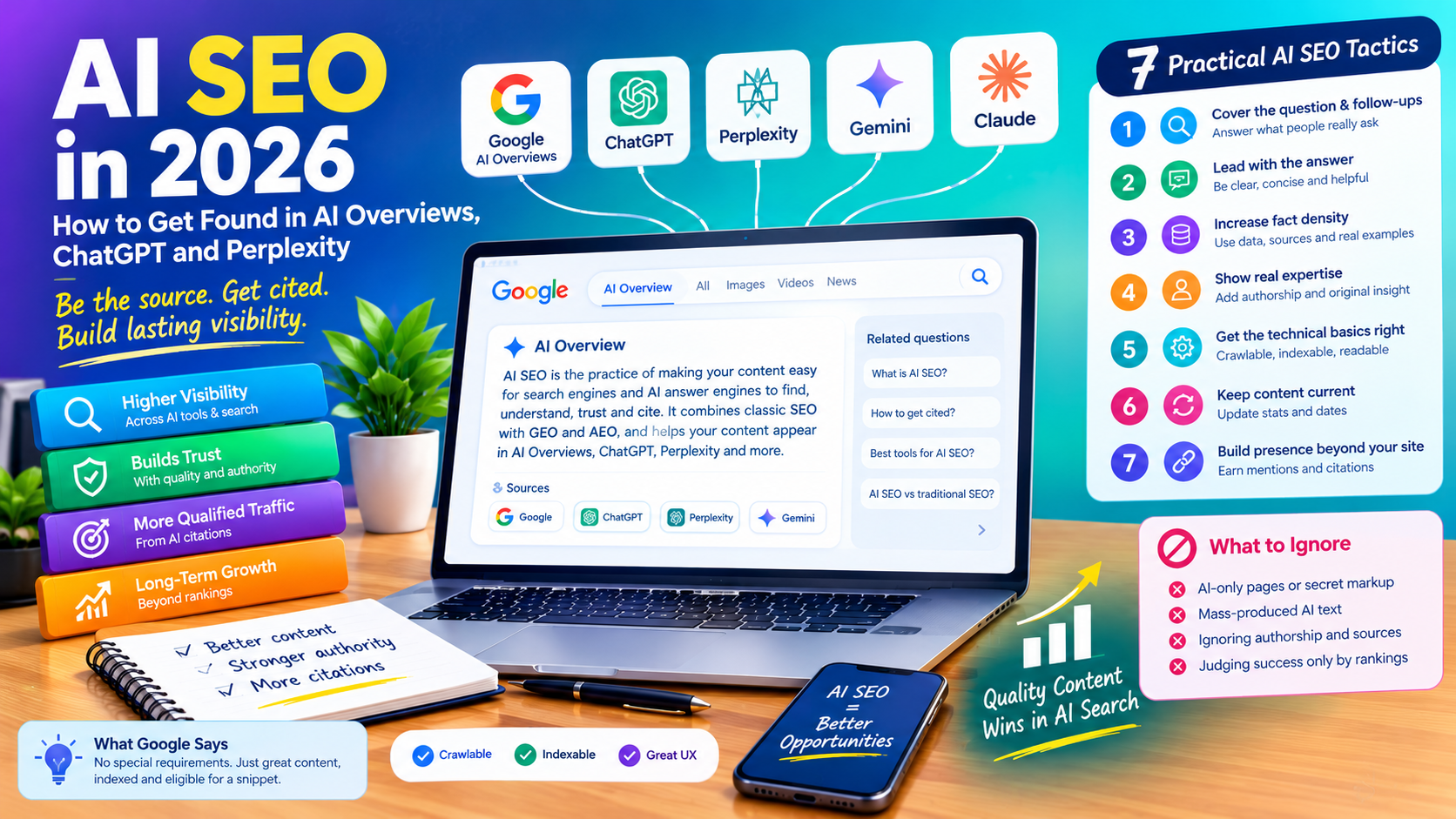
Search no longer ends with ten blue links. Google now answers many questions directly, and assistants like ChatGPT, Perplexity, Gemini and Claude build responses from a handful of cited sources. If your content isn’t one of those sources, you are invisible at the moment someone decides. That is the real challenge of AI SEO: earning a place inside the answer, not just a position beneath it.
At Sarkar SEO, we treat this as an evolution of search rather than a replacement. Here is what the evidence says and what to do about it.
What Is AI SEO?
AI SEO is the practice of making your content easy for search engines and AI answer engines to find, understand, trust and cite. It combines classic SEO (crawlability, relevance, authority) with tactics often called generative engine optimization (GEO) or answer engine optimization (AEO), which focus on being quoted in generated answers.
Why It Matters: The Click Is Shrinking
The data shows the pressure on traffic. A randomized field experiment found that AI Overviews reduced organic clicks by 38% on queries where they appeared, and zero-click searches rose from 54% to 72%. You can read the details in Search Engine Journal’s coverage of the study. Pew Research found users click 8% of the time when an AI summary appears, compared with 15% without one.
Being cited changes the picture. Seer Interactive’s 2026 update found that cited URLs earn 120% more organic clicks per impression than uncited URLs. Google also says clicks from results pages with AI Overviews tend to be higher quality, with users more likely to spend time on the site. Fewer clicks are available, but the ones you win are worth more, and visibility inside the answer is now the prize.
What Google Actually Says
There is a lot of hype about “AI-only” tricks, so start with Google’s own position. Google states that there are no additional requirements to appear in AI Overviews or AI Mode, and no special optimizations are necessary. A page must be indexed and eligible to be shown with a snippet to qualify as a supporting link.
The fundamentals Google lists are simple: allow crawling in robots.txt and through any CDN or hosting layer, make content findable through internal links, and provide a great page experience. Read the full AI features and your website guide on Google Search Central. In short, if someone sells you a secret AI file or markup, be skeptical.
The Complication: Every AI Engine Chooses Differently
Ranking well on Google does not guarantee citations elsewhere. One analysis of 22.7 million citations across ChatGPT, Gemini, Perplexity, AI Overviews and AI Mode found that 79.6% of sources appeared on only one engine. A large academic study of commercial questions also found that the paragraph that best matches the question increased citations on every engine tested, and older pages received fewer citations from ChatGPT and Gemini.
The implication is that no single trick works everywhere. Broad quality, clear passages and fresh content travel best across engines.
Seven Practical AI SEO Tactics
- Cover the question and its follow-ups. Google’s query fan-out can expand the set of results considered for a request. Map the main question plus the comparisons, objections and next steps a reader will ask, and answer them on one authoritative page or a tight cluster.
- Lead with the answer. Put a direct, self-contained answer of 40 to 60 words under each heading, then add depth. Because engines favor the best-matching paragraph, every section should work as a standalone excerpt.
- Increase fact density. In the Princeton-led GEO research, adding quotations, statistics and citations improved visibility by up to 40%, with the strongest gains for lower-ranked websites. Name your sources, date your data and cut vague claims. Keyword stuffing is not the answer.
- Show real expertise. Use named authors, credentials, original data, screenshots and case results. Google’s guidance points to creating helpful, reliable, people-first content. First-hand evidence is the hardest thing for competitors, and for generic AI content, to copy.
- Get the technical basics right. Confirm key pages are indexable, internally linked and readable as text, not locked in images or scripts. Structured data is useful for clarity, but treat it as support rather than a shortcut.
- Keep content current. Refresh statistics and dates on your best pages at least quarterly. Stale pages lose ground, especially on engines that weigh recency.
- Build presence beyond your own site. One study found ChatGPT and Claude concentrate citations on third-party editorial sites, with brand sites making up a comparatively low share. Earn mentions through expert contributions, credible directories, partnerships and communities where your audience already looks. This is why Sarkar SEO pairs on-page work with authority building rather than treating them separately.
How to Measure AI Visibility
Traditional rank tracking alone will miss the picture. Use a simple monthly routine:
- Build a fixed list of 20 to 30 real customer questions.
- Run them across Google, ChatGPT, Perplexity, Gemini and Claude, and log whether your brand or pages are cited.
- Watch Search Console impressions and clicks on your answer-style pages.
- Segment AI referral traffic in your analytics and track conversions, not just sessions.
Citation sets shift quickly, so a one-off check tells you little. Trends over several months are what count.
Common Mistakes to Avoid
- Publishing mass-produced, lightly edited AI text with no original insight.
- Creating separate “AI-only” pages instead of improving the pages that already rank.
- Ignoring authorship, sources and brand signals.
- Judging success only by rankings and ignoring citations and lead quality.
