



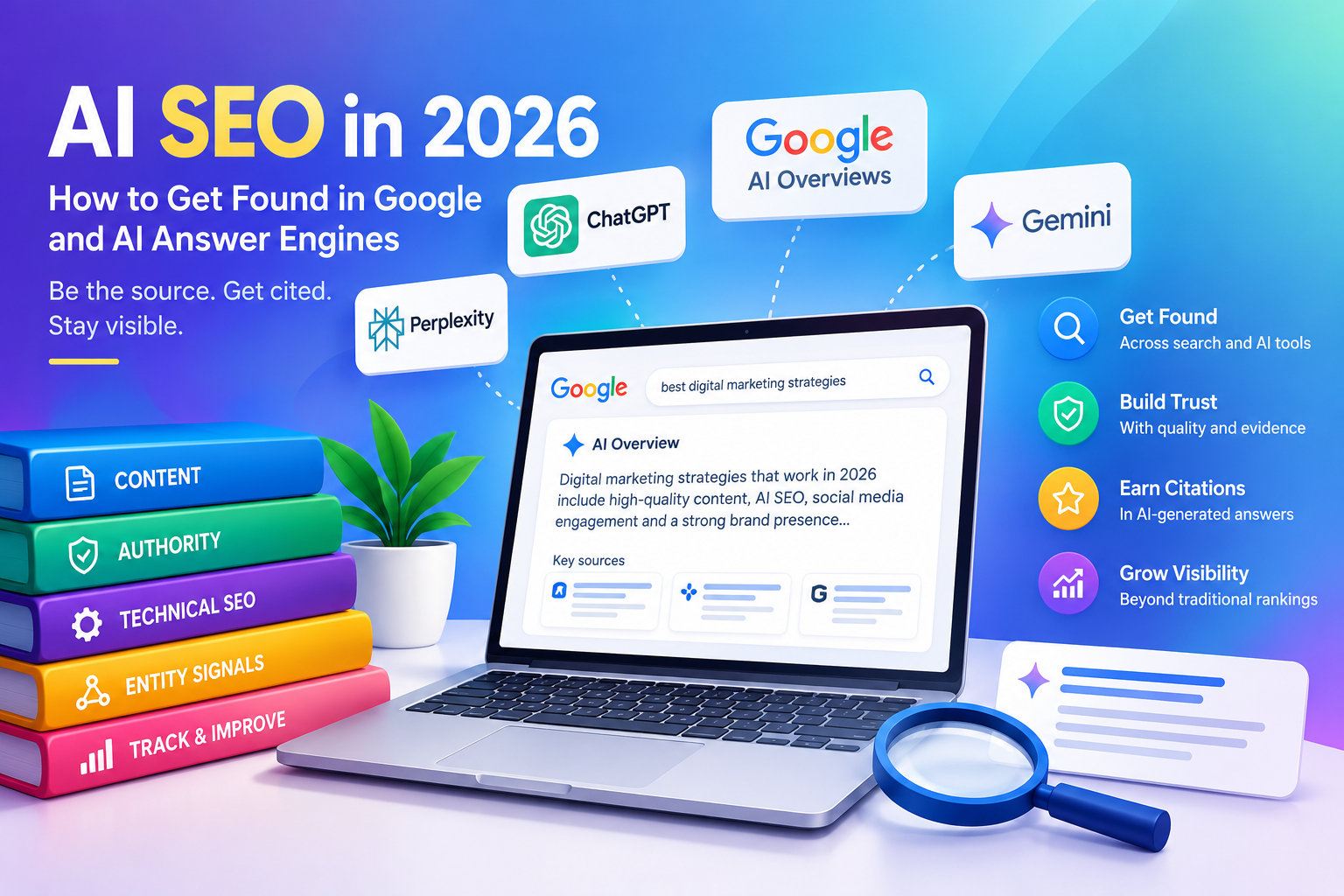
Search no longer ends with ten blue links. Google’s AI Overviews and AI Mode, ChatGPT, Perplexity and Gemini now summarise answers before anyone visits a website. AI SEO is the practice of making your content easy to find, trust and cite across all of those surfaces. It rests on the same foundations as strong traditional SEO. At Sarkar SEO, we treat it as classic search discipline with a sharper focus on clarity, evidence and authority.
What Is AI SEO?
AI SEO means optimising your website so search engines and AI assistants can retrieve, understand and cite your content inside generated answers. You will also see the terms generative engine optimisation (GEO) and answer engine optimisation (AEO). The labels differ, but the goal is the same: become a source that answers are built from.
Google’s position is reassuring. Its May 2026 guide says generative AI features run on the same crawling, indexing, ranking and quality systems as regular Search, with no special AI files, markup or AI-only content required. Read Google’s official generative AI guide before buying any “AI-ready” tool.
Why AI SEO Matters Now
The click data explains the urgency. Pew Research found people clicked a result in about 8% of visits when an AI summary appeared, versus 15% without one. Ahrefs measured a 34.5% lower click-through rate for the top page in its original study, and a later analysis comparing December 2023 with December 2025 put the drop near 58%. Seer Interactive’s study, as reported by secondary sources, saw organic CTR on AI Overview queries fall from 1.76% to 0.61%, then rebound to roughly 2.4% by February 2026, still below queries without an overview.
The studies use different methods, so treat the exact figures as directional. The message is consistent: ranking alone no longer guarantees traffic. You also need visibility inside the answer, and a brand memorable enough to be searched by name.
How AI Systems Choose What to Cite
Google describes a process called query fan-out, where one search is split into several related sub-queries. A page that covers a topic thoroughly, in clearly separated sections, has more chances to match one of them. AI systems also lift passages rather than whole pages, so every section should make sense on its own.
Seven Practical Steps
- Fix eligibility first. A page can only be cited if it can be crawled and indexed. Check robots.txt, CDN and hosting rules, and keep key content in text rather than images or scripts.
- Lead with the answer. Put a short, direct answer under each question-style heading, then add nuance. Readers get value quickly, and passages are easy to extract.
- Add information gain. Google says unique, non-commodity content has the biggest long-term impact. Original data, real examples, expert review and honest limitations beat another rewrite of the top ten results.
- Build topic clusters. Connect a main guide to supporting articles through descriptive internal links. Sarkar SEO usually begins here, because thin, isolated posts rarely earn citations.
- Strengthen entity and trust signals. Use named authors with real credentials, a clear About page and consistent business details across the web. Organization and Article schema help machines understand a page, though they are not a dedicated AI switch.
- Keep feeds and profiles current. For products or local services, keep Google Merchant Center and Business Profile accurate.
- Measure visibility, not just rankings. Track impressions and clicks in Search Console, which has been rolling out reports for AI features. Then list 20 to 30 prompts your customers would ask, run them monthly across ChatGPT, Perplexity, Gemini and Google, and record whether you are mentioned or cited.
A Quick Prioritisation Framework
Not every page deserves the same effort. Sort your URLs into three groups.
- Already ranking, informational: These are most exposed to AI summaries. Rewrite the opening, add original evidence and make each section stand alone.
- Commercial or local pages: Accuracy matters most here. Keep prices, services, reviews and business details consistent everywhere they appear.
- Branded and navigational queries: Protect them with strong entity signals, because people searching your name are the audience least likely to be replaced by a summary.
Start with five pages from the first group. Small, measured rewrites teach you more than a site-wide overhaul, and Sarkar SEO recommends recording results monthly so you know which changes earn citations.
Common AI SEO Myths
“I need special AI files or markup.” For Google, no. Useful content on a technically sound site is the requirement.
“Schema guarantees citations.” It does not. It clarifies context but cannot replace quality.
“AI-generated content is penalised automatically.” Google says much content, including AI-assisted, can perform well. The real risk is commodity content that adds nothing new.
“I can simply opt out.” Google has begun offering a Search Console control, but sites that opt out receive no traffic or impressions from those features. For most businesses, optimising beats hiding.
Frequently Asked Questions
Is AI SEO different from SEO? Mostly it extends it. Crawlability, helpful content and authority still apply; AI SEO adds answer-first structure, entity clarity and tracking across several platforms.
How long until I appear in AI answers? There is no reliable timeline. Citations depend on competition, authority and how well your content answers the query, so measure monthly.
Which platforms should I optimise for? Start with Google, since its AI features draw on organic rankings, then test ChatGPT, Perplexity and Gemini with your own prompt list.
