



Search used to be ten blue links. Now it is often a short, model-written answer with a few sources beside it. If you publish online, that changes what “ranking” means.
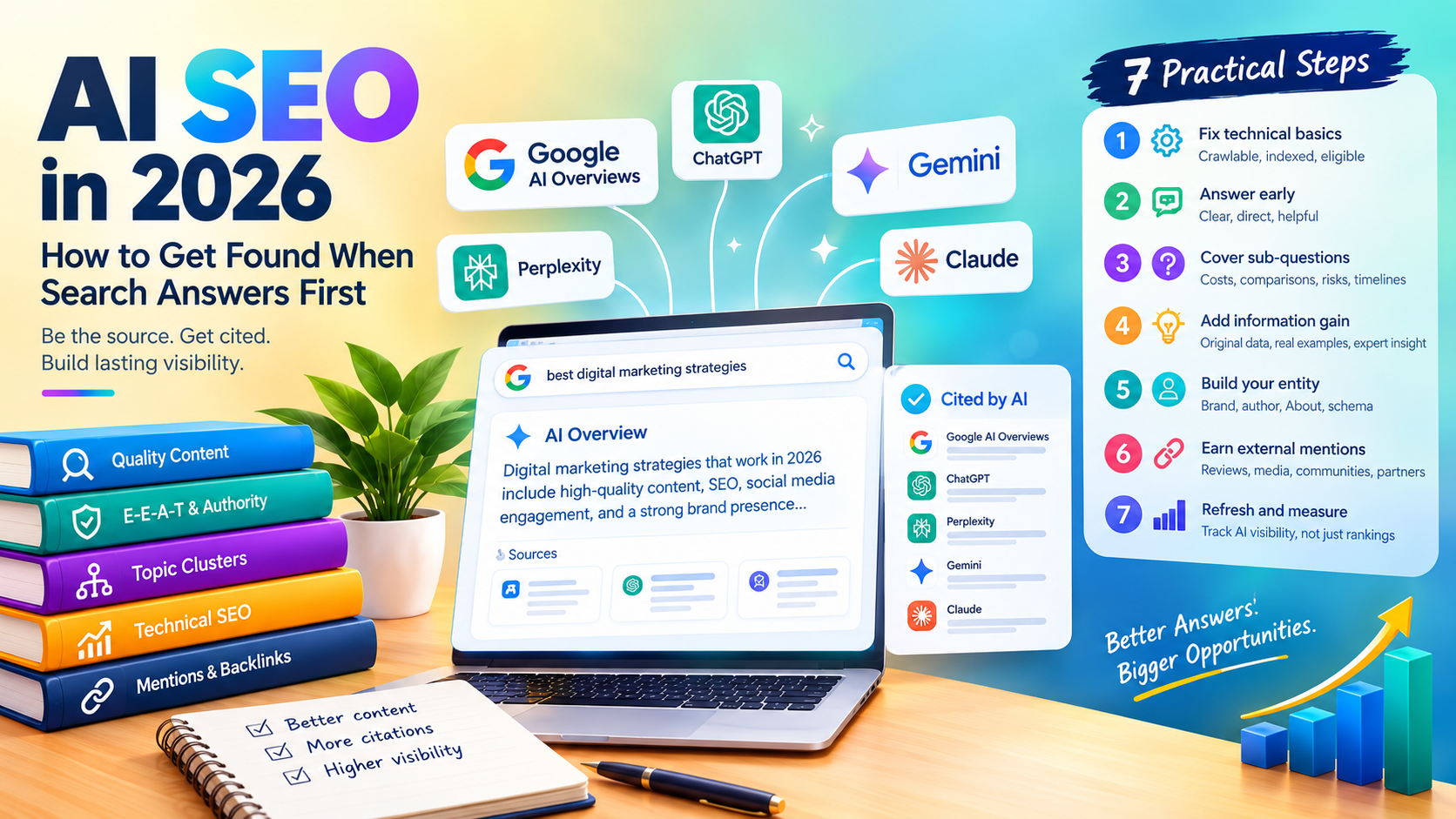
AI SEO is the practice of making content easy for search engines and answer engines to find, understand, trust and cite. It covers Google’s AI Overviews and AI Mode, plus tools such as ChatGPT, Perplexity, Gemini and Claude. At Sarkar SEO, we treat it as classic SEO held to higher standards of clarity, evidence and reputation.
What AI SEO Actually Means
Terms like generative engine optimization (GEO) and answer engine optimization (AEO) describe one goal from different angles: becoming a source an AI system draws on when it builds an answer.
It is not a separate discipline. Google’s documentation for site owners says there are no additional requirements to appear in AI Overviews or AI Mode. A page simply needs to be indexed and eligible to show with a snippet. The details are in Google’s guide to AI features and your website.
Why It Matters: The Click Problem
The pressure on clicks is real, though the numbers vary by study. Ahrefs analyzed 300,000 keywords and found that top-ranking pages had a 58% lower average click-through rate when an AI Overview appeared, up from 34.5% in its earlier study. Pew Research Center’s browsing data points the same way: users clicked a traditional result in 8% of visits with an AI summary, against 15% without one.
The picture is not entirely bleak. Seer Interactive’s data, as reported by third-party analysts, showed click-through rates on AI Overview queries partly recovering in early 2026, and brands cited inside an overview earned more clicks than similarly ranked pages that were not.
These studies measure different things, such as desktop Search Console data versus real browsing behavior, so treat them as direction, not destiny. The consistent lesson is that ranking alone is no longer the whole game. Being cited is a second layer of visibility.
How AI Search Chooses Its Sources
Nobody outside these companies knows the exact selection formulas, and anyone promising a guaranteed recipe is guessing. Google has said that AI Mode and AI Overviews can use query fan-out, which splits a question into related subtopics and gathers material across many sources. AI Mode may also show plain web links when confidence in an AI answer is low.
The implication is simple. A page that answers the main question and its likely follow-ups gives an AI system more reasons to use it. Thin, single-angle content gives it fewer.
Seven Practical Steps to Improve Your AI SEO
- Get the technical basics right. Make sure important pages are crawlable, indexed and snippet-eligible. Review robots.txt so you are not blocking systems you want to reach. Search Console also has a setting that controls whether your content can appear in Google’s generative features, so confirm it matches your intent.
- Answer the question early. Open each section with a direct answer, then add depth. Readers get what they need quickly, and answer engines can lift a clean passage without guessing your meaning.
- Cover the sub-questions. Map the follow-ups a curious reader would ask next: costs, comparisons, risks, timelines, alternatives. Cover them in the same article or in tightly linked supporting pages.
- Add information gain. This is where most content fails. If your page repeats what ten others say, an AI system has no reason to prefer it. Include original data, real examples, expert commentary or a clear point of view, and only claim experience you actually have.
- Make your entity obvious. Use one consistent brand name, real author bios, a clear About page and contact details. Add structured data only where it matches visible content. Schema helps machines understand a page, but it is not a ticket into AI answers.
- Earn mentions beyond your own site. AI systems learn about brands from the wider web. Reviews, industry publications, community discussions and partner pages all contribute. For Google, keep your Business Profile and Merchant Center details accurate, since its AI features can draw on those too.
- Refresh and measure. Update statistics regularly. In Search Console, traffic from AI features is counted within overall search performance, so watch impressions and clicks by page. Each month, ask ChatGPT, Perplexity, Gemini and Claude your ten most important customer questions, then record whether your brand appears and which sources get cited.
Common AI SEO Mistakes
Writing for machines instead of people. Keyword stuffing and bloated FAQ sections make content worse, and readers remain the ultimate test.
Mass-producing generic content. More of the same adds noise, not value. One well-researched page with original insight beats twenty interchangeable ones.
Abandoning fundamentals. Fast pages, clean architecture, helpful internal links and honest titles still decide whether you are eligible at all.
Promising rankings in ChatGPT. AI answers vary by prompt, location and time. Report visibility trends, not guarantees.
A Realistic AI SEO Roadmap
You do not need a new strategy overnight. A sensible order looks like this:
- Month one: audit technical health, indexing and your most valuable pages.
- Month two: rewrite key pages with direct answers, sub-question coverage and original evidence.
- Month three: strengthen brand mentions, author pages and external references, then begin monthly prompt tracking.
- Ongoing: refresh content and review what AI systems cite in your niche.
This is how Sarkar SEO approaches growth: build durable authority first, then let visibility follow.
