



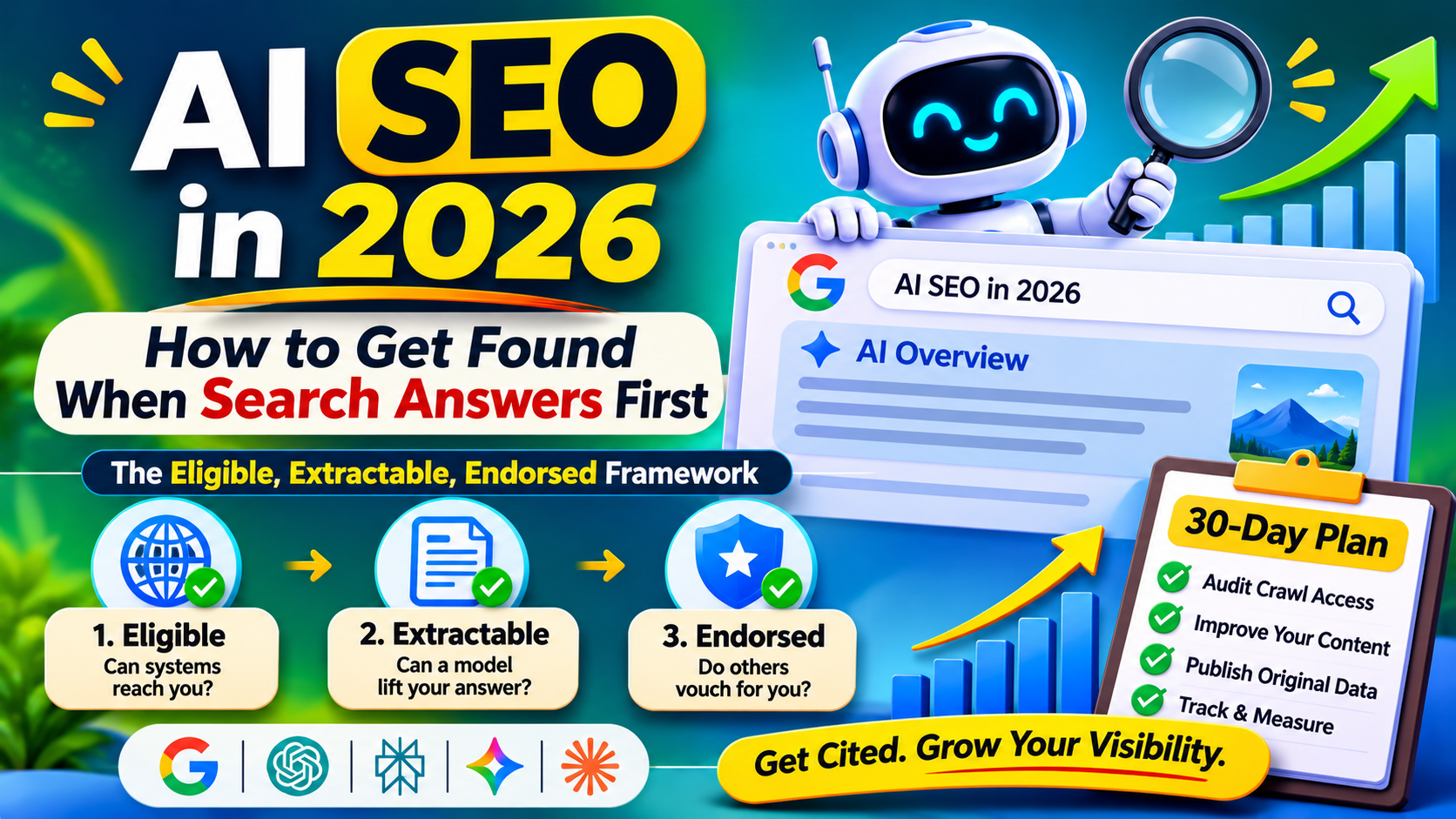
Search no longer ends with ten blue links. For many queries, an AI-written summary appears first, assembled from several sources, and the reader may never scroll further. AI SEO is the work of making your content crawlable, easy to extract, and credible enough to be cited by those systems, including Google AI Overviews, AI Mode, ChatGPT, Perplexity, Gemini and Claude. This guide separates what Google officially says from what independent studies suggest, then offers a practical framework.
What AI SEO Actually Means
AI SEO is the practice of optimizing a website so search engines and AI answer engines can find its pages, pull accurate passages from them, and trust them enough to cite or recommend them. You will also see the labels GEO (generative engine optimization) and AEO (answer engine optimization). They describe overlapping goals, and the label matters less than the outcome: being named inside the answer.
Google’s documentation is refreshingly blunt. It says there are no additional requirements for appearing in AI Overviews or AI Mode. A page simply needs to be indexed and eligible to appear in Search with a snippet. You do not need new machine-readable files, AI text files, or special schema markup.
Both features may use “query fan-out,” meaning several related searches across subtopics run before a response is composed. The likely implication: your page can be pulled into an answer through a subtopic you never targeted directly, so clear, deep coverage pays off.
Why It Matters: The Click Problem
Visibility and clicks are separating. A Pew Research Center analysis, as reported by Tech Insider, found people clicked a traditional result 8% of the time when an AI summary appeared, versus 15% without one. Ahrefs reported that position one earned 58% fewer clicks when an AI Overview was present, comparing December 2025 with December 2023. A randomized study of 1,065 Chrome users, reported in July 2026, found a 39.8% drop in outbound clicks.
The studies compare keyword groups or time periods, and none measures clicks on AI Overview links directly. Estimates range from about one-third to nearly 60%. The direction is consistent, though: ranking alone guarantees less traffic than before. Google, for its part, says clicks from pages with AI Overviews tend to be higher quality, and Seer Interactive reported that brands cited in AI Overviews saw 35% higher organic click-through rates.
The Eligible, Extractable, Endorsed Framework
Sarkar SEO uses a three-layer lens for AI SEO. Each layer must work before the next one matters.
- Eligible: Can systems reach you?
- Confirm robots.txt and any CDN or hosting firewall allow crawling.
- Verify indexing in Search Console. Snippet restrictions such as nosnippet limit what can be shown.
- Decide deliberately about AI crawlers. Practitioner guides note that blocking bots like OAI-SearchBot, PerplexityBot or ClaudeBot removes you from those engines’ retrieval. If you block for business reasons, accept the visibility cost knowingly.
- Extractable: Can a model lift your answer cleanly?
AI systems quote passages, not pages. Write so each section survives being copied out of context.
- Open sections with a direct, standalone answer. Practitioners often suggest 40 to 80 words; treat that as a heuristic, not a rule.
- Use descriptive headings phrased like real questions.
- Keep key facts in text, not images or scripts. Google lists textual availability as a best practice.
- Use tables for comparisons, and make sure structured data matches the visible text.
- Endorsed: Do others vouch for you?
Retrieval gets you considered; trust gets you cited. Original data, named expert authors, consistent brand details across the web, and mentions on sources engines already trust all help. Citation pools also differ. One analysis reported by Pixis, synthesizing more than 680 million citations, found only 11% of domains were cited by both ChatGPT and Perplexity.
How the Engines Differ
A 2026 preprint analyzing 602 controlled prompts found Perplexity averaged 16.35 citations per answer, Google AI Overviews 12.06 and ChatGPT 6.88. The authors also found ChatGPT cited fewer sources but let each fetched page influence the answer more. This is a preprint, not peer-reviewed consensus, but it suggests a sensible split: in ChatGPT, be the single best source on a narrow question; in Perplexity and Google, supporting pages across related subtopics widen your chances.
Mistakes That Waste Budget
- Hunting for secret markup. Google says none is required.
- Mass-producing AI pages. Without original insight, they give models nothing worth citing.
- Reporting only rankings. Rankings no longer show whether you appear inside answers.
- Trusting one prompt test. Outputs vary run to run.
Measuring Progress Honestly
Google folds AI feature traffic into the Search Console Performance report under the Web search type, so you cannot isolate it there. Pair it with conversion data from your analytics tool.
For other engines, build a fixed set of 20 to 30 questions your customers actually ask. Run them monthly in ChatGPT, Perplexity, Gemini, Google and Claude, and log whether you are cited. Expect noise: a SparkToro study ran 12 prompts 2,961 times across 600 volunteers precisely because answers are probabilistic. Sarkar SEO suggests tracking trends in citation share, branded search and conversions together, never a single result.
Sarkar SEO’s 30-Day Starting Plan
- Week 1: Audit crawl access, indexing and snippet controls.
- Week 2: Rewrite your ten most valuable pages with answer-first openings, clear headings and visible author credentials.
- Week 3: Publish one original asset, such as a survey, benchmark or dataset, that others can cite.
- Week 4: Run your prompt set to create a baseline, then repeat monthly.
