



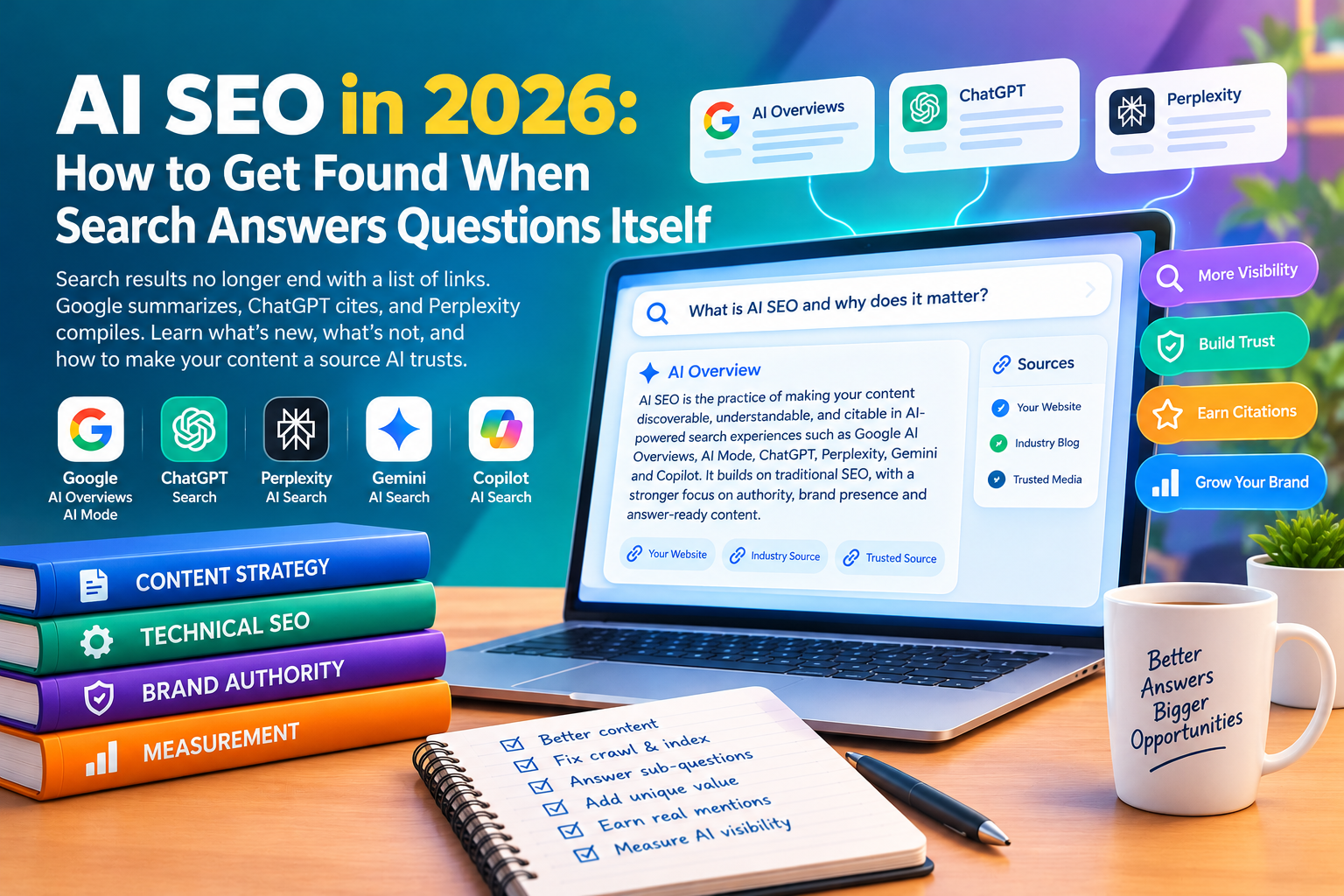
Search results no longer end with a list of links. Google summarizes, ChatGPT cites, and Perplexity compiles. For website owners this raises a practical question: what does AI SEO involve, and is it different from the SEO you already do?
The short answer is that it is mostly the same discipline, with a few shifts in emphasis. This guide explains which parts are new, which are not, and what to do about them.
What AI SEO Actually Means
AI SEO is the practice of making your content discoverable, understandable, and citable in AI-powered search experiences such as Google AI Overviews, AI Mode, ChatGPT search, and Copilot. The term is also used for something different: using AI tools to speed up SEO tasks such as research and drafting. This article covers the first meaning.
Does Google Treat AI Search as a Separate Discipline?
No. In May 2026, Google published a guide on optimizing for generative AI features that stresses unique, non-commodity content, debunks common “AEO/GEO” misconceptions, and explains why SEO best practices remain foundational. The documentation also says you can apply the same foundational SEO practices to AI features as to Google Search overall: meet the technical requirements, follow Search policies, and create helpful, reliable, people-first content. No special schema.org structured data is required either. A new resource for optimizing for generative AI in Google Search +2
This matters because it cuts through a lot of hype. You do not need a secret file or a hidden markup trick. You need a site that is crawlable, indexable, and worth citing.
How AI Search Picks Its Sources
Understanding the retrieval process shows where your effort should go. AI Mode, and to a lesser degree AI Overviews, use a technique called query fan-out, which splits one question into several sub-queries and surfaces supporting links from indexed pages. A single prompt can therefore pull from many pages, and each page competes on one narrow sub-question rather than the whole topic.
The practical consequence is that broad, thin pages lose to pages that answer a specific question completely. AI Overviews also trigger most often on informational, question-shaped queries, such as “how,” “what,” “best,” “vs,” and “why.” If your content strategy ignores these formats, you are absent from the places where AI answers form.
The Traffic Reality
Visibility in AI answers does not always mean clicks. One analysis reported that organic click-through rate fell from 1.76% to 0.61% when an AI Overview was present. Figures like this come from third-party studies and vary by query type, so treat them as directional rather than universal.
The takeaway is to measure differently. A citation can build brand recognition even when the user never visits, as one industry write-up argues, saying that being cited in an AI answer puts your brand in front of the user even without a click. That makes brand searches, assisted conversions, and lead quality more telling than raw sessions.
Seven Practical Steps That Hold Up
- Fix crawling and indexing first. AI features draw on the Search index, so a page that cannot be indexed cannot be cited. Check canonicals, robots rules, and rendering before anything else.
- Lead with the answer. Open each section with a clear, self-contained statement that resolves the question, then add nuance below it. This helps readers first and extraction systems second.
- Cover sub-questions, not just keywords. Map the follow-up questions a person would ask after the first answer, and give each its own section or page. This matches how fan-out works.
- Add information others lack. Google’s guidance emphasizes unique, non-commodity content. Original data, case observations, screenshots from your own tests, and expert commentary are far harder to replace than rewritten summaries.
- Build internal links with intent. Google lists making content easily findable through internal links as a technical requirement. Link related guides together so crawlers and readers can follow the topic path.
- Keep structured data honest. Google says structured data should match the visible text on the page. Markup that describes content users cannot see helps no one.
- Make authorship visible. Name real authors, state credentials, and show how you gathered information. Trust signals matter more as AI systems choose among similar answers.
Controls and Measurement
You have more say over AI exposure than many owners realize. Google points to preview controls such as nosnippet, data-nosnippet, max-snippet, and noindex to limit what appears in Search, and notes that Google-Extended governs AI training and grounding in some other Google systems. googlegoogle
For measurement, AI feature traffic is reported inside the Web search type of the Search Console Performance report. Reports in June 2026 also described new Search Console toggles and dedicated generative AI performance reports, initially tested with a select group of UK site owners before wider rollout. Availability may still be expanding in your market, so check your own account.
For other engines, such as ChatGPT or Perplexity, there is no unified dashboard. Run a fixed set of target questions monthly, record which sources get cited, and track changes over time. Keep the method consistent, since AI answers vary between runs.
What to Avoid
Skip mass-produced pages written only to cover keyword variations. Google states its systems aim to reward original, high-quality content however it is produced, but volume without value rarely earns citations. Also avoid chasing every new acronym. If a tactic cannot be explained in terms of helping a reader or helping a crawler, it is probably noise.
A Realistic Way to Start
Pick your ten most commercially important topics. For each, list the questions a buyer asks, check whether your pages answer them directly, and improve the weakest ones first. Sarkar SEO follows this kind of audit-first approach, because rewriting a page nobody can crawl wastes effort. Teams that want outside perspective can bring in Sarkar SEO for a content and technical review, but the process above works in-house too.
Revisit your pages quarterly. AI search products change quickly, and what the Sarkar SEO team recommends today will keep adjusting as Google’s documentation and the answer engines evolve.
