



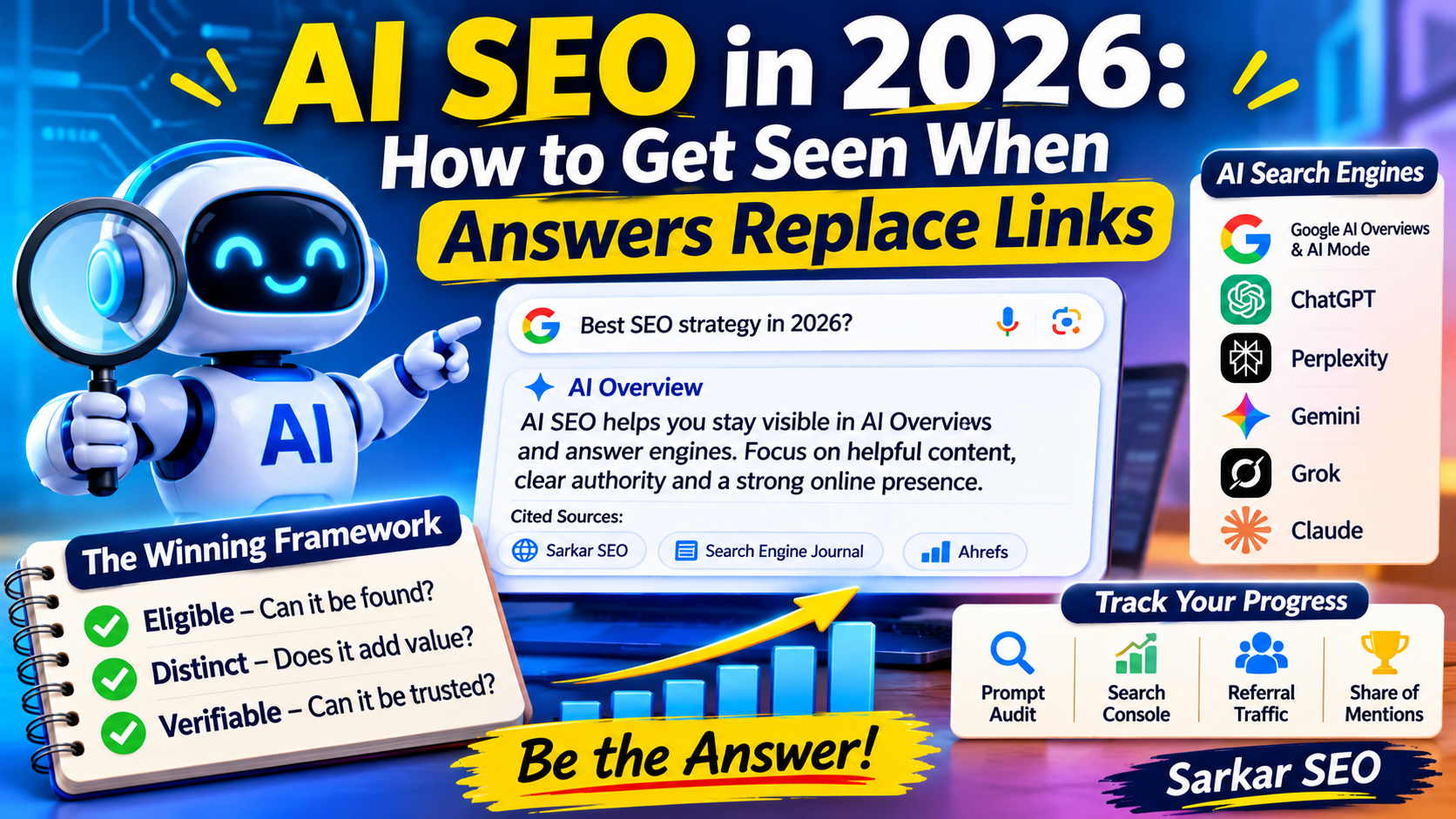
Search used to be ten links. Now many queries end with a written answer, a few cited sources, and no click at all. AI SEO is the practice of earning visibility in that world: inside Google’s AI Overviews and AI Mode, and inside assistants such as ChatGPT, Perplexity, Gemini, Grok and Claude.
The harder truth is that rankings alone no longer tell you whether you are winning.
What AI SEO Actually Means
AI SEO means making your content easy for search engines and language models to find, understand, trust and cite. It has two goals: being chosen as a supporting source in an AI-generated answer, and being described accurately when someone asks an assistant about your topic or brand.
You will also see GEO (generative engine optimization) and AEO (answer engine optimization). They name the same goal with a different emphasis, and neither replaces search fundamentals.
What Google Says, and What You Can Skip
In May 2026, Google published guidance for its generative AI features. As Search Engine Journal reported, Google’s position is that optimizing for generative AI search is still SEO. AI Overviews and AI Mode rely on the same index and core ranking systems as classic Search.
The guidance names tactics site owners do not need: llms.txt files, rewriting content specifically for language models, artificial content chunking, and special schema for AI features. It points instead to crawlability, semantic HTML, good page experience, less duplication, and original content that adds something beyond what already exists.
Structured data still helps search engines understand a page. It is just not a switch that unlocks citations, and no format or word count guarantees one.
Why Clicks Are Shrinking
The size of the traffic hit is debated, but the direction is not. Ahrefs compared 300,000 keywords and found that, as of December 2025, an AI Overview correlated with a 58% lower click-through rate for the top-ranking page, worse than the 34.5% it reported earlier. Pew Research, tracking real browsing, found clicks on traditional results fell from about 15% of visits to about 8% when an AI summary appeared, with links inside the summary clicked roughly 1% of the time. Google has disputed Pew’s methodology.
Both are correlations, mostly about informational queries. Brand exposure now matters alongside clicks, and pages that merely restate common knowledge are the most exposed.
Each Engine Cites Differently
“AI search” is not one channel. Several trackers analyzing hundreds of millions of citations report that only about 11% of domains are cited by both ChatGPT and Perplexity. These are vendor studies, so treat exact figures cautiously, but the direction is consistent.
Reported patterns differ. Perplexity shows many citations per answer and rewards fresh content. ChatGPT leans heavily on Wikipedia, and a Yext study found roughly 49% of its citations came from third-party listings and directories. BrightEdge reported that ChatGPT mentions brands far more often than it links to them. Google’s AI features stay closer to Google’s own index and quality systems.
So your website is necessary but not sufficient. How others describe you matters too.
A Framework: Eligible, Distinct, Verifiable
Instead of another checklist, put each important page through three tests.
Eligible. Can the page be crawled, rendered and indexed, and may it show snippets? A page blocked by robots rules, dependent on scripts that fail to render, or marked noindex cannot be cited anywhere. This is the cheapest fix with the biggest payoff.
Distinct. Does the page contain something a model cannot assemble from a thousand similar pages? Original data, a first-hand process, a worked example, a stated point of view, a comparison with clear criteria. AI answers combine sources, so a page that adds nothing gives the system no reason to choose it. Put a direct answer at the top of each section, then support it with depth. That serves readers first; extractability is a side effect.
Verifiable. Can a reader or retrieval system confirm who wrote this and why to trust it? Name real authors, cite primary sources, date updates honestly, and keep business details consistent across your site, profiles and listings. Inconsistent details are a common reason assistants describe companies wrongly.
At Sarkar SEO, we run content through these three tests before looking at keywords, because a page that fails the first cannot be rescued by the third.
Build Presence Beyond Your Domain
Since engines pull from different places, spread accurate information deliberately. Keep directory and review profiles complete. Earn mentions in credible industry publications. Take part honestly in communities where your audience asks questions. Do not fabricate reviews or seed artificial brand mentions; Google lists manufactured mentions among tactics that do not help, and they carry reputational risk.
How to Measure Progress
Rankings and sessions are no longer enough. Build a monthly routine:
- Prompt audit. Write 20 to 30 questions your customers really ask. Run them across major assistants and Google’s AI features. Record whether you are cited, mentioned or absent, and whether the description is accurate.
- Search Console. Google now offers a report on impressions from generative AI features, though it does not separate every click.
- Referral traffic. Check analytics for visits from chatgpt.com, perplexity.ai and similar sources, and compare conversion quality with organic search.
- Share of mentions. Compare how often you appear against two or three named competitors on the same prompts.
Expect volatility, since AI answers change between runs. Judge trends across a month, not single results. Sarkar SEO relies on this kind of repeatable sampling because it turns a vague worry into a number you can improve.
