



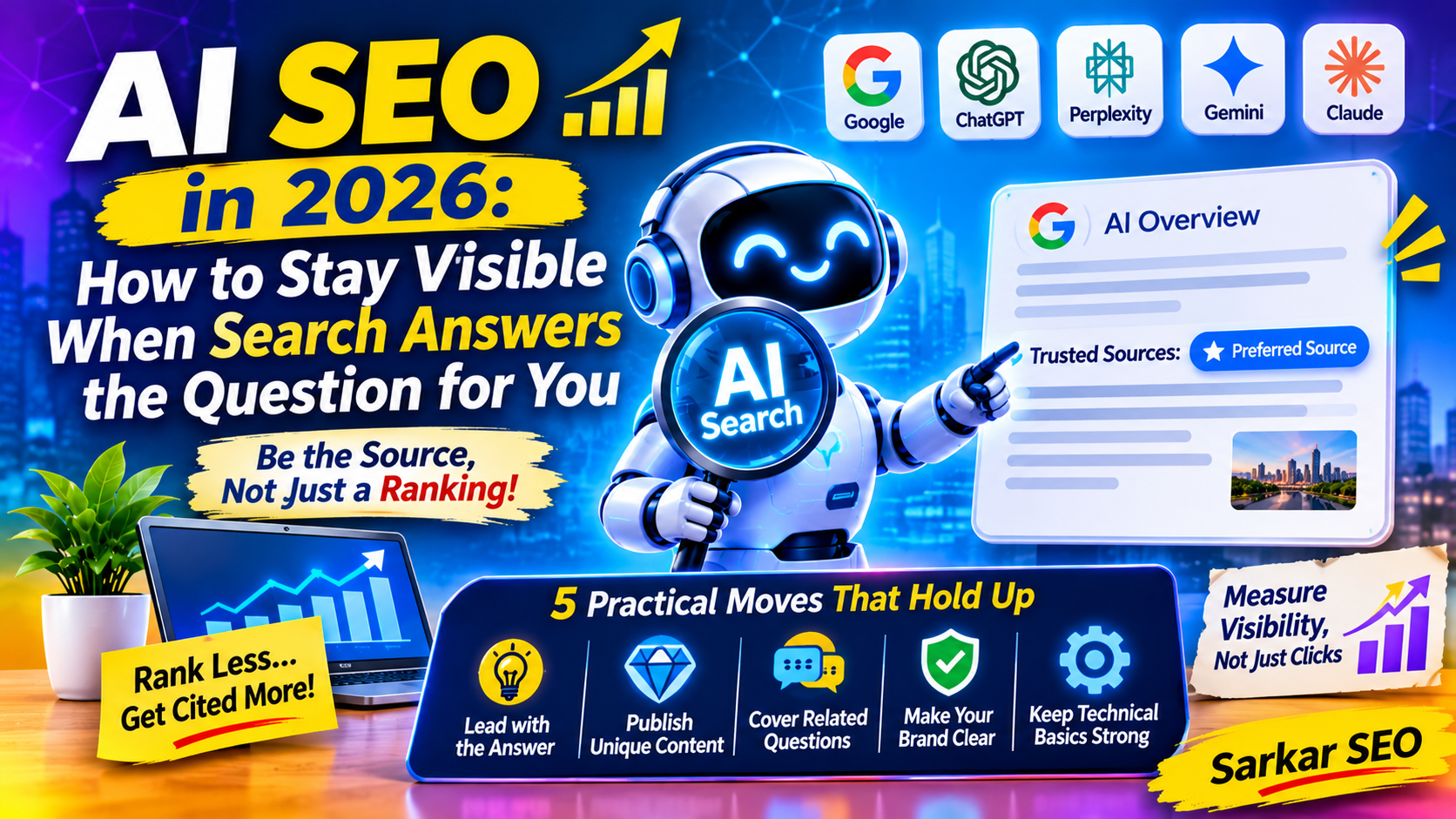
For two decades, SEO had a simple scoreboard: rank higher, get more clicks. That scoreboard is now incomplete. When Google, ChatGPT, Perplexity, Gemini and Claude can summarize an answer before anyone visits a website, the question is no longer only “Do we rank?” It is also “Are we the source the answer is built from?”
That is the real subject of AI SEO, and this guide covers what it means, what the evidence says, and what to do.
What AI SEO Actually Means
AI SEO is the work of making your content easy to find, trust and cite in two places at once: traditional search results and AI-generated answers. You will also hear it called GEO (generative engine optimization) or AEO (answer engine optimization). The labels differ; the goal is the same. You want your page to be retrieved, understood and used when a machine composes a response.
Classic SEO wins a position on a results page. AI SEO wins a place inside the answer, as a cited source or named recommendation.
Why It Matters: The Click Problem
The data on lost clicks is hard to ignore, though it needs careful reading.
Ahrefs re-ran its large keyword study using December 2025 Search Console data and found that an AI Overview now correlates with a 58% lower average click-through rate for the top-ranking page, up from 34.5% in its earlier version. The damage spreads down the page: roughly 51% lower at position two, about 19% lower at position ten.
Pew Research, using browsing data from about 900 US users, found a different angle. Users clicked a traditional result on roughly 15% of searches without an AI summary, versus about 8% with one. Links inside the summary itself were clicked in only about 1% of visits. Google has disputed the methodology.
Seer Interactive reported a 61% drop in organic click-through on informational queries with AI Overviews between mid-2024 and September 2025.
These studies use different samples and methods, so treat the percentages as directional. The direction is consistent: informational queries lose the most clicks, and ranking first protects you less than it used to.
What Google Itself Says
In May 2026, Google published its first dedicated guidance on optimizing for AI Overviews and AI Mode in Search Central. Its position is blunt: optimizing for generative AI search is still SEO. The guidance points to unique, non-commodity content with a real point of view, crawlable technical foundations, and quality images and video. It says no special markup or AI-specific file is required.
Google also explains that these features can use “query fan-out,” running several related searches across subtopics before writing a response. A page covering the neighboring questions around a topic therefore has more chances to be pulled in than one narrow answer.
One caveat: this guidance covers Google Search only. ChatGPT Search, Perplexity and Copilot use different retrieval systems.
What Research on AI Citations Shows
The most cited academic work is the 2024 “GEO” paper from Princeton and collaborators, which tested optimization tactics on generative engines. Adding relevant statistics and credible source citations were among the better-performing approaches, though the reported lift varies by write-up.
Be skeptical of headline figures. One 2026 GEO white paper admitted that several widely circulated statistics in its earlier editions had been attributed to the wrong study or platform. Much online “AI SEO data” comes from vendors measuring their own samples, so use it to spot patterns, not to justify precise promises.
Five Practical Moves That Hold Up
These recommendations follow Google’s guidance and the broader research, filtered through what is realistic for a working team.
- Lead with the answer, then earn the depth. Put a clear, quotable answer near the top of each section, then support it with evidence and nuance.
- Publish something only you can publish. Commodity content is what AI summaries replace. A proprietary dataset, a documented test, a real client outcome or an expert’s judgment gives a model a reason to cite you instead of ten near-identical pages.
- Cover the questions around the question. Map the follow-ups, comparisons and objections a buyer raises after the first query, and answer them in one strong page or a tight cluster.
- Make the entity unmistakable. Use consistent names, author bios and the same business description across your site and trusted third-party profiles.
- Protect the technical basics. Keep pages crawlable, indexable, fast and readable without heavy scripting. Add structured data that matches visible content, but do not expect it to work as a magic switch.
Sarkar SEO’s view is that these five work best as one workflow, because a strong answer on an uncrawlable page earns nothing.
Measure Visibility, Not Just Clicks
If AI answers send fewer visits, click-based reporting alone will undersell your work. Add these signals:
- Impressions and branded search growth in Search Console
- Manual checks of target queries across Google, ChatGPT, Perplexity and Gemini, logged monthly
- Whether your brand is named or cited, and whether the description is accurate
- Conversion rate from the traffic you do get, which is often higher intent
Citation tracking is noisy because AI answers vary from run to run, so look for trends across many queries rather than reacting to one result. A disciplined routine, the kind Sarkar SEO recommends, beats a screenshot of one lucky answer.
Mistakes to Avoid
Skip the tricks: hidden text, mass-produced pages and invented expert quotes violate quality policies. Do not publish unedited AI drafts, because generic content is the easiest to replace. And review key pages on a schedule, since outdated statistics get skipped.
